Introduction
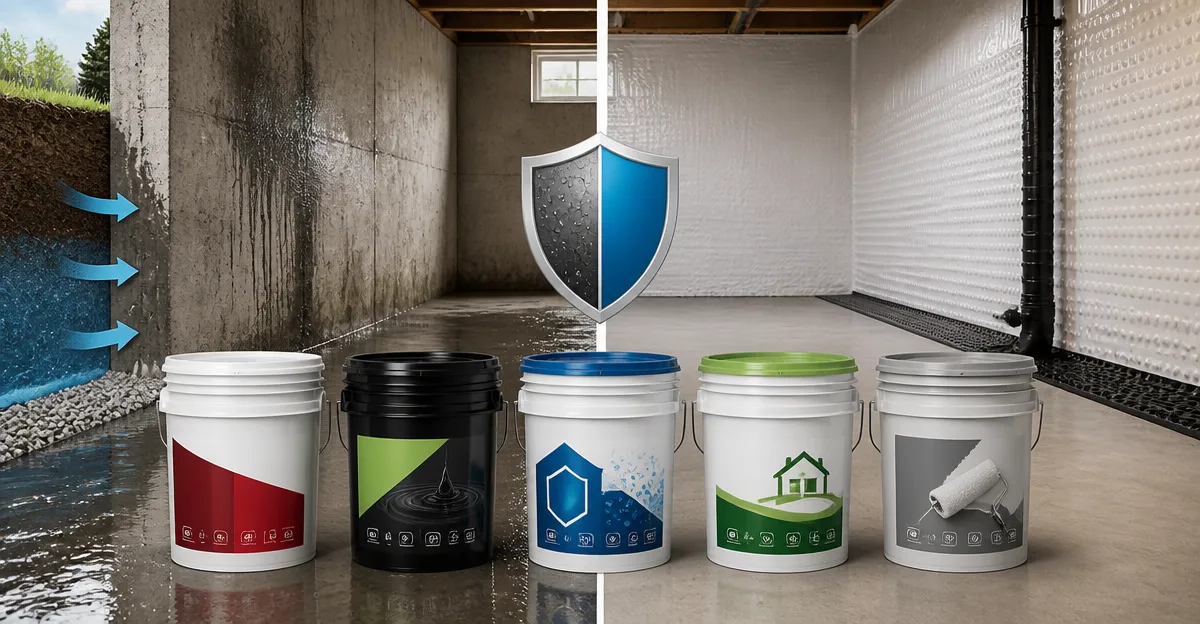
The marketplace offers numerous products designed to protect concrete and masonry from water intrusion. Homeowners and contractors must evaluate options based on price, performance, and ease of application. This article compares five highly rated waterproofing solutions that appear on Amazon. By examining specifications, customer sentiment, and practical considerations, one can select the most appropriate product for a given project.
Individual Product Overviews
KILZ Basement Waterproofing Paint
KILZ delivers a white, oil‑based primer‑sealer that forms a nanotechnology‑enhanced barrier capable of resisting up to 12 PSI of water pressure. The product is suitable for interior and exterior walls, including concrete, brick, stucco, and cinder block, and it dries to the touch within one hour. A low‑odor formula permits indoor use, and the coating fully cures in seven to fourteen days. Customer feedback highlights excellent coverage, a thin yet effective film, and a price of $48 per gallon with a 4.7‑star rating from 1,257 reviewers.
Liquid Rubber Foundation Sealant
Liquid Rubber offers a five‑gallon, black‑drying sealant that creates a flexible membrane with 900 % elongation, suitable for both interior and exterior basement applications. The product covers 50 sq ft per gallon indoors (requiring two to three coats) and 20 sq ft per gallon outdoors (three to four coats). It adheres to concrete, masonry, wood, metal, and foundation surfaces, and it contains zero VOCs for safe indoor use. Reviewers praise its ability to stop active leaks, noting a successful four‑coat application that withstood heavy rain for four months, and the price is $179.95 with a 4.6‑star rating from 3,408 reviewers.
RadonSeal Crack Repair Kit
RadonSeal provides a ten‑foot, two‑component urethane system that can be injected without drilling, allowing homeowners to seal hairline foundation cracks from the interior. The kit includes protective goggles, gloves, and a caulking gun, and it expands to fill cracks while also acting as a radon barrier. Users report permanent repairs of cracks that had leaked for 25 years, with no water ingress after heavy storms. The product costs $163.69, carries a 4.6‑star rating from 1,179 reviewers, and is praised for its comprehensive instructions and effective sealing performance.
Ames Block & Wall Waterproofer
Ames offers a five‑gallon, white liquid rubber coating that forms an elastomeric membrane with up to 1,800 % elongation, suitable for walls, foundations, and insulated concrete forms. The product provides a coverage rate of one gallon per 100 sq ft per coat, with two coats recommended for optimal protection. It is low‑odor, non‑toxic, and made in the USA, though it requires a latex topcoat for UV exposure. Customers describe the material as “thick like cake frosting” that spreads easily and has protected basements for over a decade. The price is $179.00 and the rating is 4.6 stars from 342 reviewers.
INSL‑X WaterBlock Masonry Waterproofer
INSL‑X supplies a one‑gallon acrylic masonry paint that seals vertical interior and exterior surfaces while resisting alkali up to pH‑13. The coating can be applied directly to dry or damp masonry, dries quickly, and tolerates hydrostatic pressure up to 12 psi. Reviewers note that two coats are required for complete protection, yet the product performed well during prolonged heavy rain events. The price is $49.99, the rating is 4.6 stars from 298 reviewers, and it is marketed as a low‑cost alternative to premium sealants.
Head‑to‑Head Comparison
Price and Value
- KILZ: $48 per gallon – lowest unit price among the five products.
- INSL‑X: $49.99 per gallon – comparable to KILZ but offers acrylic chemistry.
- RadonSeal: $163.69 for a ten‑foot kit – higher per‑project cost but targets crack repair rather than full‑wall coverage.
- Ames: $179 per five‑gallon pail – $35.80 per gallon, positioned as a premium elastomeric solution.
- Liquid Rubber: $179.95 for five gallons – $35.99 per gallon, includes flexible membrane technology.
Features and Specifications
| Product | Coverage (sq ft/gal) | Elongation | Water Pressure Resistance | VOC | Application Method |
|---|---|---|---|---|---|
| KILZ Basement Waterproofing Paint | Not specified (typical paint rates) | Nanotechnology barrier | Up to 12 psi | Low‑odor, zero‑VOC claim | Brush or roller |
| Liquid Rubber Foundation Sealant | 50 int / 20 ext | 900 % | Designed for active leaks, not a specific psi rating | Zero VOC | Brush, roller, or sprayer |
| RadonSeal Crack Repair Kit | Not a coverage metric – targets cracks up to 10 ft | Urethane expands, exact % not disclosed | Provides radon and water barrier | Low‑VOC components | Caulking gun injection |
| Ames Block & Wall Waterproofer | 100 sq ft per gallon per coat | 1,800 % | Not specified, designed for hydrostatic pressure | Low odor, non‑toxic | Brush, roller, or sprayer |
| INSL‑X WaterBlock Masonry Waterproofer | Typical masonry paint rates (approx. 300 sq ft per gallon) | Acrylic film, not quantified | Up to 12 psi | Water based, low VOC | Brush or roller |
Customer Ratings and Feedback
All five products maintain ratings between 4.6 and 4.7 stars, indicating strong overall satisfaction. KILZ receives praise for “great coverage and easy to apply,” though a reviewer noted the thin appearance after two coats. Liquid Rubber is lauded for “stopping leaks after four coats” and for its thick, tar‑like consistency. RadonSeal users emphasize the permanent nature of crack repairs, with one comment stating, “no water has leaked from the cracks after 25 years of leakage.” Ames reviewers describe the coating as “thick like cake frosting” that “fills gaps great for planter beds.” INSL‑X reviewers appreciate the low cost and effectiveness, noting, “It works! I did have to use two coats as recommended.”
Performance and Reliability
KILZ offers a fast‑drying, washable surface that cures in two weeks, making it suitable for interior renovations where downtime must be minimized. Liquid Rubber provides a flexible membrane that remains tacky during curing but forms a durable barrier once set, ideal for basements with active water movement. RadonSeal addresses structural cracks directly, delivering a radon‑blocking seal that also prevents water ingress, though it does not cover large surface areas. Ames delivers a high‑solids elastomeric film that resists cracking and can be applied to a variety of substrates, but it requires a topcoat for UV exposure. INSL‑X presents a cost‑effective acrylic solution that performs well on vertical masonry but may require multiple coats for full protection.
Pros & Cons
KILZ Basement Waterproofing Paint
- Pros: Low price per gallon, quick drying time, nanotechnology barrier, low odor.
- Cons: No specific coverage data, not suitable for floors or active leaks, thin film may require additional coats.
Liquid Rubber Foundation Sealant
- Pros: Extremely flexible, zero VOC, excellent for active leaks, high coverage on interior surfaces.
- Cons: Higher upfront cost, black drying color may be undesirable, not recommended for walking surfaces.
RadonSeal Crack Repair Kit
- Pros: Drill‑free injection, seals hairline cracks, radon barrier, includes safety gear.
- Cons: Limited to cracks up to 10 ft, higher per‑project cost, requires careful preparation.
Ames Block & Wall Waterproofer
- Pros: Very high elongation, thick consistency fills gaps, low odor, made in USA.
- Cons: Not UV stable without topcoat, higher price per gallon, thick texture may be difficult to spread thinly.
INSL‑X WaterBlock Masonry Waterproofer
- Pros: Affordable, acrylic chemistry resists alkali, easy brush application, works on damp surfaces.
- Cons: Requires two coats for full protection, coverage rate not specified, limited to vertical applications.
Recommendations
If budget is the primary constraint and the project involves painting interior walls, KILZ Basement Waterproofing Paint provides the best value at $48 per gallon. For homeowners confronting active basement leaks and requiring a flexible membrane, Liquid Rubber Foundation Sealant offers superior performance despite a higher price. When the issue is isolated foundation cracks, the RadonSeal Crack Repair Kit delivers a targeted, permanent fix and also mitigates radon entry. For projects demanding an elastomeric coating that tolerates significant movement, Ames Block & Wall Waterproofer is the most robust choice. Finally, for cost‑conscious DIYers who need a simple masonry paint, INSL‑X WaterBlock Masonry Waterproofer meets the requirement at $49.99 per gallon.
Frequently Asked Questions
- Can these products be applied over existing paint? Most of the listed sealants, including KILZ and INSL‑X, can be applied over clean, dry painted surfaces, but proper surface preparation is essential for adhesion.
- Which product is best for below‑grade applications? Liquid Rubber and Ames provide flexible membranes that perform well below grade, while KILZ is suitable for below‑grade walls provided cracks are pre‑filled with hydraulic cement.
- Do any of these products contain harmful VOCs? Liquid Rubber and INSL‑X explicitly state zero or low VOC formulations; KILZ advertises a low‑odor, low‑VOC blend, and Ames is low‑odor as well.
- How many coats are typically required? KILZ recommends one to two coats, Liquid Rubber suggests two to three interior coats, Ames advises two coats, RadonSeal is a single‑application injection, and INSL‑X usually requires two coats for full protection.
- Is UV protection needed? Ames is not UV stable and must be top‑coated with latex paint when exposed to sunlight. The other products are intended for interior or covered exterior use where UV exposure is limited.
- Can these sealants be used on floors? KILZ and INSL‑X explicitly state they are not for floor use. Liquid Rubber is also not recommended for walking surfaces due to tackiness during curing. Ames can be used on floors only if a suitable topcoat is applied.
- What safety equipment is recommended? RadonSeal includes goggles and gloves; for all products, wearing gloves, eye protection, and adequate ventilation is advisable.
Conclusion
The five products examined each excel in distinct scenarios. KILZ offers an economical paint‑based solution for interior and exterior walls, while Liquid Rubber delivers a high‑performance flexible membrane for active leaks. RadonSeal focuses on precise crack repair and radon mitigation, Ames provides a thick elastomeric coating for demanding structural applications, and INSL‑X supplies an affordable acrylic paint for standard masonry waterproofing. Based on the comparative analysis, the overall recommendation for most residential basement waterproofing projects is Liquid Rubber Foundation Sealant because of its versatility, durability, and comprehensive coverage, despite a higher price point.