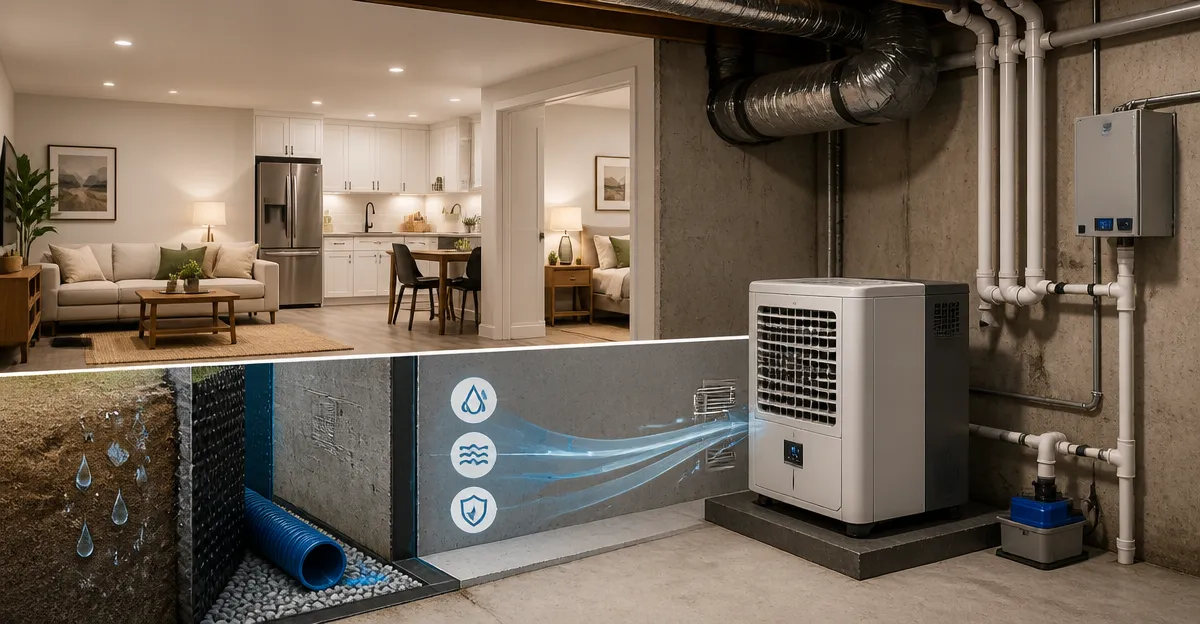
Dehumidification Plan for Basement ADU Conversions: Complete Guide to Moisture Control, Equipment & Best Practices
Introduction
Converting a basement into an accessory dwelling unit (ADU) offers valuable living space, yet it introduces unique moisture challenges that can affect structural integrity and indoor air quality. This guide explains the science of basement humidity, outlines how to select and install the right dehumidification equipment, and provides actionable best‑practice recommendations. Readers will learn how to assess moisture loads, compare leading dehumidifiers, and implement a comprehensive plan that protects both the building envelope and occupants.
Background and Context
Basements are naturally prone to dampness because they are surrounded by soil, which can transmit water through capillary action and vapor diffusion. Seasonal temperature fluctuations cause condensation on cold surfaces, while everyday activities such as laundry or cooking add latent moisture to the air. When a basement is repurposed as an ADU, the increased occupancy and interior finishes amplify these effects, making proactive moisture control essential.
Effective dehumidification reduces the risk of mold growth, protects finished walls and flooring, and improves comfort for residents. It also contributes to energy efficiency by allowing HVAC systems to operate within optimal humidity ranges. Understanding the balance between moisture sources, ventilation, and dehumidifier capacity is the foundation of a successful conversion project.
Understanding Moisture Dynamics in Basements
Moisture in a basement can be classified into three categories: infiltration, exfiltration, and internal generation. Infiltration occurs when groundwater or humid outdoor air enters through cracks, foundation walls, or floor joints. Exfiltration is the opposite process, where indoor air escapes, potentially drawing more moist air inward. Internal generation includes activities such as showering, cooking, and drying clothes, all of which release water vapor into the indoor environment.
Measuring relative humidity (RH) and temperature with a hygrometer provides a baseline for determining dehumidifier requirements. Ideal indoor RH for comfort and mold prevention ranges from 30% to 50%. When RH consistently exceeds 60%, the environment becomes conducive to microbial growth and material degradation.
In addition to RH, the dew point temperature indicates the temperature at which air becomes saturated and condensation occurs on surfaces. Maintaining indoor temperatures above the dew point, combined with adequate ventilation, mitigates surface moisture formation.
Sizing and Selecting a Dehumidifier
Choosing a dehumidifier for a basement ADU involves matching the unit’s capacity to the space’s square footage, moisture load, and climate conditions. Capacity is typically expressed in pints of water removed per day. A general rule of thumb suggests one pint per 250 square feet for moderate humidity, but high‑moisture environments may require up to two pints per 250 square feet.
Four key specifications influence performance:
- Coverage Area: The square footage the unit can effectively service.
- Tank Capacity: Determines how often the unit must be emptied or drained.
- Energy Efficiency: Measured by the Energy Star rating and power consumption.
- Additional Features: Such as auto shut‑off, sleep mode, smart connectivity, and built‑in pumps for continuous drainage.
Below are product recommendations that align with common ADU scenarios.
1. ToLife 1000 Sq Ft Dehumidifier
The ToLife 1000 Sq Ft Dehumidifier offers a 95‑oz tank, sleep mode, and a 7‑color LED indicator. It is suitable for modest‑size ADUs where space is limited and quiet operation is desired. The auto shut‑off feature prevents overflow, and the portable design facilitates placement near moisture‑prone zones such as bathrooms or laundry areas.
2. NineSky 1000 Sq Ft Dehumidifier
The NineSky 1000 Sq Ft Dehumidifier mirrors the coverage of the ToLife model but adds a quieter fan and an ambient light that can serve as a low‑intensity night lamp. Its 95‑oz tank and auto shut‑off make it equally appropriate for compact ADUs, while the slightly refined acoustic design benefits bedrooms and living spaces.
3. ALORAIR Wi‑Fi Crawlspace Dehumidifier
The ALORAIR Wi‑Fi Crawlspace Dehumidifier provides a high‑capacity 70‑pint (approximately 35 pints per day) removal rate, built‑in pump, and smartphone control via a dedicated app. This unit excels in larger ADUs or basements with significant moisture loads, such as those with unfinished crawlspaces or high water tables. Smart scheduling and remote monitoring enable owners to adjust settings without entering the space.
4. ASAHWo 2500 Sq Ft Dehumidifier
The ASAHWo 2500 Sq Ft Dehumidifier covers expansive areas up to 2,500 sq ft and features four preset modes, intelligent humidity control, and a quiet operation profile. Its 34‑pint capacity per day makes it a solid middle‑ground solution for medium‑to‑large ADUs where continuous operation is required but a full‑scale industrial unit would be excessive.
5. KNKA 4500 Sq Ft Dehumidifier
The KNKA 4500 Sq Ft Dehumidifier is engineered for the most demanding environments, delivering up to 80 pints per day and featuring Energy Star certification, smart humidity control, and a dedicated sleep mode for nighttime quietness. It is ideal for large ADUs that span multiple levels or include extensive crawlspace areas.
Comparison and Selection Guide
| Product | Coverage (sq ft) | Daily Capacity (pints) | Tank / Pump | Smart Features | Ideal Use Case |
|---|---|---|---|---|---|
| ToLife | 1,000 | ~6 | 95 oz tank, auto shut‑off | LED indicator, sleep mode | Small ADU, bedroom, bathroom |
| NineSky | 1,000 | ~6 | 95 oz tank, auto shut‑off | Ambient light, quiet fan | Compact living area, low‑noise needed |
| ALORAIR | 1,000 (crawlspace focus) | 70 | Built‑in pump, continuous drain | Wi‑Fi app control, auto defrost | Large moisture loads, smart monitoring |
| ASAHWo | 2,500 | 34 | Tank + optional hose | Four preset modes, humidity sensor | Medium‑size ADU, multi‑room coverage |
| KNKA | 4,500 | 80 | Large tank, drain hose option | Smart control, Energy Star, sleep mode | Large ADU, commercial‑grade needs |
When selecting a unit, prioritize coverage area, daily capacity, and any required smart or drainage features. For most single‑family ADU projects, a unit in the 1,000‑sq‑ft range suffices, whereas multi‑unit conversions benefit from larger capacity models.
Best Practices & Tips
- Conduct a thorough moisture audit before installation; use a calibrated hygrometer in multiple locations for at least 24 hours.
- Seal foundation cracks and install a perimeter drainage system to reduce infiltration.
- Place dehumidifiers centrally and maintain a clearance of at least 12 inches from walls for optimal airflow.
- Utilize continuous drainage hoses when possible to eliminate the need for frequent tank emptying.
- Integrate dehumidifiers with the existing HVAC system using a dedicated return air duct to improve overall air circulation.
- Set humidity setpoints between 40% and 50% during occupied periods and allow a slightly higher setpoint (up to 55%) when the ADU is unoccupied.
- Schedule regular maintenance: clean filters monthly, inspect coils quarterly, and verify pump operation annually.
Frequently Asked Questions
- What size dehumidifier is required for a 1,200 sq ft basement ADU?
- A unit covering 1,000 sq ft with a capacity of 6‑8 pints per day, such as the ToLife 1000 Sq Ft Dehumidifier, is generally sufficient if the humidity level is moderate. For higher moisture loads, consider a model with a larger tank or continuous drain option.
- Can I run a dehumidifier continuously?
- Yes, most modern units are designed for continuous operation, especially those with Energy Star certification. Continuous use is advisable in basements with persistent moisture sources.
- Do smart dehumidifiers require a Wi‑Fi network?
- Smart models such as the ALORAIR Wi‑Fi Crawlspace Dehumidifier need Wi‑Fi for remote monitoring and scheduling, but they will operate normally without connectivity.
- How often should I empty the water tank?
- Tank emptying frequency depends on capacity and humidity. A 95‑oz tank typically fills within 12‑24 hours in high‑humidity conditions; using a continuous drain hose eliminates manual emptying.
- Is a dehumidifier enough to prevent mold?
- Dehumidification is a critical component, but it must be combined with proper ventilation, insulation, and moisture source mitigation to fully prevent mold growth.
- What maintenance tasks are essential?
- Monthly filter cleaning, quarterly coil inspection, and annual pump testing ensure optimal performance and longevity.
- Can I use a single large dehumidifier for multiple ADU units?
- Yes, if the combined square footage does not exceed the unit’s rated coverage and the layout allows for adequate airflow distribution.
Conclusion
Effective moisture control is the cornerstone of a successful basement ADU conversion. By understanding humidity dynamics, selecting a suitably sized dehumidifier, and following best‑practice installation and maintenance procedures, owners can safeguard structural components, enhance indoor air quality, and create a comfortable living environment. The products highlighted in this guide provide a range of options to meet diverse needs, from compact units for small units to high‑capacity systems for expansive spaces.
Products Featured in This Guide
ToLife 1000 Sq Ft Dehumidifier
Price: Not listed
Rating: Not listed
Featured for its compact design, 95 oz tank, sleep mode, and suitability for small ADU spaces where quiet operation is essential.
NineSky 1000 Sq Ft Dehumidifier
Price: Not listed
Rating: Not listed
Featured for its quiet fan, ambient lighting, and identical coverage to the ToLife model, offering an aesthetic option for living areas.
ALORAIR Wi‑Fi Crawlspace Dehumidifier
Price: Not listed
Rating: Not listed
Featured for its high 70‑pint capacity, built‑in pump, and smart app control, making it ideal for larger moisture loads and remote monitoring.
ASAHWo 2500 Sq Ft Dehumidifier
Price: Not listed
Rating: Not listed
Featured for its versatile 34‑pint daily capacity, four preset modes, and intelligent humidity control, suitable for medium‑size ADUs.
KNKA 4500 Sq Ft Dehumidifier
Price: Not listed
Rating: Not listed
Featured for its industrial‑grade 80‑pint capacity, Energy Star efficiency, and smart humidity control, addressing the needs of large or multi‑unit basement conversions.