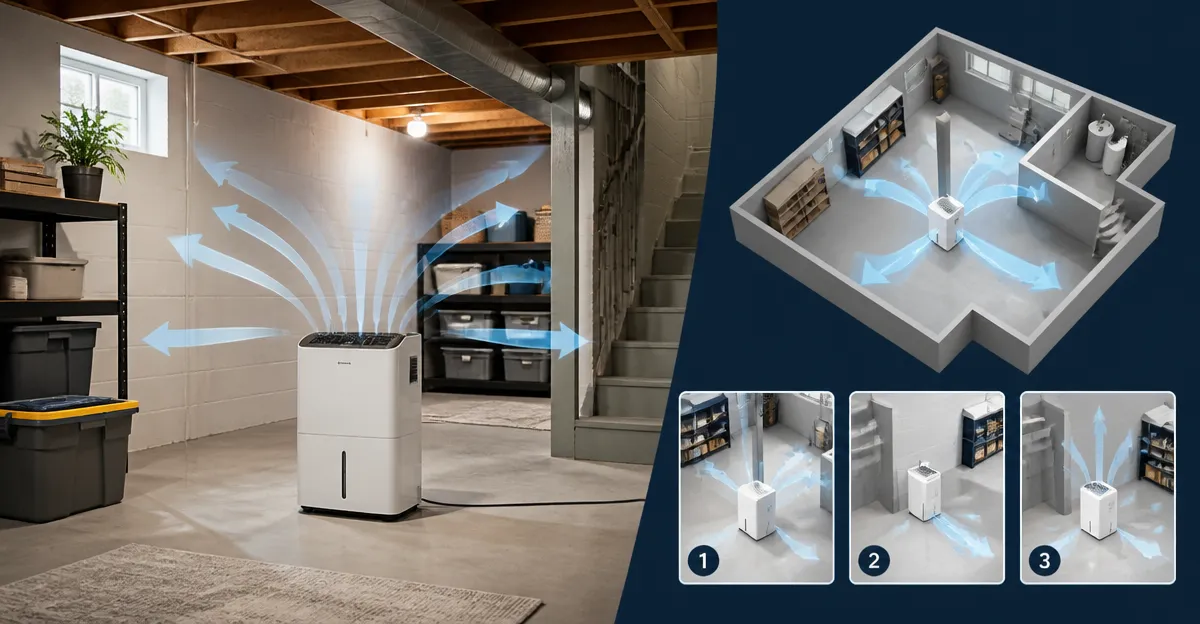
How to Place Dehumidifiers in Basements with Obstructed Airflow: Best Placement & Tips
Introduction
Basements often suffer from excess moisture because they are below grade, lack natural ventilation, and contain numerous obstacles such as storage boxes, ductwork, and support columns. This guide will teach the reader how to evaluate a damp basement, select the most suitable dehumidifier, and position the unit for maximum efficiency when airflow is obstructed. By following the recommended steps, one can reduce mold risk, protect structural components, and improve overall indoor comfort.
The information presented is practical, actionable, and supported by real‑world product data. The reader will learn how to measure humidity, create a clear airflow path, and use tools such as drainage hoses and portable casters to overcome common placement challenges. The guide remains valuable even if the reader chooses not to purchase any of the suggested devices.
What You’ll Need
- Digital hygrometer (to verify relative humidity levels)
- Measuring tape or laser distance meter
- Level or plumb line (to ensure the unit sits upright)
- Extension cord rated for the dehumidifier’s power draw
- Drain hose (included with most recommended units) or a bucket
- Optional: portable fan to assist initial air circulation
- One of the following dehumidifiers, selected according to square‑footage and budget:
Step 1: Assess the Basement Layout and Humidity Hotspots
Begin by measuring the total square footage of the basement and noting any structural elements that block airflow, such as support beams, utility closets, or stacked boxes. Use a measuring tape to record length and width, then multiply to obtain the area. Next, place a digital hygrometer in several locations: near the ceiling, at floor level, and beside any water‑prone walls. Record the relative humidity (RH) readings; values above 60 % indicate a need for active dehumidification.
Identify the zones with the highest RH; these are the humidity hotspots. In basements with obstructed airflow, moisture tends to accumulate in low‑lying corners and behind barriers. Mark these zones with removable tape so that later steps can focus on improving air movement around them.
Why this matters: Proper assessment prevents the purchase of an undersized unit and ensures that the eventual placement addresses the most problematic areas. Selecting a dehumidifier with coverage that matches or exceeds the measured square footage eliminates the need for multiple units.
Step 2: Choose the Appropriate Dehumidifier Capacity
If the basement measures up to 2,000 sq ft, the Dravonic 30-Pint Dehumidifier provides up to 30 pints per day and includes an auto‑defrost function for temperatures as low as 41 °F. At a price of $129.99, it offers a cost‑effective solution for medium‑size spaces.
For areas up to 1,000 sq ft, the ToLife 1000 Sq Ft Dehumidifier delivers 95 oz (approximately 2.8 pints) per day, operates below 30 dB in sleep mode, and includes a 7‑color LED night light. It is priced at $59.96 and holds a 4.2‑star rating from over 7,000 reviews, making it a budget‑friendly option for smaller rooms.
For large basements exceeding 4,000 sq ft, the KNKA 4500 Sq Ft Dehumidifier removes up to 80 pints per day in humid summer conditions and operates at 40‑45 dB. Priced at $189.98 with a 4.8‑star rating, it includes a 1.45‑gal tank and optional external tank for extended drainage.
The MIONJO 4500 Sq Ft Dehumidifier also covers 4,500 sq ft, features a 90° adjustable airflow outlet, and runs at 40 dB. It is priced at $189.99 and carries a 4.7‑star rating, making it comparable to the KNKA model but with a different airflow design.
Finally, the AEOCKY 4500 Sq Ft Dehumidifier is ENERGY STAR Most Efficient 2025 certified, removes up to 80 pints per day, and operates as low as 44 dB. At $236.99 and a 4.4‑star rating, it offers the highest energy efficiency for users who prioritize long‑term savings.
Select the unit whose coverage matches the assessed square footage and whose features address the specific obstacles identified in Step 1.
Step 3: Prepare the Placement Area
Clear a minimum of 12 inches of space on all sides of the intended location. This clearance allows the unit’s intake and exhaust vents to draw and release air without obstruction. Remove boxes, pallets, and excess insulation that block the airflow path. If permanent obstacles exist, consider installing a short, low‑profile shelf to raise the unit above the floor, thereby reducing the risk of water‑driven mold on the base.
Level the floor using a carpenter’s level. An uneven surface can cause the internal tank to tilt, triggering false full‑tank alerts. If the floor is uneven, place a thin rubber mat or a piece of plywood to create a stable platform.
Why this matters: Proper clearance and level placement improve the dehumidifier’s internal sensor accuracy, reduce wear on the compressor, and prevent premature shutdowns caused by water pooling.
Step 4: Connect Drainage for Continuous Operation
Most recommended units include a drain hose that can be routed to a floor drain, sump pit, or a suitable container. For the Dravonic 30-Pint Dehumidifier, attach the supplied hose to the rear outlet and lower it to a drain using a gentle slope of at least 1‑inch per foot. Secure the hose with a zip tie to prevent accidental disconnection.
The KNKA 4500 Sq Ft Dehumidifier offers a 6.56‑ft hose and an optional 2.64‑gal external tank (ASIN B0GSFWHNBL). If a permanent drain is unavailable, place the external tank in a corner and schedule regular emptying.
For the AEOCKY 4500 Sq Ft Dehumidifier, the included drain connector can be attached to a garden hose, allowing the unit to discharge directly into a sump pump pit. This configuration is ideal for basements with high water tables.
Ensuring continuous drainage eliminates the need to empty the internal tank daily, which is especially important when airflow is obstructed and moisture removal rates are higher.
Step 5: Position the Unit for Optimal Airflow
Place the dehumidifier near the center of the room but offset toward the most humid zone identified in Step 1. Align the adjustable outlet (available on the MIONJO 4500 Sq Ft Dehumidifier) so that the dry air is directed toward the obstructed area rather than against a wall. The 90° swivel outlet enables precise targeting of stagnant corners.
If the basement contains tall shelving units, position the dehumidifier on the floor but aim the airflow upward using the unit’s built‑in fan speed controls. For the ToLife 1000 Sq Ft Dehumidifier, the low‑speed sleep mode can be used overnight when the unit should operate quietly while still circulating air.
Utilize the casters on the Dravonic and KNKA models to fine‑tune the location without heavy lifting. The 360° casters allow the unit to glide into tight spaces, ensuring that the intake is not blocked by a pipe or a stack of boxes.
After positioning, run the unit for at least one hour and monitor the hygrometer. If humidity does not decrease in the target area, adjust the outlet angle or move the unit a few feet toward the problem zone.
Step 6: Configure Settings for Obstructed Airflow
Set the desired humidity level between 45 % and 55 % using the unit’s digital control panel. The KNKA 4500 Sq Ft Dehumidifier provides three smart modes: AUTO (maintains 50 % RH), DRY (accelerated drying), and SETTING (custom range). Choose AUTO for continuous control, allowing the unit to cycle on and off as needed, which is essential when airflow is limited.
Enable the timer function (available on the Dravonic model) to schedule operation during off‑peak electricity hours. This reduces energy consumption while still addressing humidity spikes that often occur after showers or laundry cycles.
Activate child lock and auto‑restart features on models that include them (Dravonic, KNKA, AEOCKY) to prevent accidental changes and ensure the unit resumes operation after a power outage.
These configurations allow the dehumidifier to adapt to the irregular air circulation patterns typical of basements with obstacles, delivering consistent moisture removal without manual intervention.
Tips & Pro Tips
- Use a portable fan to create temporary cross‑ventilation while the dehumidifier stabilizes humidity levels.
- Inspect and clean the air filter monthly; a clogged filter reduces airflow and increases energy use.
- Seal minor cracks in walls and floors with a moisture‑resistant caulk to prevent external moisture ingress.
- Consider adding a vapor barrier on concrete floors if the basement is prone to ground‑water seepage.
- When using the continuous drain option, verify that the hose does not kink; a kinked hose can cause water backup and trigger the auto‑shutoff alarm.
- For basements with very low temperatures, select a unit with an auto‑defrost feature (Dravonic, MIONJO, AEOCKY) to maintain operation below 45 °F.
Troubleshooting
| Problem | Possible Cause | Solution |
|---|---|---|
| Unit does not turn on | Improper power connection or tripped circuit breaker | Check extension cord rating, reset breaker, and ensure the plug is fully inserted. |
| Water tank fills rapidly despite continuous drain | Hose kinked or disconnected | Inspect hose for bends, re‑attach securely, and confirm a proper downward slope. |
| Humidity level remains high | Insufficient clearance around intake | Remove objects within 12 inches, reposition unit, and verify outlet direction. |
| Excessive noise | Unit placed on uneven surface | Level the base with a rubber mat or plywood and ensure casters are locked. |
Conclusion
Placing a dehumidifier in a basement with obstructed airflow requires careful assessment, proper clearance, and strategic positioning of the unit’s outlet. By following the six steps outlined above, the reader can achieve reliable humidity control, prevent mold growth, and protect valuable possessions. Selecting a dehumidifier that matches the space size and offers features such as auto‑defrost, continuous drainage, and smart modes further enhances performance in challenging environments. Implement the provided tips and troubleshooting advice to maintain optimal operation over the long term.
Products Mentioned in This Guide
Frequently Asked Questions
Where should I place a dehumidifier in a basement with many obstacles?
Place it in the center of the space, at least 3‑4 feet away from walls and obstacles, and elevate it on a platform or casters to allow free airflow.
How do I determine the optimal height for a dehumidifier in a low‑ceiling basement?
Set the unit 2‑3 feet off the floor, using a sturdy base, so it can draw humid air that rises while staying clear of floor‑level clutter.
What steps can I take to improve airflow around a dehumidifier when ducts and boxes block the room?
Create a clear path by rearranging storage, using a fan to direct air toward the unit, and keeping at least 12 inches of space on all sides.
How often should I measure humidity to ensure my dehumidifier is working effectively?
Check the relative humidity with a digital hygrometer daily for the first week, then weekly, aiming for 45‑55% in the basement.
Can I use a drainage hose to avoid frequent emptying, and how should it be set up?
Yes—attach the hose to the dehumidifier’s drain outlet and route it to a floor drain or sump pit, ensuring a continuous downward slope for proper flow.