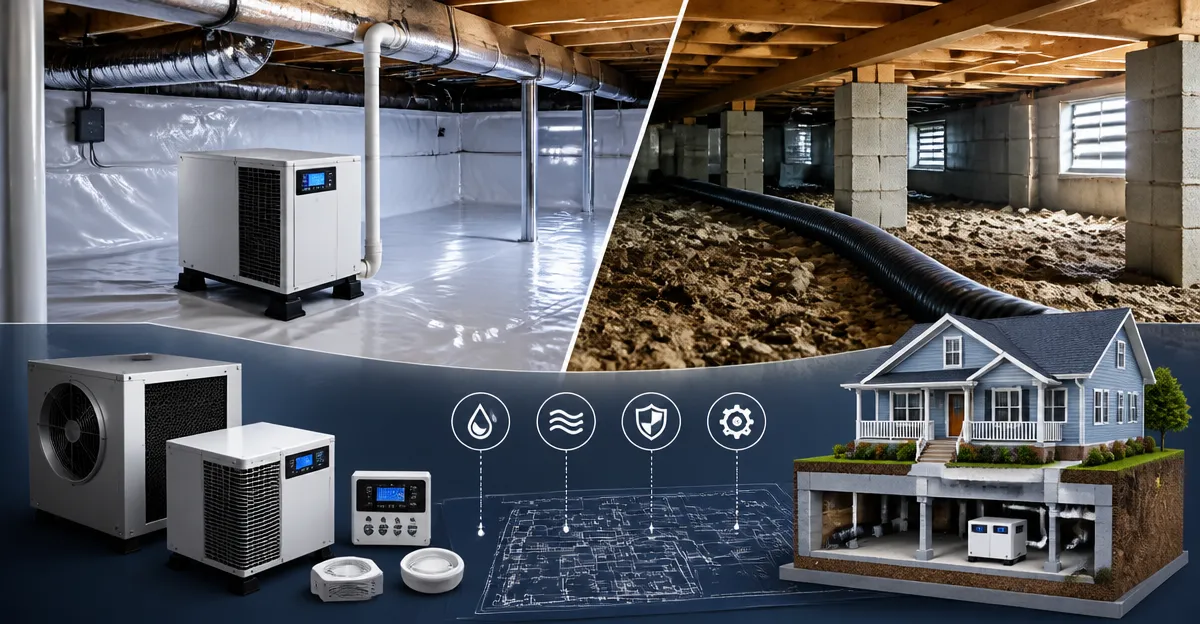
Hybrid Dehumidification Design for Conditioned and Unconditioned Crawlspaces: The Complete Guide
Introduction
This guide explains how to design a hybrid dehumidification system that protects both conditioned and unconditioned crawlspaces. Readers will learn fundamental moisture science, evaluate commercial‑grade dehumidifiers, and apply best‑practice installation techniques. By the end of the article, one will be able to select the most appropriate unit, integrate it with existing HVAC infrastructure, and maintain optimal indoor‑air quality while controlling energy costs.
Background and Context
Crawlspaces act as a conduit for ground moisture, outdoor humidity, and indoor vapor diffusion. When a crawlspace is unconditioned, ambient temperature fluctuations cause condensation on structural members, leading to mold, wood rot, and reduced energy efficiency. Conditioning the space—by extending HVAC supply and return—creates a more stable environment but often requires supplemental dehumidification to meet the recommended 45‑55% relative humidity range. Hybrid designs combine passive barriers, ventilation control, and active dehumidification to achieve durable results.
Key concepts include the psychrometric chart, which illustrates the relationship between temperature, humidity, and water‑vapor pressure; the AHAM (Association of Home Appliance Manufacturers) rating, which standardizes moisture‑removal capacity under controlled conditions; and the concept of dew point, the temperature at which air becomes saturated and water condenses. Understanding these principles enables designers to size equipment correctly and avoid under‑ or over‑specification.
Design Strategies for Hybrid Dehumidification
Effective hybrid systems employ three complementary layers: (1) moisture‑blocking envelope, (2) controlled ventilation, and (3) active dehumidification. The envelope consists of a high‑density polyethylene vapor barrier, sealed seams, and insulated walls to limit ground‑water intrusion. Controlled ventilation uses sealed intake and exhaust fans equipped with back‑draft dampers, ensuring that fresh air enters only when humidity levels exceed target thresholds.
Active dehumidification is the final layer and is where commercial‑grade units provide the greatest value. Selecting a unit requires matching capacity (pints per day) to the crawlspace volume, ambient temperature range, and expected moisture load. For large, damp spaces, a high‑capacity unit such as the Airecoler GT‑X5 offers up to 125 pints per day at saturation, a compact footprint, and an R32 refrigerant system that reduces electricity consumption. In medium‑size applications, the Waykar 125‑Pint Dehumidifier provides a built‑in pump for vertical drainage and a rotary compressor that improves reliability.
When space constraints demand a narrower profile, the Moiswell 155‑Pint Commercial Dehumidifier delivers the highest moisture‑removal capacity among the products examined, with a sleek horizontal design that fits between floor joists. For homeowners who prefer a proven, ETL‑listed solution with a strong warranty, the ALORAIR Sentinel HD55 balances capacity (113 pints) and durability, while the ALORAIR Sentinel HS35 offers a compact, 70‑pint option for tighter crawlspaces.
Comparison and Selection Guide
| Product | Max Capacity (pints/day) | AHAM Rating | Power (W) | Drain Options | Warranty | Price (USD) |
|---|---|---|---|---|---|---|
| Airecoler GT‑X5 | 125 (max) | 60 | ~800 | 6.56 ft gravity hose | 5‑year (2 yr unit, 3 yr system) | 393.59 |
| Waykar 125‑Pint | 125 | 95 % RH at 125 pints | ~850 | 16.4 ft pump hose, 6.6 ft gravity hose | 5‑year (compressor) + lifetime support | 424.99 |
| Moiswell 155‑Pint | 155 (max) | 70 | ~900 | Gravity drain only | 5‑year limited | 461.69 |
| ALORAIR HD55 | 113 (max) | 53 | ~750 | Gravity drain, optional remote | 6‑year limited | 528.89 |
| ALORAIR HS35 | 70 (max) | 35 | ~600 | 6.5 ft gravity hose | 6‑year limited | 341.74 |
When choosing a unit, prioritize the following criteria:
- Moisture Load: Calculate daily pint requirement based on square footage, floor area, and typical humidity levels. Larger loads favor the Moiswell 155‑Pint or the Airecoler GT‑X5.
- Installation Height: If the unit must be suspended, select a model with a short gravity hose (Airecoler) or a built‑in pump (Waykar) to avoid excessive hose runs.
- Energy Efficiency: Look for R32 refrigerant (Airecoler) or Energy‑Star certification (Moiswell) to reduce operating costs.
- Warranty and Service: Longer warranties, such as the 6‑year coverage on the ALORAIR models, provide confidence for commercial installations.
Best Practices & Tips
Beyond product selection, successful hybrid dehumidification requires disciplined implementation. First, install a continuous polyethylene vapor barrier that overlaps seams by at least 12 inches and is sealed with industrial tape. Second, locate the dehumidifier near the center of the crawlspace to promote even airflow; use adjustable feet or suspension brackets to maintain a level orientation.
Third, integrate the unit with a programmable thermostat or a smart humidity sensor that can trigger the dehumidifier when relative humidity exceeds 55 %. Many units, such as the Waykar model, support optional remote controls that can be mounted outside the space for convenient adjustments. Fourth, ensure proper drainage: a gravity hose must slope at a minimum of 1/4 in per foot; if vertical lift is required, a pump‑equipped model eliminates the need for a sump pump.
Fifth, conduct periodic maintenance. Clean the air‑intake filter monthly, inspect the condensate coil for frost accumulation, and verify that the auto‑defrost cycle operates during low‑temperature periods. Finally, monitor energy consumption using a plug‑in power meter; a 25 % increase in electricity usage may indicate a unit that is running continuously due to an improperly set humidity target.
Frequently Asked Questions
- What humidity level should I maintain in a crawlspace? The industry standard is 45‑55 % relative humidity. Maintaining this range prevents mold growth while avoiding over‑drying, which can cause wood shrinkage.
- Can I use a residential dehumidifier in a commercial crawlspace? Residential units are typically limited to 30‑50 pints per day and lack robust enclosures. For spaces larger than 1,000 sq ft or with high moisture loads, commercial‑grade models such as the Airecoler GT‑X5 or Moiswell 155‑Pint are recommended.
- Do I need a pump if I have a gravity drain? Gravity drainage works only when the unit is positioned higher than the discharge point. If the crawlspace floor is at or below the drain location, a pump‑equipped unit (Waykar) provides reliable vertical lift.
- How often should I replace the filter? Most commercial units use washable MERV‑1 or higher filters. Clean them every 30‑60 days in high‑humidity climates; replace if damage or excessive wear is observed.
- Is R32 refrigerant safer than R410A? R32 has a lower global warming potential and operates at higher efficiency, resulting in lower electricity consumption. The Airecoler GT‑X5 utilizes R32, offering an eco‑friendly advantage.
- What warranty considerations are important? Look for coverage that includes both the mechanical components (compressor) and the dehumidification system. The ALORAIR HD55 provides a 6‑year limited warranty, which is among the longest in this segment.
- Can I integrate a dehumidifier with my existing HVAC system? Yes. By connecting the unit’s exhaust to the return duct and using a dedicated thermostat, the dehumidifier can assist the HVAC system in maintaining indoor humidity without over‑loading the furnace.
Conclusion
Hybrid dehumidification for conditioned and unconditioned crawlspaces blends envelope control, strategic ventilation, and appropriately sized commercial dehumidifiers. By understanding psychrometric principles, calculating moisture loads, and selecting a unit that matches space constraints and energy goals, homeowners and facility managers can achieve durable moisture control. The products highlighted in this guide—Airecoler GT‑X5, Waykar 125‑Pint, Moiswell 155‑Pint, ALORAIR Sentinel HD55, and ALORAIR Sentinel HS35—represent the current market’s most reliable options for a range of applications.
Products Featured in This Guide
Airecoler GT‑X5
Price: $393.59 | Rating: 4.5/5 (274 reviews)
Featured for its 125‑pint capacity, compact footprint, R32 refrigerant efficiency, and 5‑year coverage.
Waykar 125‑Pint Dehumidifier
Price: $424.99 | Rating: 4.4/5 (282 reviews)
Featured for its built‑in pump, rotary compressor, and robust 5‑year warranty with lifetime support.
Moiswell 155‑Pint Commercial Dehumidifier
Price: $461.69 | Rating: 4.5/5 (578 reviews)
Featured for the highest moisture‑removal capacity, Energy‑Star efficiency, and sleek horizontal design for tight joist spaces.
ALORAIR Sentinel HD55
Price: $528.89 | Rating: 4.3/5 (1,184 reviews)
Featured for its 113‑pint capacity, metal construction, auto‑defrost system, and industry‑leading 6‑year warranty.
ALORAIR Sentinel HS35
Price: $341.74 | Rating: 4.3/5 (219 reviews)
Featured for its compact 70‑pint capacity, gravity‑drain hose, and affordable price point for smaller crawlspaces.