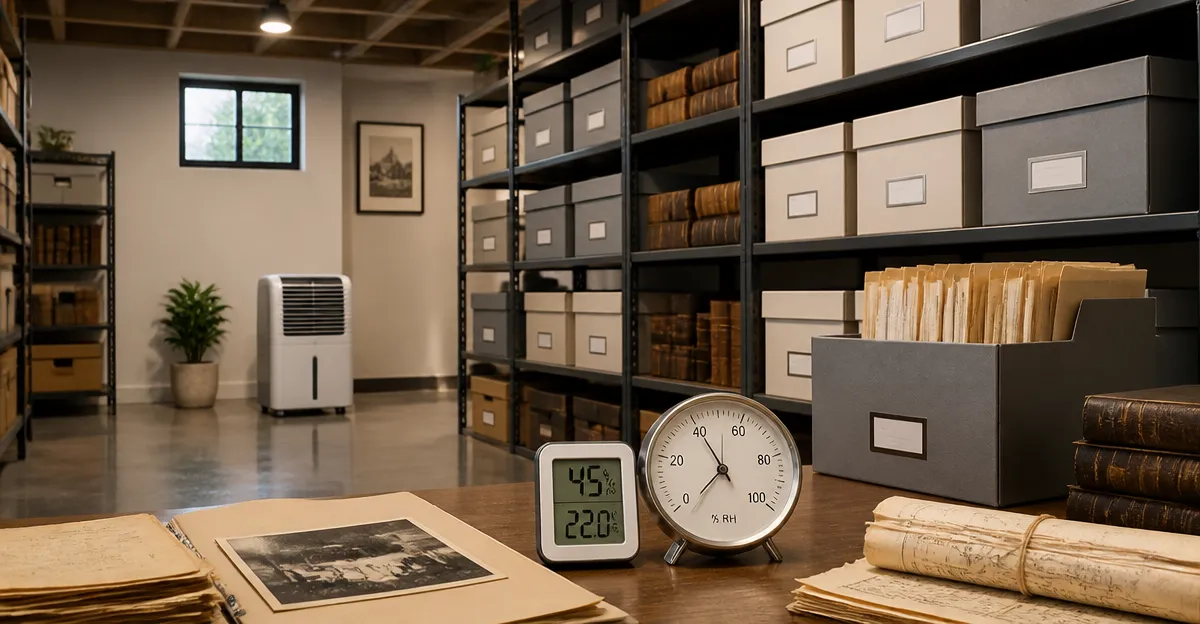
Ideal Humidity Levels for Storing Paper Archives in Basements: A Complete Preservation Guide
Introduction
Preserving paper archives in a basement requires careful control of temperature and moisture. This guide explains why humidity matters, outlines the ideal range for long‑term storage, and presents practical strategies to achieve stable conditions. Readers will learn how to assess their environment, select appropriate dehumidification equipment, and implement best‑practice habits. By the end, anyone responsible for historic documents, family records, or research materials will have a clear action plan.
Background/Context
Paper is a hygroscopic material, meaning it absorbs and releases water vapor in response to ambient humidity. When relative humidity (RH) exceeds 60 %, cellulose fibers swell, encouraging mold growth and ink bleeding. Conversely, RH below 30 % makes paper brittle, increasing the risk of cracking during handling. The archival community therefore recommends a narrow band of 30‑50 % RH, with 45 % often cited as the optimal compromise for most paper types.
Temperature also interacts with humidity; a stable 65‑70 °F (18‑21 °C) environment minimizes condensation cycles. In basements, temperature fluctuations are common due to ground temperature, water intrusion, and HVAC cycling. Without intervention, these variations can lead to repeated wet‑dry cycles that accelerate degradation.
Modern dehumidifiers, especially those using semiconductor (Peltier) technology, provide precise control without the bulk of traditional compressor units. When paired with proper ventilation and monitoring, they can maintain the target RH range even in challenging subterranean spaces.
Understanding Relative Humidity and Its Impact on Paper
Relative humidity is the percentage of water vapor present in air compared to the maximum it can hold at a given temperature. For paper, the equilibrium moisture content (EMC) aligns closely with ambient RH; a rise in RH raises the EMC, causing fibers to expand. This expansion can warp bindings, loosen stitching, and promote fungal spores that thrive above 65 % RH.
Long‑term storage guidelines from the Library of Congress and the International Organization for Standardization (ISO 18911) both cite 30‑50 % RH as the safe envelope. Within this range, the EMC remains stable, and chemical reactions that cause acid formation proceed slowly. Maintaining this envelope also protects inks, photographs, and adhesives that are sensitive to moisture.
In practice, achieving a constant 45 % RH in a basement often requires active dehumidification, especially during humid summer months or after heavy rain events. Passive solutions such as silica gel packets can supplement but cannot replace a reliable dehumidifier.
Choosing the Right Dehumidifier for Basement Archives
When selecting a dehumidifier, three criteria dominate: capacity, noise level, and control features. Capacity is expressed in ounces or liters of water removed per day; a larger capacity ensures the unit can handle spikes in humidity without frequent emptying. Noise is critical in residential basements where occupants may work or sleep nearby. Finally, features such as auto shut‑off, digital humidity displays, and ambient lighting can enhance usability.
For modest spaces up to 1,000 sq ft, the BEDRED 95 oz Dehumidifier offers a quiet operation, an intuitive auto shut‑off, and a soothing 7‑color ambient light. It is rated 4.2 / 5.0 by more than 5,900 reviewers and costs $56.97, making it an affordable entry point for small basements or dedicated archive closets.
For tighter spaces such as a bedroom‑sized archive room, the TABYIK 35 oz Dehumidifier provides ultra‑quiet 28 dB operation and a portable form factor with a built‑in handle. Its 35 oz tank and automatic shut‑off at 700‑800 ml make it low‑maintenance, while the 7‑color light can serve as a night‑light without disturbing sleep.
For large basements covering up to 5,500 sq ft, the AEOCKY 5500 Sq. Ft Dehumidifier delivers 80 pint per day removal capacity, ENERGY STAR Most Efficient 2025 certification, and a digital humidistat that maintains the set RH automatically. Although priced at $236.99, its efficiency reduces electricity costs, and its low‑noise 44 dB fan ensures the basement remains a quiet work environment.
Mid‑range solutions such as the KeepGlad 98 oz Dehumidifier combine a larger tank, timer settings, and a washable filter for easy upkeep. With a rating of 5 / 5.0 from 57 reviewers, it offers reliable performance for spaces up to 1,000 sq ft.
The MIONJO 4500 Sq. Ft Dehumidifier provides 40 dB library‑quiet operation, an adjustable 90° airflow, and dual drainage options, making it suitable for larger basements where continuous drainage is preferred.
Comparison/Selection Guide
| Feature | BEDRED 95 oz | TABYIK 35 oz | AEOCKY 5500 sq ft | KeepGlad 98 oz | MIONJO 4500 sq ft |
|---|---|---|---|---|---|
| Coverage Area | Up to 1,000 sq ft | Up to 280 sq ft | Up to 5,500 sq ft | Up to 1,000 sq ft | Up to 4,500 sq ft |
| Water Removal Capacity (per day) | ~95 oz | ~35 oz | 80 pint (≈640 oz) | ~98 oz | ~450 oz |
| Noise Level | Quiet (unspecified) | 28 dB | 44 dB (low) | 28 dB (sleep mode) | 40 dB (library quiet) |
| Auto Shut‑Off | Yes | Yes (when 700‑800 ml full) | Yes | Yes | Yes |
| Ambient Light | 7‑color | 7‑color | None | 7‑color | None |
| Price | $56.97 | $39.99 | $236.99 | $59.99 | $189.99 |
| Average Rating | 4.2/5 | 4.1/5 | 4.4/5 | 5/5 | 4.6/5 |
Choosing the appropriate unit depends on the size of the archive area, desired noise level, and budget. Small private collections benefit from the compact BEDRED or TABYIK models, while institutional basements require the high‑capacity AEOCKY or MIONJO units. Consider whether continuous drainage is feasible; models with built‑in drain hose options (AEOCKY, KeepGlad, MIONJO) reduce manual tank emptying.
Best Practices & Tips for Archival Storage in Basements
- Install a calibrated hygrometer at eye level to monitor RH continuously. Digital displays on the AEOCKY and KeepGlad units provide real‑time feedback.
- Seal cracks and improve ventilation before adding a dehumidifier. Use waterproof sealant on foundation walls to prevent seepage.
- Maintain a steady temperature of 65‑70 °F. If HVAC is unavailable, consider a low‑wattage space heater with a thermostat to avoid temperature swings.
- Arrange paper boxes on shelving rather than directly on the floor. Elevating items promotes air circulation and reduces moisture absorption from the concrete slab.
- Rotate stored materials periodically. Exposure to air for a few minutes each month helps equalize moisture content throughout the collection.
- Use acid‑free archival boxes and tissue. These materials buffer against pH changes that can be accelerated by humidity fluctuations.
- When possible, employ a continuous drain hose to a floor drain or condensate pump. This eliminates the need to empty tanks during prolonged humid periods.
Combining these practices with a reliable dehumidifier creates a synergistic environment where paper remains stable for decades. Regularly inspect the unit’s filter (if applicable) and clean the water tank to prevent mold growth inside the appliance itself.
FAQ
- What is the ideal RH for most paper archives? The consensus among archivists is 30‑50 % RH, with 45 % offering the best balance between dryness and flexibility.
- Can a dehumidifier alone maintain the target RH? It can, provided the space is sealed from external moisture sources and the unit’s capacity matches the room size.
- How often should the water tank be emptied? For units with a 95 oz tank, emptying once a week during humid months is typical; larger tanks may require bi‑weekly service.
- Is a continuous drain hose necessary? It is not required but highly recommended for large basements or when the unit runs continuously, as it prevents overflow and reduces maintenance.
- Do ambient lights affect humidity control? No, the LED ambient lights are purely decorative and consume negligible power; they do not influence moisture removal.
- What noise level is acceptable for a basement archive? A level below 40 dB is generally considered quiet enough not to disturb reading or work; the TABYIK and KeepGlad models operate at 28 dB.
- How does ENERGY STAR certification help? ENERGY STAR models, such as the AEOCKY dehumidifier, consume up to 50 % less electricity, lowering operational costs while maintaining performance.
Conclusion
Preserving paper archives in a basement hinges on maintaining a stable 30‑50 % RH and a moderate temperature. Dehumidifiers equipped with auto shut‑off, digital humidistats, and low noise levels are essential tools for achieving these conditions. By assessing the size of the storage area, selecting a unit that matches the required capacity, and following best‑practice storage guidelines, custodians can protect valuable documents from mold, brittleness, and irreversible damage. The combination of scientific control and thoughtful handling ensures that paper collections remain accessible for future generations.
Products Featured in This Guide
BEDRED 95 oz Dehumidifier
Price: $56.97 | Rating: 4.2/5 (5,915 reviews)
Featured for its compact size, auto shut‑off, and 7‑color ambient light, making it ideal for small basements and archive closets.
TABYIK 35 oz Dehumidifier
Price: $39.99 | Rating: 4.1/5 (16,429 reviews)
Highlighted for ultra‑quiet 28 dB operation, portable design, and built‑in handle, suitable for tight archive rooms or RV storage.
AEOCKY 5500 Sq. Ft Dehumidifier
Price: $236.99 | Rating: 4.4/5 (6,082 reviews)
Chosen for its high capacity, ENERGY STAR Most Efficient 2025 certification, and digital humidistat for large basement archives.
KeepGlad 98 oz Dehumidifier
Price: $59.99 | Rating: 5/5 (57 reviews)
Featured for its digital humidity display, timer function, and washable filter, offering precise control for medium‑size basements.
MIONJO 4500 Sq. Ft Dehumidifier
Price: $189.99 | Rating: 4.6/5 (219 reviews)
Selected for its library‑quiet 40 dB operation, adjustable 90° airflow, and dual drainage options for flexible installation.
Frequently Asked Questions
What relative humidity range is recommended for storing paper archives in a basement?
Archivists recommend maintaining 30‑50% RH, with about 45% being optimal for most paper types.
Why is humidity above 60% harmful to paper collections?
Above 60% RH causes cellulose fibers to swell, promoting mold growth and ink bleeding.
What problems can occur if basement humidity drops below 30%?
Low humidity makes paper brittle, increasing the risk of cracks and tears during handling.
How does temperature affect humidity control for paper preservation?
Temperature influences the air’s moisture‑holding capacity; a stable 65‑70 °F helps keep RH within the desired range.
What are practical ways to maintain stable humidity in a basement archive?
Use a reliable dehumidifier, monitor RH with a hygrometer, seal cracks, and avoid frequent temperature fluctuations.