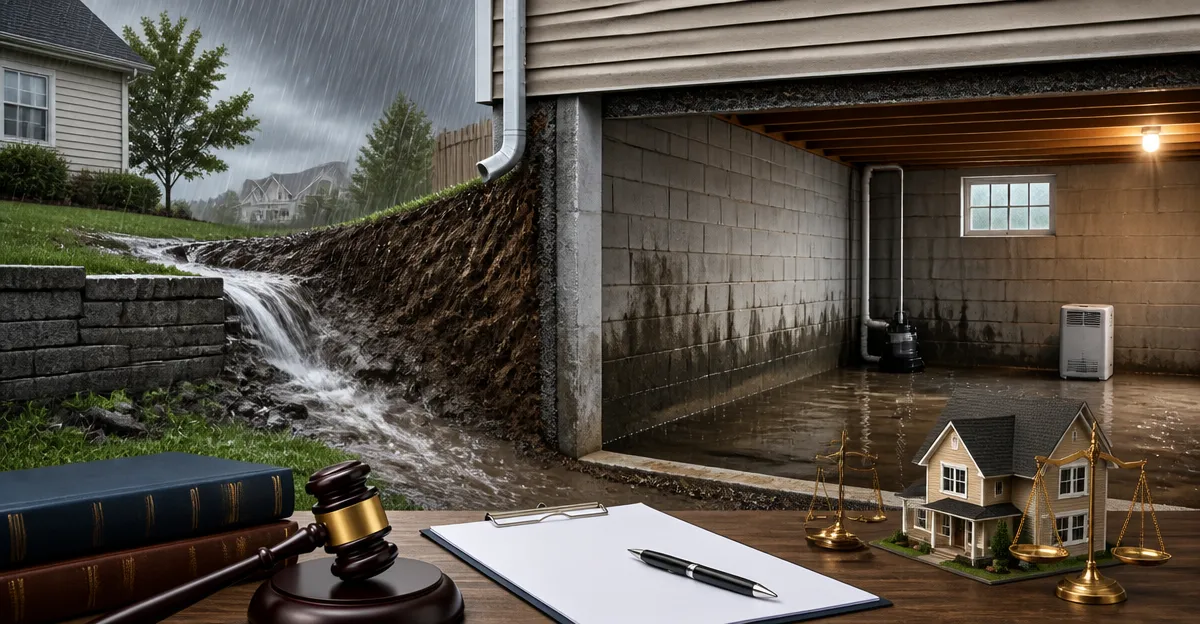
Who’s Responsible When Runoff Causes Basement Moisture? A Homeowner’s Legal Guide to Neighbor Liability
Introduction
This guide explains how surface water runoff can infiltrate a basement, the legal principles that determine neighbor liability, and practical steps a homeowner can take to protect the property. Readers will learn how to assess drainage patterns, document damage, and pursue remedies through negotiation or litigation. The article also recommends proven waterproofing products that mitigate moisture while legal matters are resolved. By the end of the guide, homeowners will have a clear roadmap for both legal recourse and effective moisture control.
Background and Context
Runoff is water that flows over land surfaces after precipitation, snow melt, or irrigation. When a neighboring property slopes toward a home, gravity can channel water directly to the foundation, creating hydrostatic pressure that forces moisture through cracks. Most jurisdictions apply the doctrine of "reasonable use," which requires property owners to manage water in a way that does not unreasonably harm adjacent land. Exceptions include easements, local storm‑water ordinances, and historic floodplain designations. Understanding these concepts is essential before pursuing any claim.
Key legal terms include:
- Negligence: Failure to exercise reasonable care in directing runoff.
- Nuisance: An unreasonable interference with the use and enjoyment of property.
- Strict liability: In some states, certain activities (e.g., large-scale grading) impose liability regardless of fault.
Documenting the source of water, the extent of damage, and any prior attempts at mitigation strengthens a homeowner’s position. Photographs, topographic surveys, and professional drainage assessments are valuable evidence.
Identifying the Source of Runoff
Before confronting a neighbor, a homeowner should verify that runoff, rather than internal plumbing or condensation, is the cause of moisture. Common indicators include water stains on interior walls that correspond with exterior grading, and dampness that appears after heavy rain events.
Engage a licensed civil engineer or a qualified waterproofing contractor to perform a site analysis. The professional will measure slope, evaluate gutter and downspout performance, and recommend corrective grading or drainage solutions.
When the analysis confirms that a neighbor’s higher elevation or improper grading directs water toward your foundation, the legal discussion can proceed with a factual foundation.
Legal Strategies for Homeowners
Homeowners have several avenues to address runoff‑related damage:
- Direct Negotiation: Present findings to the neighbor, propose a mutually agreeable drainage correction, and request reimbursement for repairs.
- Mediation: If direct talks stall, a neutral third party can facilitate a settlement without court involvement.
- Small Claims or Civil Court: File a claim for damages, typically including repair costs, moisture‑related depreciation, and possibly attorney fees.
- Insurance Claim: Some homeowner policies cover water intrusion; however, insurers may pursue subrogation against the neighbor.
Each strategy carries costs and timelines; choosing the appropriate path depends on the severity of damage, the neighbor’s willingness to cooperate, and local court procedures.
Recommended Waterproofing Products
While legal remedies address the source of runoff, immediate protection of the basement is essential. The following products have been selected for their performance, consumer ratings, and suitability for interior or exterior applications.
The first product mentioned below is linked to its Amazon page using the friendly name.
KILZ Basement Waterproofing Paint provides a nanotechnology‑based barrier that resists up to 12 PSI of water pressure. It is rated 4.7/5 from 1,253 reviews and costs $48.00 per gallon. The low‑odor formula dries to the touch in one hour, making it ideal for interior basement walls that already show signs of seepage.
INSL‑X WaterBlock Masonry Waterproofer is a water‑based acrylic coating that tolerates hydrostatic pressure up to 12 psi and offers high alkali resistance (pH‑13). Priced at $49.99 per gallon and holding a 4.6/5 rating from 298 reviewers, it works well on exterior foundation walls where exposure to the elements is continuous.
Ames Block & Wall Waterproofer is a liquid‑rubber sealant that forms an elastomeric membrane. At $49.91 per gallon with a 4.6/5 rating from 341 reviews, it is praised for its thick, cake‑like consistency that fills cracks and adheres to a variety of substrates. It is not UV‑stable, so a topcoat of latex paint is recommended for exposed walls.
Ames Blue Max Waterproofer delivers a 900 % elongation elastomeric membrane that remains flexible in freezing temperatures. The product costs $46.08 per gallon, carries a 4.6/5 rating from 604 reviews, and is suitable for both below‑grade foundations and insulated concrete forms.
Zinsser WaterTite Waterproofing Paint is a latex‑based paint that resists up to 20 lb of water pressure and includes mold‑resistant additives. Priced at $40.98 per gallon with a 4.0/5 rating from 71 reviews, it offers an ultra‑low odor formulation ideal for interior bathrooms and basement walls where mold is a concern.
Comparison and Selection Guide
| Product | Key Strength | Best Use Case | Price (per gal) | Rating |
|---|---|---|---|---|
| KILZ Basement Waterproofing Paint | Nanotech barrier, fast dry time | Interior basement walls, quick projects | $48.00 | 4.7 |
| INSL‑X WaterBlock | High alkali resistance, water‑based | Exterior foundations, damp surfaces | $49.99 | 4.6 |
| Ames Block & Wall | Thick elastomeric coat, crack filler | Areas needing heavy buildup, interior & exterior | $49.91 | 4.6 |
| Ames Blue Max | 900 % elongation, freeze‑tolerant | Below‑grade walls, ICF foundations | $46.08 | 4.6 |
| Zinsser WaterTite | Mold‑proof latex, low odor | Interior wet rooms, basement ceilings | $40.98 | 4.0 |
Choosing the right product depends on the location of the moisture, exposure conditions, and whether a rapid turnaround is required. For interior walls where low odor is critical, Zinsser WaterTite or KILZ are strong choices. For exterior foundations that may receive direct rain, INSL‑X WaterBlock or Ames Blue Max provide superior durability.
Best Practices & Tips
- Conduct a thorough site grading assessment before applying any coating; water will find the lowest point regardless of paint quality.
- Install or repair gutters and downspouts to divert roof runoff at least six feet away from the foundation.
- Use a French drain or perimeter drainage system where grading alone cannot achieve a safe slope.
- Apply waterproofing coatings in two coats, allowing the manufacturer‑specified cure time between applications.
- Document all repairs, receipts, and communications with neighbors; this record supports any future legal claim.
- Consider a professional moisture meter to verify that the coating has reduced humidity levels to below 60 % relative humidity.
Frequently Asked Questions
- Can I force a neighbor to re‑grade their property?
- In most states, a court may order a corrective action if the neighbor’s grading constitutes a nuisance and causes measurable damage.
- What if the neighbor refuses to cooperate?
- Homeowners can pursue mediation, file a civil claim, or request that their insurer pursue subrogation on their behalf.
- Do waterproofing paints eliminate the need for legal action?
- No; they mitigate damage but do not address the root cause. Legal remedies may still be necessary to prevent future runoff.
- How long does it take for a waterproofing coating to cure?
- Most products, including KILZ and INSL‑X, achieve full cure within 7–14 days, though touch‑dry times are often one hour.
- Is homeowner’s insurance required to cover runoff damage?
- Policies vary. Some cover water intrusion from external sources, but exclusions often apply if the homeowner has not taken reasonable preventive measures.
- Can I apply these products myself?
- Yes, all listed products are designed for DIY application, but proper surface preparation is essential for performance.
- What if the water source is a municipal storm‑drain overflow?
- Municipal liability may be pursued, but the burden of proof is higher; documentation of city‑issued flood warnings strengthens the claim.
Conclusion
Runoff‑induced basement moisture is a complex issue that blends property law, civil engineering, and practical waterproofing. Homeowners should first verify the source of water, document evidence, and attempt amicable resolution. When negotiation fails, legal avenues such as nuisance claims or small‑claims court can compel corrective action or compensation. Simultaneously, applying a high‑quality waterproofing coating protects the home while legal matters proceed. By following the steps outlined in this guide, homeowners can safeguard their property, preserve its value, and assert their rights against negligent neighbors.
Products Featured in This Guide
KILZ Basement Waterproofing Paint
Price: $48.00 | Rating: 4.7/5 (1,253 reviews)
Featured for its nanotechnology barrier, fast drying time, and suitability for interior basement walls.
INSL-X WaterBlock Masonry Waterproofer
Price: $49.99 | Rating: 4.6/5 (298 reviews)
Recommended for exterior foundations and high‑alkali environments where a water‑based acrylic system is preferred.
Ames Block & Wall Waterproofer
Price: $49.91 | Rating: 4.6/5 (341 reviews)
Chosen for its thick, elastomeric formulation that fills cracks and creates a durable waterproof membrane.
Ames Blue Max Waterproofer
Price: $46.08 | Rating: 4.6/5 (604 reviews)
Highlighted for its 900 % elongation, freeze‑tolerance, and suitability for below‑grade foundations.
Zinsser WaterTite Waterproofing Paint
Price: $40.98 | Rating: 4.0/5 (71 reviews)
Selected for its mold‑resistant latex base, low odor, and ability to protect interior wet areas such as bathroom ceilings.