Introduction
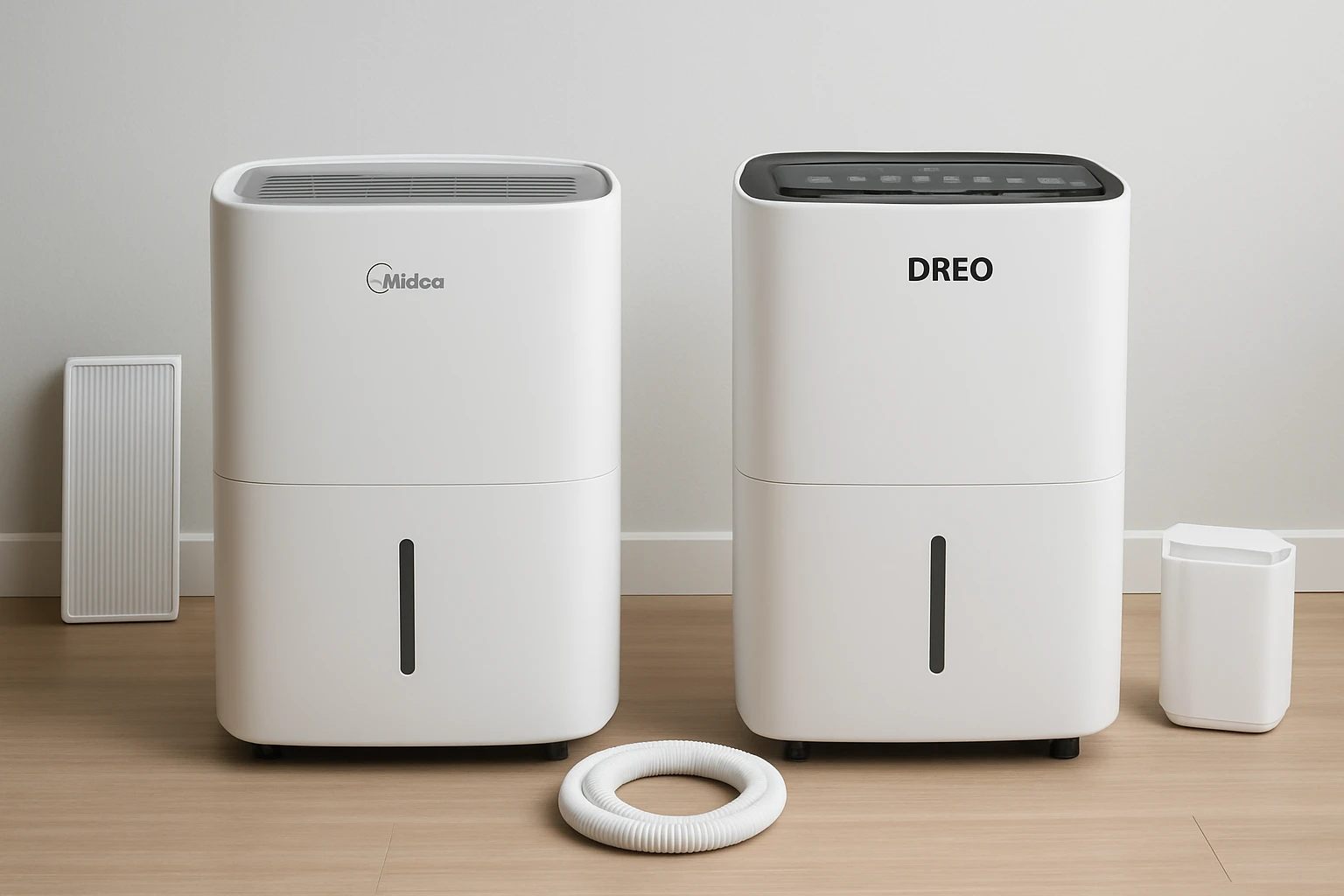
Humidity control is essential for preserving comfort, health, and the integrity of structures. Excess moisture can cause mold, mildew, and increased energy consumption for cooling systems. This article compares two high‑capacity dehumidifiers—Midea 35‑Pint Dehumidifier and Dreo 110‑Pint Smart Dehumidifier—alongside two accessories: the NUHFUFA Humidity Sensor Module and the Acyoyava 13‑Ft Drain Hose. Understanding their capabilities helps buyers select the most appropriate solution for basements, large rooms, or specialized applications.
Individual Product Overviews
Midea 35‑Pint Dehumidifier
The Midea model is rated for up to 3,000 sq ft., removing up to 35 pints of moisture per day. It offers an adjustable humidity range of 35 %–85 % and maintains a target range of 45 %–55 % in continual comfort mode. Key strengths include ultra‑quiet operation at 47 dBA, ENERGY STAR certification (19 % energy savings), and Wi‑Fi smart control via the SmartHome app with Alexa and Google Assistant integration. The unit features a reusable air filter, simple drainage options (tank or hose), and automatic restart after power loss. At $219.99 it carries a 4.4‑star rating from 2,652 reviews.
Customer feedback highlights durability: "It has been running 24 hours a day for three years without issues" and notes that the unit reduces A/C workload, lowering overall electricity use. Some users report occasional beeping when the tank is full and limited usefulness of the SmartHome app.
Dreo 110‑Pint Smart Dehumidifier
The Dreo unit targets spaces up to 4,500 sq ft., delivering 50‑110 pints of water removal per day. It boasts rapid dehumidification, reducing humidity by up to 45 % per hour, and claims a water‑removal efficiency of 4.0 pints/kWh—exceeding the Energy Star 2024 benchmark of 3.8 pints/kWh. The dehumidifier includes a 2‑gallon (8 L) tank, continuous‑drain hose outlet, and three operating modes (Comfort, Auto, Continuous) with a high‑precision sensor maintaining humidity within a 5 % tolerance. Smart control is provided through the DREO app and voice assistants. Pricing and rating details were not disclosed in the source data.
Customer sentiment is not provided, but the specification sheet emphasizes energy savings of up to 50 % annually and ETL certification for safety.
NUHFUFA Humidity Sensor Module
This 3‑pin sensor module is designed as a replacement part for many dehumidifier models. It offers good anti‑interference performance and is suitable for household, warehousing, tobacco, pharmaceutical, and other industrial applications. The module is priced at $17.99 and carries a 4.2‑star rating, though no reviews are listed.
Acyoyava 13‑Ft Drain Hose
The Acyoyava hose provides a universal, cut‑table 13‑ft solution for continuous drainage of dehumidifiers and air conditioners. Constructed from flexible 3/4" FHT rubber, it includes a clamp for secure attachment. At $11.99 it has a perfect 5‑star rating from a single reviewer who described it as "Good".
Head‑to‑Head Comparison
Price and Value
- Midea 35‑Pint: $219.99, strong value given its 35‑pint capacity, ENERGY STAR rating, and smart features.
- Dreo 110‑Pint: Price not disclosed; however, the higher capacity and advanced energy efficiency suggest a premium price point.
- NUHFUFA Sensor: $17.99, low‑cost upgrade for existing units.
- Acyoyava Hose: $11.99, inexpensive accessory that adds convenience.
Features and Specifications
| Product | Coverage (sq ft.) | Capacity (pints/day) | Energy Efficiency | Smart Control | Price | Rating |
|---|---|---|---|---|---|---|
| Midea 35‑Pint Dehumidifier | 3,000 | 35 | ENERGY STAR (19 % savings) | Wi‑Fi via SmartHome app, Alexa/Google | $219.99 | 4.4/5 (2,652 reviews) |
| Dreo 110‑Pint Smart Dehumidifier | 4,500 | 50‑110 | 4.0 pints/kWh (exceeds Energy Star 2024) | DREO app, Alexa/Google | Not disclosed | Not disclosed |
| NUHFUFA Humidity Sensor Module | N/A | N/A | N/A | Replacement part | $17.99 | 4.2/5 (0 reviews) |
| Acyoyava 13‑Ft Drain Hose | N/A | N/A | N/A | Continuous drainage | $11.99 | 5/5 (1 review) |
Customer Ratings and Feedback
The Midea unit enjoys a robust 4.4‑star rating, with reviewers praising its durability, quiet operation, and ability to lessen A/C load. One user noted, "It has been running 24 hours a day for three years without any issues." Negative comments focus on the beeping alarm and a limited SmartHome app experience.
The Dreo model lacks public ratings in the provided data, so objective assessment relies on manufacturer claims of energy savings and advanced humidity control. Potential buyers should verify current reviews on Amazon before purchase.
The NUHFUFA sensor, while unreviewed, holds a respectable 4.2‑star rating, indicating satisfactory performance for those who need a replacement part.
The Acyoyava hose received a single 5‑star review stating simply "Good," suggesting basic functional satisfaction.
Performance and Reliability
Midea’s 35‑pint capacity is sufficient for medium‑size basements and large rooms, delivering consistent dehumidification even in high‑humidity climates such as Florida. The unit’s auto‑restart and auto‑defrost features enhance reliability during power interruptions and low‑temperature operation.
Dreo’s higher capacity (up to 110 pints) positions it for very large spaces or commercial‑grade applications. Its claimed 4.0 pints/kWh efficiency translates to lower operating costs, especially in regions with high electricity rates.
The sensor module can improve accuracy of humidity readings in compatible dehumidifiers, potentially extending the lifespan of the primary unit by preventing over‑cycling.
The drain hose adds convenience by allowing continuous removal of water, eliminating the need for frequent tank emptying—a common complaint among Midea users.
Best Use Cases
- Midea 35‑Pint: Ideal for residential basements, large bedrooms, or offices up to 3,000 sq ft. Works well where quiet operation and smart home integration are priorities.
- Dreo 110‑Pint: Suited for expansive basements, whole‑house applications, or small commercial spaces up to 4,500 sq ft. Best for users seeking maximum moisture removal and superior energy efficiency.
- NUHFUFA Sensor: Appropriate for owners of compatible dehumidifiers who need to replace a faulty humidity sensor.
- Acyoyava Hose: Perfect for any dehumidifier with a standard hose outlet, enabling continuous drainage in basements, garages, or laundry rooms.
Pros & Cons
Midea 35‑Pint Dehumidifier
- Pros: ENERGY STAR certified, ultra‑quiet (47 dBA), Wi‑Fi control, strong customer satisfaction, durable build.
- Cons: No built‑in pump for vertical water lift, SmartHome app considered limited, occasional beeping alarm.
Dreo 110‑Pint Smart Dehumidifier
- Pros: Highest capacity, rapid humidity reduction, exceeds Energy Star 2024 efficiency, multiple drainage options, precise sensor tolerance.
- Cons: Price not disclosed, limited public reviews, larger footprint may require more floor space.
NUHFUFA Humidity Sensor Module
- Pros: Low cost, improves sensor accuracy, compatible with many models.
- Cons: No user reviews to confirm long‑term reliability, requires correct model verification.
Acyoyava 13‑Ft Drain Hose
- Pros: Inexpensive, universal fit, flexible length, leak‑proof design.
- Cons: Single short review, may require clamp adjustment for some units.
Recommendations
For homeowners with a standard basement or large room (up to 3,000 sq ft.) who value quiet operation and smart home connectivity, the Midea 35‑Pint Dehumidifier offers the best balance of price, performance, and reliability.
For users needing to dehumidify very large areas (up to 4,500 sq ft.) or seeking the lowest possible operating cost, the Dreo 110‑Pint Smart Dehumidifier is the superior choice, provided the budget aligns with its premium positioning.
Owners of either unit who experience sensor drift should consider the NUHFUFA Humidity Sensor Module as a cost‑effective replacement.
Anyone who prefers continuous drainage over manual tank emptying will benefit from the Acyoyava 13‑Ft Drain Hose, which works with both dehumidifiers.
FAQ
- Can the Midea dehumidifier operate without Wi‑Fi? Yes, all core functions (humidity control, timer, fan speed) work offline; Wi‑Fi only adds remote app control.
- Does the Dreo unit include a pump for vertical water discharge? No built‑in pump is listed; it relies on gravity‑drain through the hose outlet.
- How often should the reusable filter be cleaned? The Midea model alerts users when cleaning is required; generally cleaning every 1‑2 months maintains optimal airflow.
- Is the NUHFUFA sensor compatible with the Midea 35‑Pint? Compatibility depends on the dehumidifier’s sensor connector; verify the 3‑pin configuration before purchase.
- What length of hose is recommended for continuous drainage? The 13‑ft Acyoyava hose provides ample reach for most basements; longer hoses can be joined with compatible fittings.
- Which unit is quieter? Midea advertises 47 dBA operation, whereas Dreo does not specify decibel level; based on available data, Midea is the quieter choice.
- Do both units support voice control? Yes, both integrate with Alexa and Google Assistant for hands‑free operation.
Conclusion
Both dehumidifiers deliver reliable moisture removal, but they serve distinct market segments. The Midea 35‑Pint model excels in affordability, quiet operation, and proven durability, making it the optimal pick for most residential settings. The Dreo 110‑Pint model shines in large‑area coverage and energy efficiency, ideal for demanding environments where higher capacity justifies a higher price. Complementary accessories—the NUHFUFA sensor and Acyoyava hose—enhance functionality for either unit. By matching the product to the specific space and usage pattern, consumers can achieve healthier indoor air while controlling energy costs.
Products Mentioned in This Review
Frequently Asked Questions
What is the difference in moisture removal capacity between the Midea 35‑Pint and Dreo 110‑Pint dehumidifiers?
The Midea removes up to 35 pints per day for spaces up to 3,000 sq ft, while the Dreo handles up to 110 pints per day, covering much larger areas.
Can the Dreo 110‑Pint dehumidifier be controlled remotely?
Yes, it features Wi‑Fi connectivity and a mobile app for remote monitoring and adjustments.
How does the NUHFUFA Humidity Sensor Module enhance dehumidifier operation?
It provides accurate real‑time humidity readings, enabling precise set‑points and reducing unnecessary run time.
What length and type of drain hose is required for continuous drainage?
A standard ½‑inch outlet fits the 13‑ft Acyoyava drain hose, allowing uninterrupted water removal.
What are common signs that a basement dehumidifier is failing?
Reduced moisture removal, frequent cycling, unusual noises, and water pooling around the unit are typical failure indicators.