Introduction
This guide explains how passive hygroscopic materials can be combined with modern dehumidification technology to achieve reliable basement moisture control. Readers will learn the scientific principles, practical installation strategies, and how to select the most appropriate equipment for their specific environment. The article also highlights five Amazon‑listed dehumidifiers that complement passive solutions, providing real‑world examples of performance, energy efficiency, and user satisfaction.
Background/Context
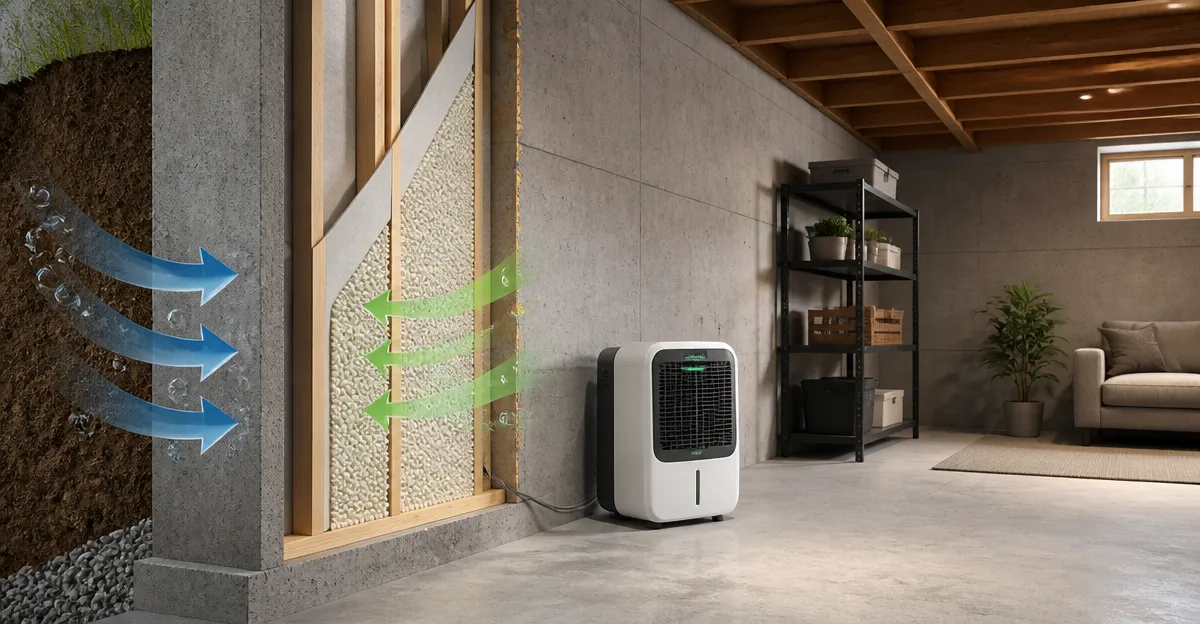
Basements are prone to excess humidity because they are below grade, often lack natural ventilation, and are surrounded by moist soil. High humidity can lead to mold growth, structural decay, and poor indoor air quality. Traditional approaches rely on mechanical dehumidifiers that continuously extract water from the air, but these units consume electricity and may produce noise. Passive hygroscopic materials, such as silica gel, calcium chloride, and specially engineered polymers, absorb moisture without external power, reducing the load on active devices.
Understanding the moisture balance in a basement requires knowledge of three key concepts: relative humidity, vapor pressure differentials, and the sorption capacity of hygroscopic agents. Relative humidity (RH) is the ratio of water vapor present in the air to the maximum amount the air can hold at a given temperature. When indoor RH exceeds 60 %, condensation can occur on cold surfaces, creating conditions favorable for mold. Vapor pressure drives moisture movement; warm, moist indoor air will migrate toward cooler, drier zones, such as walls and concrete floors. Hygroscopic materials capture water molecules through adsorption or absorption, lowering the indoor RH without the need for compressors.
Effective moisture management therefore combines passive sorbents that act as a first line of defense with active dehumidifiers that handle larger loads or periods of extreme humidity. The synergy between these two approaches can lower energy consumption, extend equipment lifespan, and improve occupant comfort.
Understanding Passive Hygroscopic Materials
Passive hygroscopic materials are classified into three categories based on their mechanism of moisture capture:
- Adsorbents: Materials such as silica gel and zeolites have high surface area and attract water molecules to their surface. They are reusable after heating or exposure to dry air.
- Absorbents: Substances like calcium chloride dissolve in the water they capture, forming a liquid brine. These are typically single‑use and require replacement when saturated.
- Polymeric Sorbents: Engineered polymers combine adsorption and absorption, offering high capacity and the ability to release moisture when ambient conditions become drier.
When deployed in a basement, these materials are placed in strategic locations—near foundation walls, under floor joists, or inside vented containers—to intercept moisture before it reaches living spaces. Their effectiveness is measured in grams of water absorbed per kilogram of sorbent and is influenced by temperature, airflow, and the initial RH level.
While passive sorbents are valuable, they have finite capacity and must be monitored. Integrating a smart dehumidifier ensures that once the sorbents approach saturation, the active system takes over, maintaining a stable RH between 45 % and 55 %.
Integrating Dehumidifiers with Passive Systems
Modern dehumidifiers equipped with intelligent humidity control, low‑noise compressors, and dual‑drain options can be paired with passive hygroscopic materials to create a balanced moisture management system. The following products exemplify the capabilities required for such integration.
Large‑Area Coverage
For basements exceeding 4,000 sq ft, a high‑capacity unit is essential. The MIONJO 4500 Sq Ft Dehumidifier offers an 80 % daily moisture reduction rate across up to 4,500 sq ft. Key features include a 90° adjustable airflow for targeted drying, library‑level quiet operation at 40 dB, and Energy Star certification for reduced electricity usage. Users praise its intelligent humidity sensor, dual drainage (1.72‑gallon tank or continuous hose), and easy mobility via 360° swivel wheels. With a 4.7‑star rating from 207 reviews, it provides reliable performance for large, high‑traffic basements.
Maximum Efficiency for Very Large Spaces
The AEOCKY 5500 Sq Ft Dehumidifier holds the ENERGY STAR Most Efficient 2025 certification, a distinction earned by less than 3 % of models. It can remove up to 80 pints per day in hot, humid conditions and 59.3 pints in typical basement climates. Advanced features such as a high‑efficiency rotor compressor, millisecond‑level humidity sensing, and low‑temperature defrost enable continuous operation even in cooler basements. Reviewers highlight its ultra‑quiet 44 dB lowest fan speed, robust construction, and three‑year warranty. The unit is priced at $236.99 and carries a 4.4‑star rating from over 6,000 reviews.
Balanced Performance and Affordability
The KNKA 4500 Sq Ft Dehumidifier combines ENERGY STAR efficiency with a user‑friendly interface. It delivers up to 80 pints per day in peak summer conditions, operates at 40‑45 dB, and provides three smart modes (AUTO, DRY, SETTING). The unit includes a 1.45‑gallon internal tank, optional external tank, and a 6.56‑ft drain hose for continuous drainage. Customers appreciate its quiet operation, rainbow‑woven handle, and real‑time humidity display. It is rated 4.8 stars from 324 reviews and costs $189.98.
Compact Solutions for Small Areas
For closets, bathrooms, or RVs under 300 sq ft, the TABYIK 35 oz Dehumidifier provides a low‑power, Peltier‑based solution. It removes up to 16 oz of water per day, consumes less than 1 kWh, and operates at an ultra‑quiet 28 dB. The unit features a 35‑oz transparent tank, auto shut‑off, and a 7‑color ambient light for aesthetic appeal. Reviewers note its portability, quiet fan, and suitability for small spaces, despite limited capacity compared with floor models.
Stylish Mid‑Size Option
The BEDRED 95 oz Dehumidifier targets rooms up to 1,000 sq ft. Its thermoelectric cooling system offers silent operation, an automatic shut‑off, and a 7‑color ambient light. Users commend its compact footprint, quiet performance, and the large 95‑oz tank that reduces the frequency of emptying. It holds a 4.2‑star rating from 5,849 reviews and is priced at $59.99.
Comparison/Selection Guide
| Feature | MIONJO 4500 Sq Ft | AEOCKY 5500 Sq Ft | KNKA 4500 Sq Ft | TABYIK 35 oz | BEDRED 95 oz |
|---|---|---|---|---|---|
| Coverage Area | Up to 4,500 sq ft | Up to 5,500 sq ft | Up to 4,500 sq ft | Up to 280 sq ft | Up to 1,000 sq ft |
| Daily Water Removal (95°F, 95% RH) | ~80 pints | 80 pints | 80 pints | 0.5 pint | ~2 pints |
| Noise Level (Lowest Setting) | 40 dB | 44 dB | 40‑45 dB | 28 dB | ~30 dB |
| Energy Star | Yes | Most Efficient 2025 | Yes | No (Peltier) | No (Thermoelectric) |
| Price (USD) | 189.99 | 236.99 | 189.98 | 39.99 | 59.99 |
| Average Rating | 4.7/5 (207) | 4.4/5 (6,051) | 4.8/5 (324) | 4.1/5 (16,403) | 4.2/5 (5,849) |
When selecting a unit, consider the size of the space, the typical humidity load, and the desired noise level. Large basements benefit from the high capacity and dual‑drain options of the MIONJO or AEOCKY models. For moderate spaces where quiet operation and aesthetic design are priorities, the KNKA and BEDRED units provide a balanced solution. Compact areas such as bathrooms or RVs are best served by the TABYIK dehumidifier, which sacrifices capacity for portability and ultra‑low sound.
Best Practices & Tips
- Place passive hygroscopic containers near the floor where cool, moist air settles. Replace or regenerate them according to manufacturer instructions.
- Position the dehumidifier centrally, with at least 12 inches of clearance around the intake and exhaust to ensure unrestricted airflow.
- Set the target relative humidity between 45 % and 55 % for optimal mold prevention while minimizing energy consumption.
- Utilize the continuous drain hose on units that support it (MIONJO, AEOCKY, KNKA) to avoid frequent tank emptying, especially in high‑humidity seasons.
- Schedule regular filter cleaning—typically monthly—to maintain airflow efficiency and prevent dust buildup.
- Combine dehumidification with proper ventilation: use exhaust fans in bathrooms and kitchens to reduce moisture ingress.
- Monitor humidity levels with a separate hygrometer to verify that the system maintains the desired range.
Frequently Asked Questions
1. How do passive hygroscopic materials differ from active dehumidifiers?
Passive materials absorb or adsorb moisture without electricity, acting as a first‑line buffer. Active dehumidifiers use compressors or thermoelectric elements to actively extract water from the air, providing continuous control.
2. Can I rely solely on a small tabletop dehumidifier for a large basement?
No. Small units such as the TABYIK 35 oz model are designed for spaces under 300 sq ft. For basements larger than 1,000 sq ft, a high‑capacity unit like the MIONJO or AEOCKY is required to prevent persistent humidity.
3. How often should I replace or regenerate the hygroscopic sorbents?
Regeneration frequency depends on ambient humidity and the sorbent’s capacity. In a typical basement, silica‑gel packs may need re‑drying every 2‑3 weeks, while calcium‑chloride crystals are single‑use and should be replaced when the container is saturated.
4. What is the significance of the ENERGY STAR Most Efficient 2025 label?
The label indicates that the unit meets stringent energy‑use criteria that are more rigorous than standard ENERGY STAR certification. It typically results in up to 50 % lower electricity consumption compared with conventional models.
5. Will the dehumidifier affect indoor air temperature?
Dehumidifiers remove moisture by cooling the air slightly during the condensation process; the temperature change is generally less than 2 °F and is not noticeable in most residential settings.
6. Is it safe to run a dehumidifier continuously?
Yes, provided the unit has an auto‑defrost function and an automatic shut‑off when the water tank is full. Models such as the MIONJO and AEOCKY include overload protection and continuous drainage options for safe 24/7 operation.
Conclusion
Passive hygroscopic materials and intelligent dehumidifiers together provide a comprehensive strategy for controlling basement moisture. By understanding the science of humidity, selecting the appropriate capacity, and following best‑practice installation guidelines, homeowners can achieve a dry, healthy environment while minimizing energy costs. The products featured in this guide illustrate the range of solutions available, from high‑capacity floor units to compact tabletop models, ensuring that every basement size and budget can benefit from effective moisture management.
Products Featured in This Guide
MIONJO 4500 Sq Ft Dehumidifier
Price: $189.99 | Rating: 4.7/5 (207 reviews)
Featured for its large coverage area, adjustable airflow, and Energy Star efficiency, making it ideal for extensive basements.
AEOCKY 5500 Sq Ft Dehumidifier
Price: $236.99 | Rating: 4.4/5 (6,051 reviews)
Featured for its ENERGY STAR Most Efficient 2025 certification, ultra‑quiet operation, and robust low‑temperature performance.
KNKA 4500 Sq Ft Dehumidifier
Price: $189.98 | Rating: 4.8/5 (324 reviews)
Featured for its smart modes, quiet operation, and flexible drainage options, offering a balanced solution for medium‑size basements.
TABYIK 35 oz Dehumidifier
Price: $39.99 | Rating: 4.1/5 (16,403 reviews)
Featured for its ultra‑compact size, low power consumption, and 28 dB silent operation, perfect for small rooms or RVs.
BEDRED 95 oz Dehumidifier
Price: $59.99 | Rating: 4.2/5 (5,849 reviews)
Featured for its stylish design, ambient lighting, and quiet thermoelectric operation suitable for rooms up to 1,000 sq ft.