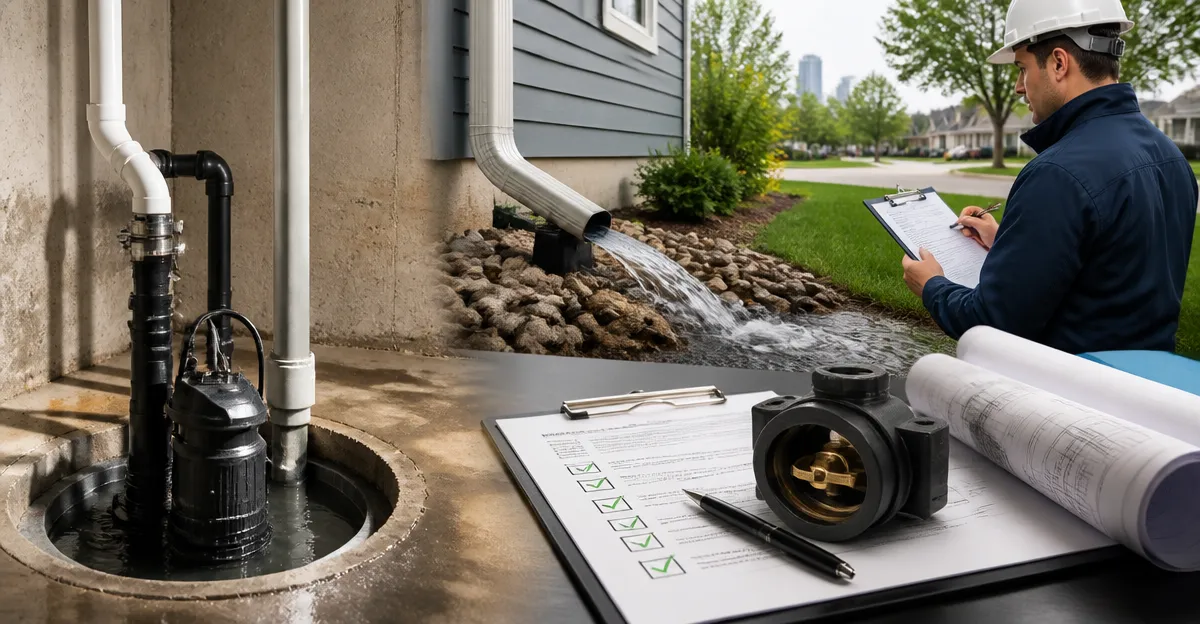
Municipal Sump Pump Discharge Regulations: The Ultimate Guide to Compliance, Permits & Avoiding Fines
Introduction
Municipal authorities impose strict rules on how residential and commercial sump pump water may be discharged into public storm‑water or sanitary systems. This guide explains the regulatory landscape, outlines the permitting process, and provides actionable strategies to remain compliant while protecting property. Readers will learn key concepts such as backflow prevention, required documentation, and how to select reliable hardware that meets local codes. By the end of the article, one will be equipped to avoid costly citations and ensure a safe, efficient discharge system.
Background and Context
Historically, many municipalities treated sump pump effluent as ordinary runoff, but increasing concerns about contaminants, flooding, and infrastructure strain have prompted tighter controls. Regulations typically differentiate between storm‑water (permitted in many jurisdictions) and sanitary sewer discharge (generally prohibited without treatment). Understanding the distinction is essential because non‑compliant connections can result in cross‑connection hazards, where polluted water re‑enters the potable supply.
Backflow prevention devices are the technical cornerstone of compliance. These devices block reverse flow caused by pressure fluctuations, ensuring that contaminated water never reaches clean water mains. The most common types include reduced‑pressure principle (RPP) backflow preventers, pressure vacuum breakers (PVB), and anti‑siphon vacuum breakers. Selecting the appropriate device depends on hazard level, pipe size, and local certification requirements.
In addition to hardware, municipalities often require a written discharge plan, hydraulic calculations, and proof of installation by a licensed plumber. Permit fees vary, but the cost of non‑compliance—fines, forced re‑work, or legal liability—far outweighs the initial investment.
Understanding Municipal Sump Pump Discharge Requirements
Most jurisdictions mandate that sump pump water be directed to a storm‑water system, a detention basin, or a qualified infiltration area. The discharge pipe must be sized to handle peak flow, typically calculated using the formula Q = 0.5 × A × √(2gH), where A is pipe cross‑section, g is gravity, and H is head pressure. Failure to meet hydraulic capacity can cause backups and trigger code violations.
Where a direct connection to the sanitary sewer is unavoidable, municipalities require an approved backflow preventer rated for the specific health hazard. The device must be listed by agencies such as ASSE, IAPMO, or CSA, and installed with a test port for periodic inspection. Documentation of the device’s serial number, test results, and maintenance logs is often part of the permit renewal process.
Some cities also impose discharge timing restrictions to reduce peak flow during storm events. In such cases, a discharge timer or a controlled release valve may be required. Understanding these nuances before design saves time and prevents re‑submission of plans.
Permitting Process and Compliance Steps
The permitting workflow can be broken into four distinct phases: pre‑application, plan submission, inspection, and final approval. During the pre‑application phase, one should consult the local public works department to confirm required forms and any special ordinances.
- Gather site‑specific data: elevation, existing pipe layout, and soil permeability.
- Prepare hydraulic calculations and a schematic showing the discharge route and backflow device location.
- Complete the municipal permit application, attaching product data sheets for any listed backflow preventer.
After plan approval, a licensed plumber installs the system according to the approved drawing. The inspector will verify pipe sizing, proper slope, and correct placement of the backflow device. A functional test of the device’s test port is performed, and the results are recorded on the inspection form.
Finally, the municipality issues a compliance certificate. Many jurisdictions require annual re‑testing of the backflow preventer; keeping a digital log of test dates, results, and technician signatures simplifies this recurring task.
Choosing the Right Backflow Prevention Devices
Selecting a backflow preventer that satisfies both code and operational needs is critical. The following products represent industry‑approved solutions for typical 1‑inch residential and commercial applications.
The first recommendation is the Zurn 975XL Backflow Preventer. This reduced‑pressure principle device offers a wye‑pattern design that simplifies installation in tight spaces. Its cast‑bronze body provides durability, and separate access to the relief valve and each check valve reduces labor time during maintenance. With a 4.5‑star rating from 516 reviewers and a price of $528.54, it is a premium choice for high‑hazard irrigation systems.
- Wye pattern design reduces installation time.
- Easy access to first check valve for debris removal.
- Entire unit serviceable in line, minimizing downtime.
- ASSE, IAPMO, UL, C‑UL, and CSA listed for compliance.
For smaller residential hose‑bib applications, the Eastman Hose Bibb Vacuum Breaker provides reliable anti‑siphon protection. Constructed from heavy‑duty brass, it features a self‑draining mechanism and a break‑off screw for permanent installation. At $— (price not provided), it remains an affordable option, earning a solid 4‑star rating based on user feedback.
- Self‑draining design prevents water retention.
- Break‑off screw allows permanent, leak‑free installation.
- Maximum pressure rating of 125 psi and temperature rating of 180 °F.
- Corrosion‑resistant brass construction ensures longevity.
For applications requiring a pressure vacuum breaker, the Zurn 720A Pressure Vacuum Breaker is a widely accepted choice. It incorporates an approved check valve, two test cocks, and full‑port shut‑off valves. Priced at $164.99 and supported by a 4.6‑star rating from over 3,300 reviews, it meets ASSE, IAPMO, and CSA standards, making it suitable for both residential and commercial irrigation.
- Serial number visible in any orientation simplifies field verification.
- Test cocks on the center line allow versatile installation.
- Corrosion‑resistant bronze construction offers winterization protection.
- Maximum pressure of 150 psi and temperature range 33 °F–110 °F.
Finally, the WHK 1" Bronze Backflow Ball Valve serves as a replacement ball valve for 720A assemblies. Its lead‑free bronze body exceeds the strength of standard brass, and the full‑port design minimizes pressure drop. Priced at $46.99 with a perfect 5‑star rating from four reviewers, it includes a built‑in 1/8" NPT test port for convenient pressure testing.
- Lead‑free bronze construction provides superior corrosion resistance.
- Full‑port design ensures minimal pressure loss.
- Integrated test port supports 1/8" pressure gauge or test cock.
- 1/4‑turn metal handle enables quick shut‑off.
Comparison and Selection Guide
| Device | Type | Size | Key Certifications | Price | Rating |
|---|---|---|---|---|---|
| Zurn 975XL Backflow Preventer | Reduced‑Pressure Principle | 1 in. | ASSE, IAPMO, UL, C‑UL, CSA | $528.54 | 4.5/5 (516 reviews) |
| Eastman Hose Bibb Vacuum Breaker | Anti‑Siphon Vacuum Breaker | 3/4 in. | Not listed (brass construction) | Not disclosed | 4/5 (unspecified reviews) |
| Zurn 720A Pressure Vacuum Breaker | Pressure Vacuum Breaker | 1 in. | ASSE, IAPMO, CSA | $164.99 | 4.6/5 (3,352 reviews) |
| WHK 1" Bronze Backflow Ball Valve | Ball Valve with Test Port | 1 in. | Lead‑free bronze, compatible with 720A | $46.99 | 5/5 (4 reviews) |
When selecting a device, consider the hazard classification (low vs. high), pipe size, and required certifications. High‑hazard irrigation typically mandates an RPP device such as the Zurn 975XL, while low‑hazard residential hose connections may be served by the Eastman vacuum breaker. For retrofit scenarios where a ball valve replacement is needed, the WHK valve offers a cost‑effective, lead‑free solution.
Best Practices & Tips for Compliance
Beyond product selection, the following practices help maintain compliance and avoid fines:
- Document every installation step, including serial numbers, test results, and plumber credentials.
- Schedule annual backflow tests with a certified tester; retain the test report for municipal review.
- Use pipe insulation on discharge lines in colder climates to prevent freezing, which can cause back‑pressure events.
- Install a pressure‑reducing valve upstream of the backflow device if municipal water pressure exceeds the device’s rating.
- Maintain clear access to the test port; avoid covering it with landscaping or permanent structures.
Regular visual inspections—looking for corrosion, leakage, or valve misalignment—can catch issues before they become violations. When in doubt, consult a certified backflow prevention specialist who can verify that the chosen device meets the latest edition of local codes.
Frequently Asked Questions
1. Do I need a permit to discharge sump pump water into the storm‑water system?
Most municipalities require a permit if the discharge connects to a public storm‑water conduit, especially when the volume exceeds a certain threshold. Check with the local public works department for specific limits.
2. Can I connect my sump pump directly to the sanitary sewer?
Generally no. Direct discharge to a sanitary sewer is prohibited in many jurisdictions because it can overload treatment facilities and introduce contaminants. If an exception is granted, an approved backflow preventer must be installed.
3. How often must a backflow preventer be tested?
Annual testing is the standard requirement in most states. Some localities may require semi‑annual testing for high‑hazard devices.
4. What size pipe should I use for my sump pump discharge?
Pipe size should be calculated based on peak flow rate and local slope requirements. A 1‑inch pipe is typical for residential pumps, but larger capacities may need 1½‑inch or 2‑inch piping.
5. Are there any low‑cost alternatives to premium backflow preventers?
For low‑hazard applications, an anti‑siphon vacuum breaker such as the Eastman Hose Bibb model can provide adequate protection at a lower cost. However, it does not replace an RPP device for high‑hazard irrigation.
6. What penalties can I face for non‑compliance?
Penalties range from monetary fines (often $100–$1,000 per violation) to mandatory system shutdowns and legal liability for water‑borne contamination.
Conclusion
Municipal sump pump discharge regulations aim to protect public water supplies, prevent flooding, and maintain infrastructure integrity. By understanding the distinction between storm‑water and sanitary‑sewer discharge, securing the appropriate permits, and installing certified backflow preventers, property owners can avoid fines and ensure long‑term system reliability. The products highlighted in this guide—Zurn 975XL, Eastman Hose Bibb Vacuum Breaker, Zurn 720A, and WHK Bronze Ball Valve—represent reliable, code‑compliant solutions for a range of applications. Combine these hardware choices with diligent documentation, regular testing, and best‑practice installation, and compliance becomes a straightforward, manageable process.
Products Featured in This Guide
Zurn 975XL Backflow Preventer
Price: $528.54
Rating: 4.5/5 (516 reviews)
Featured because it provides high‑hazard reduced‑pressure protection, meets multiple certification standards, and is favored for complex irrigation systems.
Eastman Hose Bibb Vacuum Breaker
Price: Not disclosed
Rating: 4/5 (reviews not specified)
Featured as an affordable, brass‑constructed anti‑siphon device suitable for residential hose‑bib connections.
Zurn 720A Pressure Vacuum Breaker
Price: $164.99
Rating: 4.6/5 (3,352 reviews)
Featured for its versatile PVB design, test ports, and compliance with ASSE, IAPMO, and CSA standards.
WHK 1" Bronze Backflow Ball Valve
Price: $46.99
Rating: 5/5 (4 reviews)
Featured as a cost‑effective, lead‑free replacement valve that integrates a test port for easy inspection.