Introduction
Testing the flow capacity of a French drain is essential for ensuring that water moves efficiently away from foundations, gardens, and walkways. One will learn how to measure flow rates accurately, interpret the results, and address performance problems before they cause costly water damage. This guide provides a systematic, DIY‑friendly approach that balances technical precision with practical accessibility for homeowners and landscaping professionals. By following the steps, one can diagnose drainage issues, verify design specifications, and maintain a healthy yard ecosystem.
What You'll Need
- Measuring container (5‑gallon bucket or graduated cylinder)
- Stopwatch or digital timer
- Level and measuring tape
- Garden hose or water source with controllable flow
- Clear plastic tubing for directing water (optional)
- Geowaky Pond Hose – 1‑inch corrugated PVC hose, 20 ft
Step 1: Prepare the Drain for Testing
Begin by clearing any debris, leaves, or sediment from the inlet and outlet of the French drain to avoid obstructed flow during measurement. Use a garden rake or a hand‑held vacuum to remove surface material, then flush the pipe with a gentle stream of water to verify that the interior is clean. Inspect the visible sections for cracks or kinks; a damaged hose can cause false low‑flow readings and should be repaired before proceeding. If the drain includes a perforated pipe, ensure that the perforations are not clogged, as this directly affects infiltration capacity.
Step 2: Set Up a Collection Basin
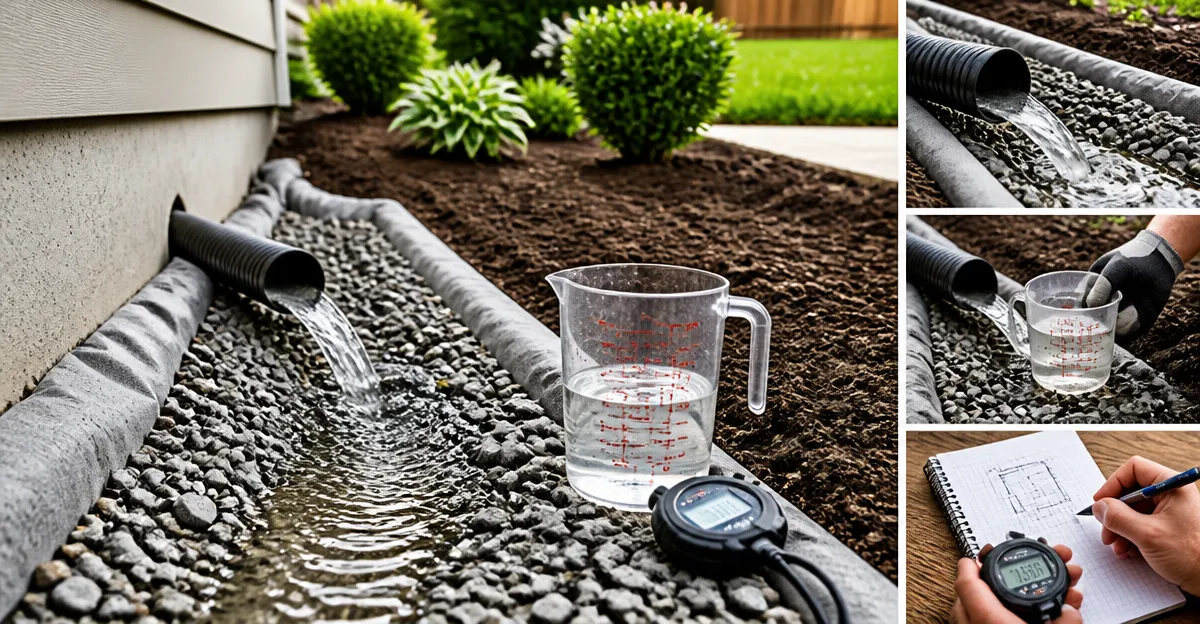
Position a 5‑gallon bucket directly beneath the outlet of the French drain to capture the discharged water for volume measurement. Place the bucket on a level surface to guarantee that the water depth is measured accurately, and use a level to confirm that the bucket is not tilted. For longer drain runs, connect the Geowaky Pond Hose to the outlet and run it to the bucket, allowing the hose’s flexible, kink‑proof design to navigate around obstacles without restricting flow. The hose’s smooth interior reduces friction, ensuring that the collected volume reflects the true capacity of the drain rather than losses caused by turbulent flow.
Step 3: Measure Baseline Flow Rate
With the collection basin ready, open the water source at a moderate, steady pressure and allow water to flow through the French drain for a brief stabilization period of 30 seconds. Start the stopwatch as soon as water begins to fill the bucket, and stop it when the bucket reaches a clearly marked volume, such as the 3‑gallon line on the container. Record the elapsed time in seconds; this raw data will be used to calculate the flow rate in gallons per minute (GPM). Repeat the measurement three times, resetting the bucket each time, and compute the average to reduce random error.
Step 4: Conduct a Controlled Flow Test
To assess the drain’s performance under varying conditions, repeat the measurement using two additional flow settings: a low‑flow setting (approximately 25 % of the source’s maximum output) and a high‑flow setting (near‑full pressure). Adjust the garden hose’s nozzle or use a flow‑control valve to achieve the desired settings, then follow the same timing procedure as in Step 3. Document each flow setting, the corresponding time, and the measured volume. Comparing these results reveals how the drain behaves under different loads, which is valuable for identifying bottlenecks that only appear at peak runoff.
Step 5: Record and Calculate Flow Capacity
Convert the collected data to flow rates using the formula: GPM = (Volume in gallons ÷ Time in minutes). For example, if the bucket collected 3 gallons in 45 seconds, the calculation is 3 ÷ (45 ÷ 60) ≈ 4 GPM. Summarize the results in a simple table that lists the flow setting, measured volume, time, and calculated GPM. Compare the observed GPM values to the design specifications of the French drain; a typical residential drain should handle at least 5‑10 GPM depending on slope and pipe diameter. If the measured capacity falls significantly below expectations, further investigation is required.
Tips & Pro Tips
- Perform the test on a dry day to avoid interference from natural rainfall, which can skew volume measurements.
- Use a clear, graduated container to improve visual accuracy when reading water levels.
- When connecting the Geowaky Pond Hose, ensure that the fittings are snug to prevent leaks that could lower the recorded volume.
- Record ambient temperature; PVC hoses expand slightly in higher temperatures, which can affect flow resistance.
- If the drain includes multiple outlets, test each outlet individually to identify localized blockages.
Troubleshooting
Low flow rate despite clean inlet. Check for hidden kinks in the hose or buried pipe; the corrugated design of the Geowaky hose resists kinking, but sharp bends can still restrict flow. Re‑route the hose using a gentler curve.
Inconsistent timing results. Ensure the stopwatch is started precisely when water first contacts the bucket. Using a digital timer with a split‑second display reduces human reaction error.
Water pooling at the outlet. This may indicate a clogged outlet or a sediment buildup in the drainage field. Flush the system with a high‑pressure jet or a mixture of water and mild detergent to dissolve accumulated particles.
Conclusion
By following the outlined steps, one can reliably test the flow capacity of a French drain, calculate accurate GPM values, and identify performance issues before they compromise property integrity. The use of a flexible, kink‑proof hose such as the Geowaky Pond Hose simplifies water collection and ensures that measurements reflect true system capability. Regular testing, especially after major storms or landscaping changes, helps maintain optimal drainage and protects foundations from water intrusion. Armed with this knowledge, homeowners can take proactive steps to keep their yards dry and structurally sound.
Products Mentioned in This Guide
Geowaky Pond Hose
Price: Not listed
Rating: Not listed
Features:
- 1‑inch inner diameter, 20 ft length – easy to cut to custom sizes.
- Durable, non‑toxic PVC; corrosion‑resistant from –5 °C to 60 °C.
- Corrugated design provides flexibility and kink resistance for easy installation.
- Smooth interior reduces friction, maximizing water flow.
- Suitable for ponds, waterfalls, irrigation, and French drain testing.
Frequently Asked Questions
How can I measure the flow rate of a French drain?
Collect water exiting the drain in a measured container while timing the collection with a stopwatch, then divide the volume by the elapsed time (gallons per minute).
What tools are required for testing French drain capacity?
You need a 5‑gallon bucket or graduated cylinder, a stopwatch or digital timer, a level, a measuring tape, and a water source with controllable flow.
How long should I run the test to get an accurate flow measurement?
Run the test for at least 30 seconds to a minute to allow steady flow, then record the volume collected during that period.
What flow rate indicates a properly functioning French drain?
A healthy French drain typically moves 5–10 gpm (gallons per minute) depending on pipe size and slope; rates significantly lower suggest blockage or design issues.
How do I troubleshoot a French drain that shows low flow during testing?
Inspect the inlet and outlet for debris, check for proper slope, and clear any sediment or roots; if flow remains low, verify pipe diameter and consider professional evaluation.