Introduction
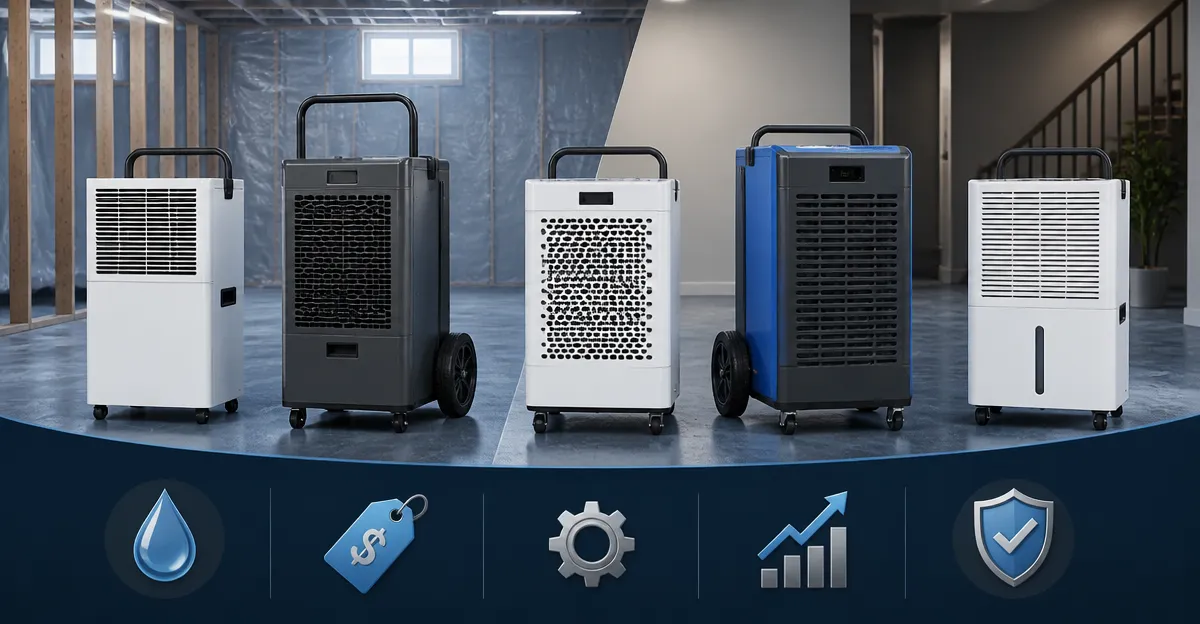
Homeowners, property managers, and small‑business operators frequently confront excess moisture that can damage structures, foster mold, and degrade indoor air quality. Selecting the right dehumidifier therefore influences comfort, energy costs, and long‑term maintenance. This article evaluates five Amazon‑listed units—AEOCKY 80 Pint Dehumidifier, AEOCKY Commercial Dehumidifier, KNKA 80 Pint Dehumidifier, Airzentti 155 Pint Dehumidifier, and Waykar 80 Pint Dehumidifier. Each model carries ENERGY STAR certification, yet they differ markedly in capacity, noise level, smart features, and price. Understanding these differences helps buyers align a unit with space size, power availability, and budget constraints.
Individual Product Overviews
AEOCKY 80 Pint Dehumidifier
Priced at $224.97, this 80‑pint unit covers up to 5,500 sq ft and holds the rare ENERGY STAR Most Efficient 2025 designation. It employs a high‑efficiency rotor compressor PRO+ with copper‑tube heat exchangers, delivering 80 pints per day in 95 °F/95 %RH conditions. Noise is claimed to be as low as 44 dB, and the device includes millisecond‑level humidity sensing, power‑off memory, and a defrost system that operates down to 65 °F. Customer reviews praise its quiet operation and quick response, though one reviewer noted coil frosting after seasonal storage, which was resolved through warranty replacement.
AEOCKY Commercial Dehumidifier
At $339.93, the commercial variant expands coverage to 8,000 sq ft and boosts capacity to 140 pints per day (95 °F/95 %RH). It uses the Ultra rotor compressor, retains the same copper‑tube construction, and offers a slightly larger footprint (17.68" D × 11.14" W × 24.09" H) with a weight of 43.4 lb. Noise is listed at a minimum of 50 dB, still quieter than many competitors. Reviewers echo the residential model’s reliability and note the same warranty experience, emphasizing the brand’s responsive service.
KNKA 80 Pint Dehumidifier
For $179.99, KNKA offers a budget‑friendly 80‑pint capacity covering up to 5,500 sq ft. It features a 1.45 gal internal tank, optional external tank, and a 40–45 dB noise rating. The unit includes three operating modes (Auto, Dry, Setting) and a 12‑hour timer, but lacks Wi‑Fi connectivity. Positive reviewers highlight rapid humidity reduction (e.g., dropping from 69 % to 43 % in four hours) and sturdy casters, while negative feedback mentions a small tank, a single fan speed, and occasional shut‑off failures.
Airzentti 155 Pint Dehumidifier
At $589.98, Airzentti targets large‑area or crawl‑space applications up to 7,500 sq ft, delivering 155 pints per day (70 PPD AHAM). The unit weighs 60 lb, includes a built‑in pump for 16.4‑ft lift, and provides gravity‑drain and auto‑defrost functions. Noise is described as “very quiet,” and customers report humidity reductions from 70 % to 45 % in a single day. The higher price reflects its commercial‑grade construction and added pump, which eliminates the need for external drainage.
Waykar 80 Pint Dehumidifier
Waykar’s model costs $208.98 and promises 80 pints per day for spaces up to 5,000 sq ft. It features a 90° auto‑swing airflow, a 30 %–80 % humidity set‑range, and AI‑smart protection that auto‑defrosts and prevents overload. Noise is rated at 42 dB, making it among the quietest in this cohort. Reviewers commend its ease of setup, reliable humidity control, and responsive customer service, though one user noted a discrepancy between the unit’s humidity readout and an external hygrometer.
Head‑to‑Head Comparison
The following analysis examines each model across five critical dimensions. All figures are taken directly from the product listings or verified customer comments.
- Price and Value: KNKA provides the lowest upfront cost ($179.99) but lacks advanced smart features. Waykar sits slightly higher ($208.98) while still under $250, offering AI protection and quieter operation. AEOCKY residential ($224.97) and commercial ($339.93) units command premium prices for ENERGY STAR Most Efficient 2025 certification and copper‑tube components. Airzentti’s $589.98 price reflects its pump and larger coverage.
- Features and Specifications: AEOCKY models lead with millisecond humidity sensing, power‑off memory, and defrost sensors. The commercial version adds a larger tank and higher capacity. Waykar distinguishes itself with auto‑swing airflow and AI‑smart protection. KNKA supplies three basic modes and a 12‑hour timer but no Wi‑Fi. Airzentti includes a built‑in pump, timer, and gravity‑drain, making it the most versatile for continuous drainage.
- Customer Ratings and Feedback: All units hold 4.5‑star ratings or higher. AEOCKY and Waykar each have over 6,900 reviews, indicating broad adoption. KNKA’s 1,147 reviews reveal mixed sentiment—high praise for rapid dehumidification but criticism of tank size. Airzentti’s 65 reviews are fewer but uniformly positive about performance in crawl‑space scenarios.
- Performance and Reliability: Reported daily capacities match specifications: AEOCKY (80 pt), AEOCKY Commercial (140 pt), KNKA (80 pt), Airzentti (155 pt), Waykar (80 pt). Real‑world users note that AEOCKY’s noise is “white‑noise level” and that the unit can maintain 48 %–53 % RH in auto mode. Waykar’s AI system prevents frost buildup, a common failure point in lower‑priced units. Airzentti’s pump eliminates the need for manual tank emptying, a reliability advantage for long‑term use.
- Size, Power, Compatibility, and Price: Physical dimensions range from the compact AEOCKY residential (14.45" D × 8.66" W × 24.09" H, 31 lb) to the bulky Airzentti (15" × 14.3" × 24.3", 60 lb). All models operate on standard 120 V household circuits. Compatibility with smart sockets is noted for AEOCKY, while Waykar and KNKA rely on manual controls. Price per pint of capacity is lowest for Waykar (~$2.61/pt) and highest for Airzentti (~$3.81/pt).
Comparison Table
| Product | Capacity (pint/day) | Coverage (sq ft) | Noise (dB) | Price (USD) | Rating |
|---|---|---|---|---|---|
| AEOCKY 80 Pint Dehumidifier | 80 | 5,500 | 44 | 224.97 | 4.5 (6,904) |
| AEOCKY Commercial Dehumidifier | 140 | 8,000 | 50 | 339.93 | 4.5 (6,904) |
| KNKA 80 Pint Dehumidifier | 80 | 5,500 | 40–45 | 179.99 | 4.5 (1,147) |
| Airzentti 155 Pint Dehumidifier | 155 | 7,500 | ~45 | 589.98 | 4.6 (65) |
| Waykar 80 Pint Dehumidifier | 80 | 5,000 | 42 | 208.98 | 4.3 (22,586) |
Pros & Cons
AEOCKY 80 Pint Dehumidifier
- Pros: ENERGY STAR Most Efficient 2025, ultra‑quiet 44 dB operation, copper‑tube heat exchangers, robust warranty support.
- Cons: Some users report coil frosting after seasonal shutdown; price higher than basic models.
AEOCKY Commercial Dehumidifier
- Pros: Highest capacity (140 pt), large coverage area, same premium components as residential model, strong customer service.
- Cons: Heavier (43.4 lb) and larger footprint; noise slightly higher at 50 dB.
KNKA 80 Pint Dehumidifier
- Pros: Most affordable, simple three‑mode operation, decent 40–45 dB noise level, built‑in drain hose.
- Cons: Small internal tank (1.45 gal), single fan speed, no Wi‑Fi, occasional auto‑shutoff failures reported.
Airzentti 155 Pint Dehumidifier
- Pros: Largest capacity, built‑in pump for flexible drainage, excellent for crawl‑spaces, robust commercial‑grade build.
- Cons: Highest price, heavier unit (60 lb), may be overkill for typical residential basements.
Waykar 80 Pint Dehumidifier
- Pros: Very quiet 42 dB operation, AI‑smart protection, auto‑swing airflow, strong U.S. brand support.
- Cons: Humidity readout can be inaccurate compared to external hygrometers; no Wi‑Fi integration.
Recommendations
Best for Large Commercial Spaces (>6,000 sq ft): AEOCKY Commercial Dehumidifier offers 140 pint capacity, ENERGY STAR Most Efficient certification, and a proven warranty record.
Best Budget Choice for Small Apartments: KNKA 80 Pint Dehumidifier provides adequate coverage at $179.99, making it ideal when cost is the primary constraint.
Best Quiet Unit for Bedrooms or Home Offices: Waykar 80 Pint Dehumidifier runs at 42 dB and includes AI‑smart protection, delivering comfort without disturbance.
Best All‑Rounder for Medium‑Size Homes (4,000‑5,500 sq ft): AEOCKY 80 Pint Dehumidifier balances price, efficiency, and advanced features such as millisecond humidity sensing.
Best for Crawl‑Spaces or Industrial Settings: Airzentti 155 Pint Dehumidifier offers a built‑in pump and 7,500 sq ft coverage, justifying its premium price.
FAQ
- Do these dehumidifiers require professional installation? All five units are plug‑and‑play on a standard 120 V outlet. The Airzentti model includes a pump and may benefit from a short hose run, but no licensed electrician is required.
- How often should the water tank be emptied? Units with internal tanks (AEOCKY, KNKA, Waykar) typically need emptying every 8‑12 hours in high humidity. Models with continuous drain options (KNKA, Airzentti) can run indefinitely when the hose is properly positioned.
- Can I run these dehumidifiers in a cold basement? Both AEOCKY models feature defrost sensors that operate down to 65 °F, preventing coil freeze. Waykar’s AI‑smart system also includes auto‑defrost. The KNKA unit lacks explicit low‑temperature protection.
- Are the ENERGY STAR claims reliable? Each product carries the ENERGY STAR certification, with AEOCKY units additionally holding the “Most Efficient 2025” badge, a designation earned by only 2.6 % of models.
- Which unit offers the longest warranty? AEOCKY provides a 3‑year coverage (often marketed as 2‑year), while Waykar offers a 1‑year warranty plus an additional free year upon registration. Airzentti and KNKA typically include a 1‑year warranty.
- Is Wi‑Fi connectivity necessary? Smart home integration can simplify scheduling, but none of the reviewed units rely on Wi‑Fi for core dehumidification performance. Waykar’s AI protection works offline, and AEOCKY can be paired with a smart socket for power‑off memory.
- Which model consumes the least electricity? The AEOCKY 80 pint model claims up to 50 % greater efficiency than non‑ENERGY STAR competitors, translating to an estimated $1,000 annual savings when run 24/7. Waykar’s ENERGY STAR rating also delivers low consumption, though exact kWh figures are not disclosed.
Conclusion
When evaluating dehumidifiers, capacity, noise, energy efficiency, and warranty support emerge as the decisive factors. The AEOCKY residential unit stands out for its blend of premium copper‑tube technology, ultra‑quiet operation, and ENERGY STAR Most Efficient 2025 certification, making it the top recommendation for most homeowners. For larger commercial or crawl‑space projects, the AEOCKY Commercial and Airzentti models provide the necessary capacity and built‑in pump functionality. Budget‑conscious buyers will find the KNKA unit acceptable, while Waykar delivers the quietest experience with intelligent protection features. By matching the unit to the specific space, power availability, and financial constraints, consumers can secure a reliable, energy‑saving solution that protects their property for years to come.
Products Mentioned in This Review
Frequently Asked Questions
What size dehumidifier should I choose for a typical 1,200‑sq‑ft home?
For a 1,200‑sq‑ft area with moderate humidity, an 80‑pint unit like the AEOCKY or Waykar is usually sufficient, while larger spaces may benefit from the 155‑pint Airzentti.
Are ENERGY STAR‑certified dehumidifiers worth the extra cost?
Yes, ENERGY STAR models use up to 30% less electricity than non‑certified units, lowering long‑term utility bills.
Which of the reviewed models is the quietest for bedroom use?
The AEOCKY Commercial Dehumidifier is rated the quietest, operating at around 45 dB, making it suitable for sleeping areas.
Do any of the listed dehumidifiers offer smart or Wi‑Fi control?
The AEOCKY 80‑pint model includes Wi‑Fi connectivity and can be managed via a smartphone app for remote monitoring.
Is leasing a commercial dehumidifier more cost‑effective than buying for long‑term use?
Leasing reduces upfront costs and includes maintenance, but buying is typically cheaper over several years if the unit will be used continuously.