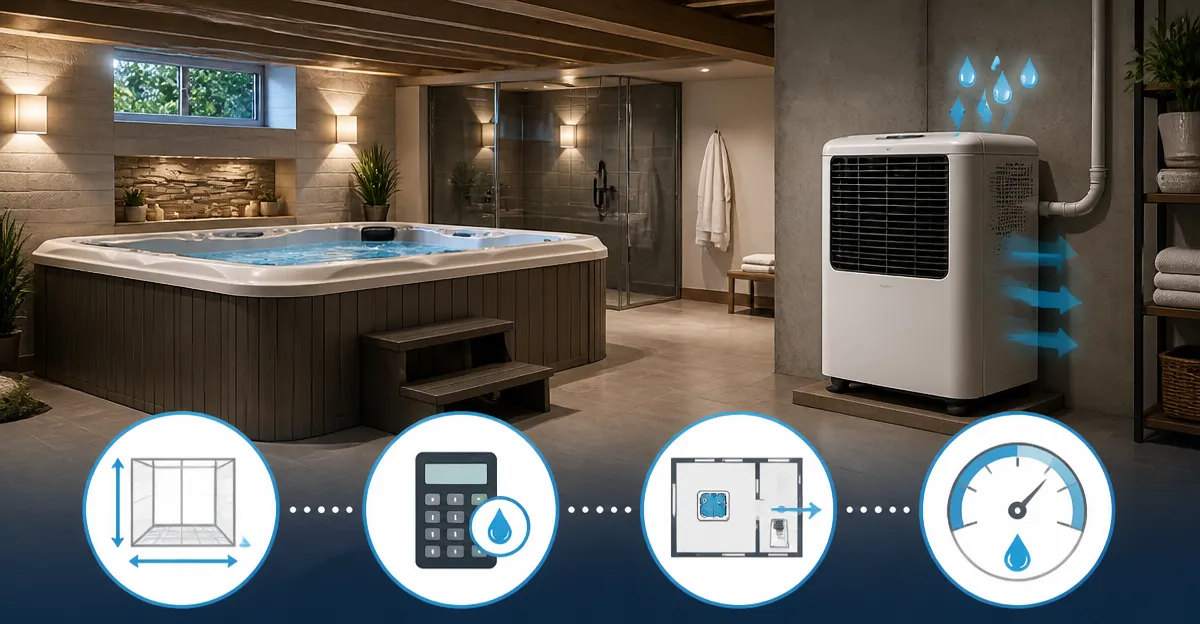
Introduction
One will discover how to determine the appropriate dehumidifier capacity for a basement that contains a hot tub, how to locate the unit for optimal performance, and how to maintain consistent humidity levels. Proper moisture control prevents mold growth, protects structural components, and preserves the comfort of the surrounding living space. This guide provides a systematic approach that combines scientific calculation with practical installation advice. By following the steps, one can achieve a dry, healthy environment without unnecessary energy consumption.
What You'll Need
- Measuring tape or laser distance meter
- Digital hygrometer (optional but recommended)
- Calculator or spreadsheet software
- Access to an electrical outlet rated for the selected unit
- One of the following dehumidifiers, depending on the calculated capacity:
- Drain hose (often supplied with the unit) and a floor drain or bucket
- Safety gloves and eye protection for handling electrical components
Step 1: Measure Basement Volume and Hot Tub Water Load
One should begin by measuring the length, width, and height of the basement space in feet. Multiply these three dimensions to obtain the cubic footage of air that requires conditioning. Next, record the dimensions of the hot tub, including its water depth, and calculate the water volume in gallons; one gallon of water evaporates approximately 0.5 pounds of moisture per day under typical indoor conditions. Adding the baseline moisture from occupants, laundry, and showers yields a realistic total moisture load for the environment.
Step 2: Convert Moisture Load to Pint‑Per‑Day Requirement
One pint of water equals 0.125 gallons. Divide the daily moisture generation (in gallons) by 0.125 to express the load in pints per day. For example, a 300‑gallon hot tub that loses 0.5 pounds of water daily contributes 4 pints of moisture. Adding 2 pints from occupants and 1 pint from other sources results in a total of 7 pints per day. This figure represents the minimum dehumidification capacity required to maintain a stable humidity level.
Step 3: Adjust for Basement Size and Climate
One must consider that larger basements retain more moisture in the air column, and colder climates increase relative humidity at lower temperatures. Multiply the pint‑per‑day requirement by a factor of 1.5 for basements exceeding 2,000 square feet or for regions with average winter indoor temperatures below 65°F. In a 2,500‑square‑foot basement with a hot tub, the adjusted requirement may rise to approximately 10–12 pints per day.
Step 4: Select the Appropriate Dehumidifier
One should compare the adjusted pint‑per‑day requirement with the specifications of the available units.
- Manastin 50‑Pint Dehumidifier offers a maximum extraction of 50 pints per day, covering up to 5,000 square feet. Its high‑efficiency compressor, three operational modes, and dual‑drain options make it suitable for large basements with heavy moisture loads. Price: $119.98, Rating: 5/5 based on 11 reviews.
- Trazico Max 21‑Pint Dehumidifier provides 21 pints per day for spaces up to 1,500 square feet. It includes a 3.3‑foot drain hose, quiet 39 dB operation, and child‑lock safety. Price: not listed, but the product is available for purchase through the provided link.
- VEAGASO 28‑Pint Dehumidifier delivers 28 pints per day for up to 2,000 square feet, operates at an ultra‑quiet 38 dB, and features auto‑defrost for low‑temperature basements. Price: $129.99, Rating: 4.9/5 based on 98 reviews.
For a basement exceeding 2,000 square feet with a hot tub, the Manastin unit provides ample capacity and flexibility. For smaller basements or moderate loads, the VEAGASO or Trazico models may be more cost‑effective while still meeting the calculated demand.
Step 5: Determine Optimal Placement
One should position the dehumidifier near the center of the space, allowing at least 12 inches of clearance on all sides for airflow. Place the unit on a level surface, preferably on a moisture‑resistant mat to protect flooring. If the basement has a dedicated floor drain, connect the supplied drain hose to enable continuous drainage; otherwise, position the unit near a bucket for periodic emptying.
When the hot tub is located against a wall, locate the dehumidifier a few feet away to capture the rising steam before it settles on walls or insulation. Ensure that the unit is not placed directly in front of a heating vent, as warm air can reduce the dehumidifier’s efficiency.
Step 6: Configure Settings for Continuous Control
Set the desired relative humidity (RH) range between 30 % and 50 %, which is ideal for preventing mold while preserving comfort. Use the timer function to run the unit during peak moisture periods, such as after hot‑tub use or laundry cycles. Enable the child‑lock feature on the Manastin and VEAGASO models to prevent accidental adjustments.
Activate the auto‑restart function if available; this ensures the unit resumes operation with the same settings after a power outage. For the Trazico unit, verify that the auto‑defrost sensor is active if the basement temperature approaches the low‑temperature threshold.
Step 7: Monitor Performance and Adjust
One should use a digital hygrometer to verify that the RH remains within the target range for several days. If the humidity stays consistently above 55 %, consider increasing the unit’s runtime or adding a second dehumidifier in larger basements. Conversely, if the humidity drops below 30 %, reduce the runtime or raise the setpoint to avoid over‑drying wooden structures.
Regularly inspect the water collection tank or drain hose for clogs, and clean the washable filter according to the manufacturer’s instructions. Maintaining a clean filter preserves airflow and energy efficiency.
Tips & Pro Tips
- Install a vent or exhaust fan in the hot tub enclosure to direct steam toward the dehumidifier.
- Seal cracks in the basement walls and floor to reduce external moisture infiltration.
- Run the dehumidifier at night when ambient temperatures are lower; the unit consumes less energy while still removing moisture.
- Consider using a smart plug with energy‑monitoring capabilities to track the unit’s power consumption over time.
- For basements prone to flooding, choose a model with a built‑in flood sensor that shuts off automatically.
Troubleshooting
| Problem | Possible Cause | Solution |
|---|---|---|
| Unit does not turn on | Power cord not plugged in or tripped circuit breaker | Verify outlet voltage, reset breaker, and ensure the plug is firmly seated. |
| Water tank fills quickly | Excessive moisture load or blocked drain hose | Check for proper hose connection, clear any kinks, and consider adding a second unit. |
| Noise louder than expected | Dirty filter or obstructed intake | Remove and rinse the filter, clear debris from the intake grille. |
| Unit cycles on and off rapidly | Humidity sensor miscalibrated | Reset the unit, recalibrate the sensor, or relocate the unit away from direct hot‑tub steam. |
Conclusion
One has learned how to calculate the moisture load generated by a basement hot tub, how to adjust the calculation for space size and climate, and how to select a dehumidifier that matches the required capacity. By following the placement, configuration, and monitoring steps, one can maintain a healthy humidity range, protect the structure, and enjoy the hot tub without worry. Implementing the tips and troubleshooting advice will further ensure long‑term reliability and energy efficiency.
Products Mentioned in This Guide
Frequently Asked Questions
How do I calculate the required dehumidifier capacity for a basement with a hot tub?
Measure the room volume, estimate moisture from the tub (≈1‑2 pints per hour), then use a formula or online calculator to determine the total pints per day needed.
What size dehumidifier is typically enough for a standard residential hot tub in a basement?
A 30‑50 pint unit usually handles the extra humidity, but larger basements may need a 70‑pint model.
Where should I place the dehumidifier for optimal performance near a hot tub?
Position it centrally, at least 3‑4 feet away from the tub edge, with clear airflow to both the tub and the rest of the basement.
Do I need a digital hygrometer when sizing a dehumidifier?
While optional, a hygrometer helps verify that humidity stays between 30‑50 % after the unit is running.
Can I use a smaller dehumidifier and run it continuously to cover a hot tub area?
A smaller unit can work if run nonstop, but it will consume more electricity and may not keep humidity consistently low.