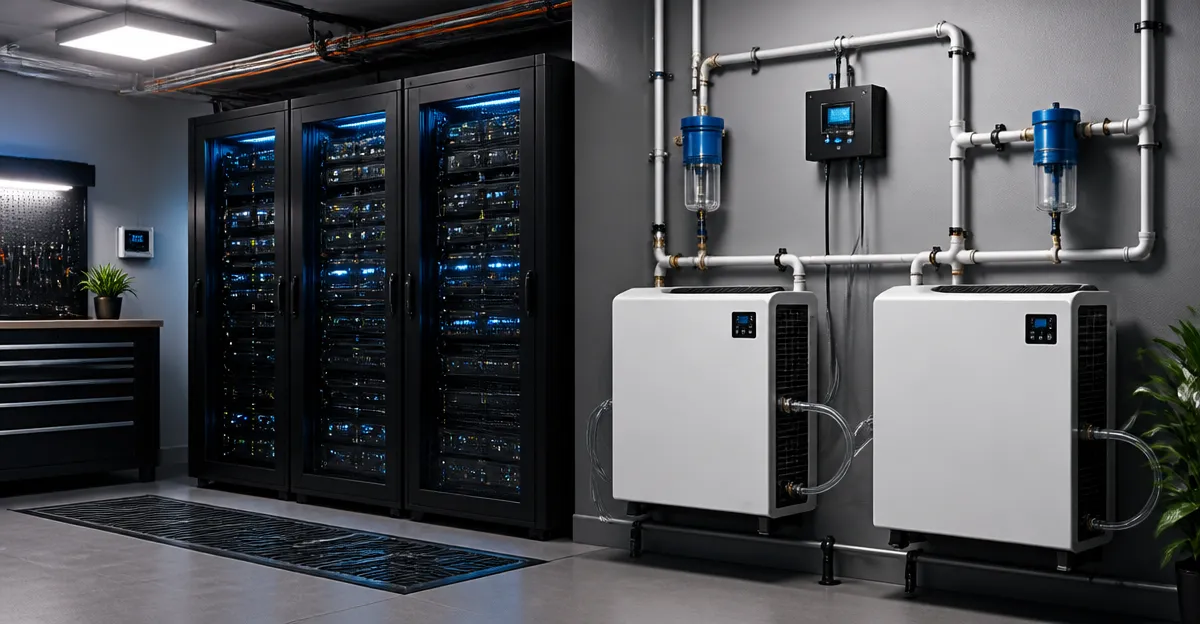
Redundant Dehumidifier System Design for Home Server Rooms: Complete Step‑by‑Step Guide to Reliable Humidity Control
Introduction
Maintaining optimal humidity in a home server room is essential for equipment longevity and data integrity. This guide explains the principles of humidity control, outlines a systematic design process, and recommends specific Amazon products that enhance reliability. Readers will learn how to assess environmental requirements, select appropriate dehumidifiers, implement redundancy, and monitor performance over time. By the end of the guide, one will be equipped to construct a robust system that prevents moisture‑induced failures.
Background and Context
Electronic components are vulnerable to both excessive moisture and overly dry conditions. High humidity can cause condensation on circuit boards, leading to short circuits, while low humidity increases static electricity risk. The ideal relative humidity (RH) for most server equipment lies between 45 % and 55 % at temperatures of 68 °F to 77 °F. Understanding these parameters provides the foundation for selecting dehumidification capacity and control logic.
Two technologies dominate the consumer dehumidifier market: compressor‑based units and thermoelectric (Peltier) units. Compressor models achieve higher removal rates and are suitable for large spaces, whereas Peltier units are quieter, lighter, and excel in confined areas. Both types can be integrated with external sensors and smart plugs to create a layered control strategy.
Redundancy in humidity control mirrors the redundancy principles used for power and networking. By employing at least two independent dehumidifiers, the system tolerates a single‑device failure without allowing RH to exceed safe thresholds. Redundant design also permits maintenance without service interruption.
System Architecture Overview
The recommended architecture consists of three layers: sensing, control, and actuation. Sensors continuously report temperature and RH to a central controller, which evaluates the data against predefined set points. The controller then activates one or both dehumidifiers based on current load and redundancy rules. Alerts are dispatched via email or mobile notification when thresholds are approached.
Key components include:
- High‑accuracy digital hygrometer (±2 % RH)
- Smart power strips capable of remote on/off commands
- Two dehumidifiers with complementary capacities
- Uninterruptible Power Supply (UPS) for continuous operation
Each component should be selected for reliability, ease of integration, and low maintenance overhead.
Choosing the Right Dehumidifiers
When selecting devices for a redundant configuration, one should balance capacity, noise, energy consumption, and physical footprint. The following products are well‑suited for typical home server rooms ranging from 100 sq ft to 250 sq ft.
Primary Recommendation: Tenergy Sorbi Mini Dehumidifier
The Tenergy Sorbi Mini Dehumidifier employs Peltier technology and a true HEPA filter, removing up to 750 ml of moisture per day in 80 % RH environments at 86 °F. Its 1‑liter removable water tank and ultra‑quiet operation (35‑42 dB) make it ideal for enclosed server closets where acoustic disturbance must be minimal. The unit weighs only 7 lb, allowing flexible placement, and includes an auto‑shutoff and water‑level sensor for safety. With a rating of 4.4 / 5.0 from 2,952 reviews and a price of $89.99, it offers a cost‑effective primary line of defense.
Secondary Recommendation: AEOCKY 105 Pint Dehumidifier
The AEOCKY 105 Pint Dehumidifier is a compressor‑based unit certified as ENERGY STAR Most Efficient 2024. It can extract up to 105 pints (≈4.9 L) of water per day in extreme summer conditions (95 °F, 95 % RH), providing ample capacity for larger server rooms or basements. Advanced features include an intelligent humidistat, drain hose option, and a high‑efficiency rotor compressor that reduces energy usage by up to 50 % compared with non‑certified models. Priced at $265.96 and holding a 4.4 / 5.0 rating from 5,604 reviewers, it serves as a robust backup that can sustain humidity control during peak loads or primary unit maintenance.
Both devices support plug‑and‑play operation, allowing integration with smart power strips for automated redundancy management.
Step‑by‑Step Design Process
- Assess Room Volume and Target RH – Measure the cubic footage of the server enclosure and calculate the moisture load based on typical ambient conditions. Use the formula: Moisture Load (L) = Volume × (Current RH – Desired RH) × 0.0012 to estimate daily removal needs.
- Select Primary and Backup Units – Choose a primary unit that can handle at least 60 % of the calculated load. The secondary unit should exceed the remaining load by a safety margin of 20 %.
- Install Sensors – Place a calibrated hygrometer at the center of the rack, away from direct airflow. Connect the sensor to a home automation hub such as Home Assistant or a simple Raspberry Pi running a monitoring script.
- Configure Control Logic – Program the hub to activate the primary dehumidifier when RH rises above 55 %. If RH exceeds 60 % or the primary unit fails to reduce humidity within 15 minutes, the hub should power on the secondary unit.
- Integrate Power Redundancy – Connect both dehumidifiers to a UPS with sufficient capacity for at least 30 minutes of operation. Ensure the UPS provides surge protection and battery health monitoring.
- Test Failure Scenarios – Simulate a primary unit failure by disconnecting it and verify that the secondary unit engages automatically and maintains RH within the target range.
- Document and Schedule Maintenance – Record device serial numbers, firmware versions, and maintenance dates. Schedule monthly tank emptying for the Sorbi and quarterly filter replacement for optimal performance.
Comparison and Selection Guide
| Feature | Tenergy Sorbi Mini | AEOCKY 105 Pint |
|---|---|---|
| Technology | Peltier (thermoelectric) | Compressor with high‑efficiency rotor |
| Daily Removal Capacity | 0.75 L (750 ml) | 4.9 L (105 pints) |
| Noise Level | 35‑42 dB (ultra‑quiet) | ~50‑55 dB (moderate) |
| Power Consumption | ≈30 W | ≈150 W (ENERGY STAR Most Efficient) |
| Water Tank Size | 1 L removable | Continuous drain option |
| Price | $89.99 | $265.96 |
| Rating (Reviews) | 4.4 / 5.0 (2,952) | 4.4 / 5.0 (5,604) |
For small closets or cabinets where space and noise are critical, the Tenergy Sorbi Mini provides sufficient capacity and silent operation. For larger basements or rooms exceeding 200 sq ft, the AEOCKY 105 Pint offers the necessary throughput and energy‑saving certification. Combining both devices yields a tiered approach: the Sorbi handles routine moisture while the AEOCKY activates during extreme humidity spikes.
Best Practices and Tips
- Place Units Strategically – Position the primary dehumidifier near the intake of the server rack and the backup unit near the exhaust path to promote uniform air circulation.
- Seal the Enclosure – Use weather‑stripping or foam tape around door frames to prevent external humid air from infiltrating the room.
- Monitor Energy Usage – Track watt‑hour consumption via a smart plug; this data helps verify ENERGY STAR claims and identify abnormal power draw.
- Maintain Filters – Replace the HEPA filter in the Sorbi Mini every six months to sustain air‑cleaning performance and prevent microbial growth.
- Utilize Drainage Options – For the AEOCKY unit, connect the supplied drain hose to a floor drain or a condensate pump to eliminate manual tank emptying.
- Implement Alerts – Configure email or SMS notifications for RH breaches, power loss, or filter‑change reminders to ensure rapid response.
- Document Environmental Baselines – Record average temperature and RH over a month to fine‑tune set points and reduce unnecessary cycling.
Frequently Asked Questions
- 1. Why is redundancy necessary for dehumidification?
- Redundancy ensures continuous humidity control when one device fails, preventing moisture‑related damage to sensitive server components.
- 2. Can a Peltier dehumidifier handle a large basement?
- Peltier units are best suited for spaces up to 200 sq ft. For larger areas, a compressor‑based model such as the AEOCKY 105 Pint provides the required capacity.
- 3. How often should the water tank be emptied?
- The Sorbi Mini’s 1 L tank typically requires emptying every 24 hours under normal humidity; however, continuous monitoring will indicate the exact interval.
- 4. Does the ENERGY STAR Most Efficient label guarantee lower electricity bills?
- Yes, the label indicates that the unit meets stringent efficiency standards, often delivering up to 50 % energy savings compared with non‑certified models.
- 5. What is the ideal RH set point for server equipment?
- Most manufacturers recommend maintaining RH between 45 % and 55 % to balance condensation risk and static discharge.
- 6. Can I integrate these dehumidifiers with Home Assistant?
- Both units operate via standard AC power and can be controlled through smart plugs that are compatible with Home Assistant, enabling automated redundancy logic.
- 7. Is a UPS required for dehumidifiers?
- A UPS provides backup power during outages, ensuring that humidity control does not cease abruptly, which could otherwise lead to rapid condensation.
Conclusion
Designing a redundant dehumidifier system for a home server room combines environmental science with practical engineering. By assessing room requirements, selecting complementary devices such as the Tenergy Sorbi Mini and the AEOCKY 105 Pint, and implementing automated control logic, one can achieve reliable humidity regulation. Ongoing monitoring, regular maintenance, and adherence to best practices will extend equipment lifespan and protect valuable data.
Products Featured in This Guide
Tenergy Sorbi Mini Dehumidifier
Price: $89.99
Rating: 4.4/5.0 (2,952 reviews)
Featured because it provides quiet, low‑capacity dehumidification ideal for small server closets and includes a true HEPA filter for air cleaning.
AEOCKY 105 Pint Dehumidifier
Price: $265.96
Rating: 4.4/5.0 (5,604 reviews)
Featured because it delivers high‑capacity, ENERGY STAR Most Efficient performance suitable for larger server rooms and serves as a reliable backup unit.