How to Size Solar Panels and Battery Backups for Sump Pumps: Step‑by‑Step Guide to Calculate Capacity, Run Time & Costs
Introduction
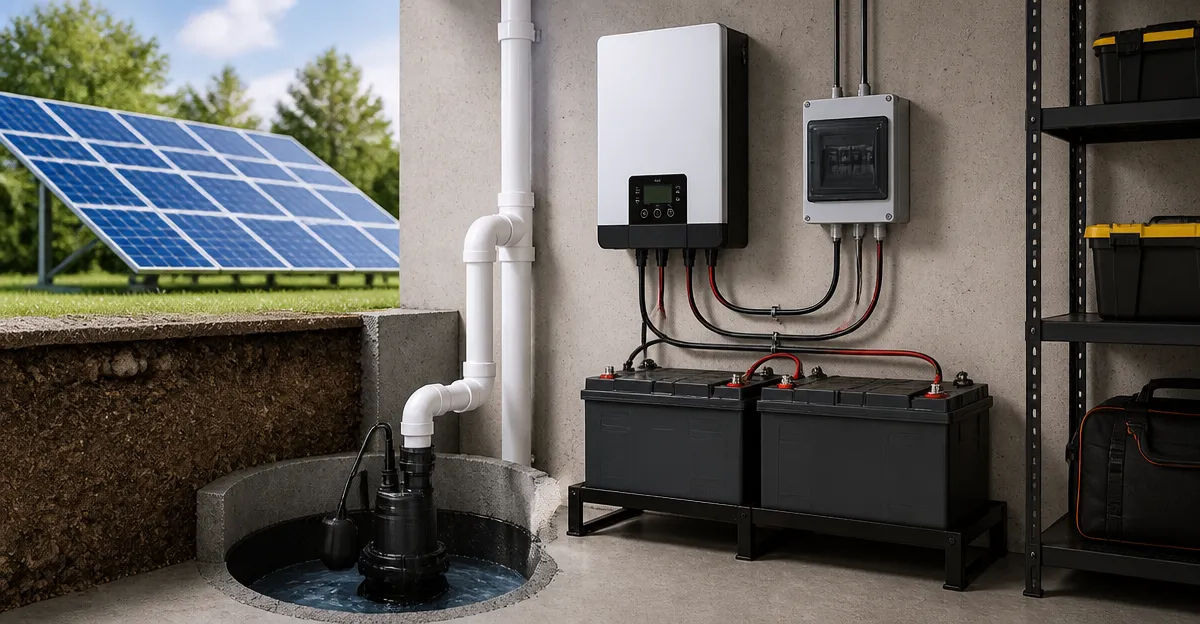
Homeowners who rely on sump pumps to protect basements from flooding often wonder how to keep those pumps operational during power outages. This guide explains how to size solar panels and battery backups so that a sump pump can run reliably when the utility grid is unavailable. Readers will learn how to calculate energy demand, select appropriate solar modules, choose battery capacity, compare popular pump models and implement best practices for long‑term resilience.
The information presented is based on real product specifications, user reviews and engineering principles. By following the step‑by‑step methodology, one can design a system that balances cost, performance and durability.
Background and Context
Sump pumps are electric devices that move water from a basement pit to a drainage location. Most residential pumps operate on standard 120 V AC power and consume between 300 W and 900 W depending on motor size. During severe storms, power utilities may experience outages, leaving the pump without energy just when it is needed most.
Solar photovoltaic (PV) panels convert sunlight into direct current (DC) electricity, which can be stored in batteries for later use. When paired with an inverter or a pump that accepts DC input, the solar system can provide continuous operation even in the absence of grid power.
Key concepts that underpin system sizing include:
- Average pump power draw (watts)
- Required run time during a storm event (hours)
- Solar irradiance in the installation region (kWh/m²/day)
- Panel efficiency and derating factors
- Battery depth‑of‑discharge and round‑trip efficiency
Understanding these variables enables accurate calculation of the required panel wattage and battery amp‑hour (Ah) capacity.
Calculating Solar Panel Requirements
The first step is to determine the pump’s daily energy consumption. Multiply the pump’s power rating by the expected maximum run time. For example, a 1/2 HP pump such as the Wayne CDU790 consumes approximately 400 W and may need to run for six hours during a heavy rain event, resulting in 2.4 kWh of energy demand.
Next, estimate the average solar insolation for the location. In many parts of the United States, a realistic value is 4.5 kWh/m²/day. Divide the daily energy demand by the insolation value to obtain the required panel capacity, then apply a derating factor of 0.8 to account for temperature losses, wiring and inverter inefficiency.
Using the example above, the calculation is as follows:
Required panel capacity = (2.4 kWh ÷ 4.5 kWh/m²/day) ÷ 0.8 ≈ 0.67 kW
Therefore, a solar array of roughly 700 W will meet the demand. Selecting two 350 W panels or a single 400 W panel with a modest safety margin is advisable.
When the pump operates at a higher power level, such as the 1 HP Wayne CDU800 (approximately 750 W), the required panel size increases proportionally. Always round up to the next commercially available panel rating.
Calculating Battery Backup Capacity
Battery capacity must cover the pump’s energy consumption for the duration of the longest anticipated outage. The same 2.4 kWh demand used in the panel calculation can be used here. Select a battery chemistry, such as lithium‑iron‑phosphate (LiFePO₄), that offers high cycle life and a usable depth‑of‑discharge (DoD) of at least 80 %.
Divide the required energy by the product of battery voltage and usable DoD to obtain the amp‑hour rating. For a 12 V system:
Required Ah = 2.4 kWh ÷ (12 V × 0.8) ≈ 250 Ah
A 12 V, 250 Ah lithium battery will provide the necessary autonomy with a safety margin. If a lead‑acid battery is preferred, use a DoD of 50 % and increase the Ah rating accordingly, which will raise the cost and weight.
It is also prudent to size the battery for at least two days of autonomy in regions prone to prolonged storms. This doubles the required Ah and ensures the pump remains operational even if solar generation is temporarily reduced by cloud cover.
Product Recommendations for Solar‑Ready Sump Pumps
While any standard sump pump can be powered by a solar‑battery system, certain models offer features that simplify integration and improve reliability.
- Wayne CDU790 – This 1/3 HP pump delivers up to 4,600 GPH, features a vertical float switch and a top‑suction design that reduces clogging. It is rated 4.7/5.0 by 2,313 reviewers and is priced at $137.08. Its moderate power draw makes it an excellent match for a 500‑W solar array.
- Zoeller M53 – A rugged 1/3 HP unit with a non‑clogging vortex impeller and cast‑iron housing. Users rate it 4.6/5.0 (3,261 reviews) and it costs $215.54. Its durability is ideal for installations where maintenance access is limited.
- Wayne CDU800 – A 1/2 HP pump capable of 5,100 GPH, priced at $158.78 with a 4.8/5.0 rating (1,299 reviews). The higher flow rate suits larger basements, and the tested vertical float switch is rated for one million cycles.
- Wayne CDU980E – This 3/4 HP model moves up to 5,490 GPH and carries a 4.6/5.0 rating (3,476 reviews) at $211.78. Its heavy‑duty construction is appropriate for high‑risk flood zones.
- LANCHEZ 1.6HP – Although marketed as a utility pump, its 1.6 HP motor and stainless‑steel body provide 6,000 GPH at a price of $84.78. The lower price point makes it attractive for users who need extra capacity without a large budget.
Each of these pumps can be paired with a solar array and battery bank sized according to the calculations above. Selecting a pump with a lower power draw reduces the required solar and battery investment, while a higher‑capacity pump may be justified for larger flood‑prone areas.
Comparison and Selection Guide
| Model | Motor Power | Max Flow (GPH) | Price (USD) | Rating | Best Use Case |
|---|---|---|---|---|---|
| Wayne CDU790 | 1/3 HP | 4,600 | $137.08 | 4.7/5 (2,313) | Standard basements, moderate flow needs |
| Zoeller M53 | 1/3 HP | ~4,500 | $215.54 | 4.6/5 (3,261) | Harsh environments, longevity focus |
| Wayne CDU800 | 1/2 HP | 5,100 | $158.78 | 4.8/5 (1,299) | Large basements, higher flow demand |
| Wayne CDU980E | 3/4 HP | 5,490 | $211.78 | 4.6/5 (3,476) | High‑risk flood zones, maximum capacity |
| LANCHEZ 1.6HP | 1.6 HP | 6,000 | $84.78 | 4.2/5 (707) | Budget‑focused projects, utility‑style applications |
When choosing a pump, consider the following criteria:
- Required flow rate based on pit size and anticipated water volume.
- Power consumption relative to the solar‑battery budget.
- Durability features such as cast‑iron housing, epoxy coating and float‑switch reliability.
- User feedback regarding noise level and ease of installation.
For most homeowners, the Wayne CDU790 offers the best balance of cost, performance and ease of integration with a modest solar array. Users with larger basements or higher flood risk may prefer the Wayne CDU800 or Wayne CDU980E despite the higher power draw.
Best Practices and Tips
- Install the solar panels on a south‑facing roof or a ground‑mount structure with a tilt angle equal to the local latitude for optimal annual production.
- Use a charge controller with MPPT (Maximum Power Point Tracking) technology to maximize energy harvest from the panels.
- Place the battery bank in a temperature‑controlled environment; extreme cold reduces capacity, while excessive heat shortens lifespan.
- Include a manual override switch on the pump so that it can be operated during maintenance or when the battery is depleted.
- Periodically inspect the float switch and suction inlet for debris; a clogged inlet increases motor load and reduces efficiency.
- Document the system’s wiring diagram and keep spare fuses and connectors on hand to reduce downtime during storms.
By following these recommendations, one can achieve a resilient, low‑maintenance solution that protects the home while reducing dependence on the utility grid.
Frequently Asked Questions
- What size solar array is needed for a 1/2 HP pump?
- A 1/2 HP pump typically consumes 750 W. Assuming six hours of operation and 4.5 kWh/m²/day of solar insolation, a 1.1 kW array (approximately three 350 W panels) provides sufficient energy.
- How many days of battery backup should I plan for?
- Most experts recommend at least two days of autonomy for regions that experience prolonged storms. This ensures continuous pump operation even when solar generation is temporarily reduced.
- Can I use a standard inverter with my pump?
- Yes, a pure‑sine‑wave inverter rated for at least 1.5 times the pump’s maximum power draw will protect the motor and provide reliable operation.
- Is a lithium battery always better than lead‑acid?
- Lithium batteries offer higher usable depth‑of‑discharge, longer cycle life and lighter weight, but they carry a higher upfront cost. Lead‑acid batteries are cheaper but require deeper sizing due to lower usable DoD.
- Do I need a separate float switch for the solar system?
- The pump’s built‑in float switch controls water‑level activation. The solar system only supplies power; no additional float switch is required.
- What maintenance does the pump require?
- Regularly clean the suction inlet, check the float switch for free movement, and verify that the discharge pipe remains clear of obstructions.
- Can I expand the solar array later?
- Yes, if the charge controller and inverter are sized with headroom, additional panels can be added to increase generation capacity.
Conclusion
Designing a solar‑powered backup for a sump pump involves understanding the pump’s energy demand, translating that demand into panel wattage and battery amp‑hour requirements, and selecting a pump that aligns with budget and performance goals. By applying the calculations provided, choosing a reliable pump such as the Wayne CDU790 or the higher‑capacity Wayne CDU800, and following best‑practice installation guidelines, homeowners can achieve a resilient, cost‑effective solution that protects their basements from flooding even during power outages.
Products Featured in This Guide
Wayne CDU790
Price: $137.08 | Rating: 4.7/5 (2,313 reviews)
Featured for its moderate power draw, 4,600 GPH flow rate and reliable vertical float switch, making it well‑suited for modest solar‑battery installations.
Zoeller M53
Price: $215.54 | Rating: 4.6/5 (3,261 reviews)
Featured for its robust cast‑iron construction, non‑clogging vortex impeller and reputation for long‑term durability in demanding environments.
Wayne CDU800
Price: $158.78 | Rating: 4.8/5 (1,299 reviews)
Featured for its 1/2 HP motor, 5,100 GPH capacity and tested vertical float switch rated for one million cycles, ideal for larger basements.
Wayne CDU980E
Price: $211.78 | Rating: 4.6/5 (3,476 reviews)
Featured for its 3/4 HP motor delivering 5,490 GPH, heavy‑duty cast‑iron and stainless‑steel construction, and integrated vertical float switch.
LANCHEZ 1.6HP
Price: $84.78 | Rating: 4.2/5 (707 reviews)
Featured for its high 1.6 HP motor, 6,000 GPH flow and stainless‑steel body, offering a budget‑friendly high‑capacity option for utility‑style applications.