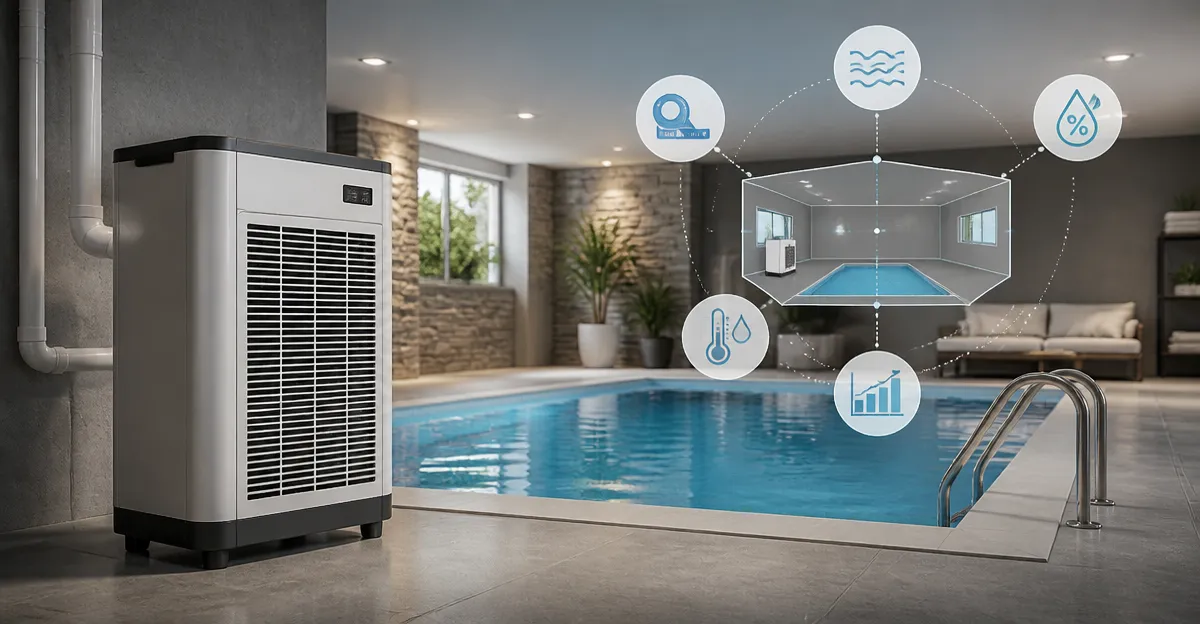
How to Size a Dehumidifier for an Indoor Pool Basement: Complete Guide to Capacity, Placement & Moisture Control
Introduction
Indoor pool basements present a unique humidity challenge that can affect structural integrity, comfort, and health. This guide explains how to assess moisture generation, calculate required dehumidification capacity, and select an appropriate unit. Readers will learn practical strategies for optimal placement, energy efficiency, and smart integration. By the end of the article one will be equipped to make an informed purchase decision.
Background and Context
When water evaporates from a pool surface it increases indoor relative humidity, often exceeding 70 percent in confined spaces. High humidity can lead to mold growth, condensation on walls, and corrosion of metal components. Understanding the relationship between temperature, relative humidity, and water vapor pressure is essential for accurate sizing. The following sections provide the scientific foundation needed for precise calculations.
Understanding Dehumidifier Capacity
Dehumidifier capacity is expressed in pints of water removed per 24‑hour period under standardized conditions. The industry standard assumes a temperature of 80°F and 60 % relative humidity, although real‑world conditions may differ. Capacity ratings such as "32 pint" indicate the maximum moisture extraction under ideal circumstances. Selecting a unit with a capacity that exceeds the calculated load ensures reliable performance.
For indoor pool basements the moisture load is often several times higher than in typical residential rooms. The pool surface area, water temperature, ventilation rate, and ambient climate all contribute to the total load. A common rule of thumb suggests that each 1,000 sq ft of pool surface generates approximately 10 pints of moisture per day at 80°F. However, precise calculations provide a more accurate requirement.
Modern dehumidifiers incorporate smart features such as Wi‑Fi connectivity, allowing remote monitoring and adjustment. The hOmeLabs Dehumidifier offers up to 32 pints per day at 80°F and up to 80 pints at 95°F, making it suitable for larger basements. Its quiet operation and auto shut‑off enhance user convenience while maintaining energy efficiency.
When evaluating capacity, also consider the unit's energy consumption measured in watts or kilowatt‑hours. High efficiency models provide greater moisture removal per unit of electricity, reducing operational costs over time. Look for Energy Star certification or manufacturer claims of low power draw.
Calculating Moisture Load for an Indoor Pool Basement
The first step in sizing is to determine the pool surface area in square feet. Multiply the length by the width, and if the pool has a non‑rectangular shape, approximate using geometric formulas. For example, a 20 ft × 40 ft rectangular pool has a surface area of 800 sq ft.
Next, calculate the evaporation rate using the formula: Evaporation (pints/day) = Surface Area (sq ft) × Evaporation Factor. The evaporation factor varies with water temperature, air temperature, and relative humidity. A typical factor for a heated indoor pool is 0.03 pints per sq ft per day at moderate conditions.
Applying the factor to an 800 sq ft pool yields 24 pints of moisture per day. If the basement also experiences additional sources such as showers, humidity from the pool house, or inadequate ventilation, add a safety margin of 20‑30 percent. This results in an estimated load of approximately 30 pints per day.
Finally, compare the calculated load to the dehumidifier’s rated capacity at the expected operating temperature. If the basement temperature is likely to reach 90°F during summer, the hOmeLabs Dehumidifier can remove up to 80 pints, comfortably covering the required 30 pints with ample headroom for peak humidity spikes.
Placement and Airflow Considerations
Effective dehumidification depends on proper unit placement to ensure uniform air circulation. Position the dehumidifier near the center of the basement, away from walls and obstructions, to promote even distribution of dry air. Maintain a clearance of at least 12 inches on all sides for optimal airflow.
Install the unit at a height of 3‑5 feet above the floor, where the majority of humid air accumulates. Avoid placing the device directly above the pool surface, as water splashes can damage electrical components. Use a drip pan or waterproof barrier if proximity to the pool is unavoidable.
Integrate the built‑in drain hose with a continuous drainage system when possible. The hOmeLabs Dehumidifier includes a hose outlet, allowing direct connection to a floor drain or condensate pump, eliminating the need for frequent manual emptying.
Consider supplemental fans to enhance air mixing, especially in large basements with multiple levels. Proper ventilation, such as a dedicated exhaust fan, helps remove excess moisture that the dehumidifier cannot capture alone.
Energy Efficiency and Cost Management
Operating a high‑capacity dehumidifier can impact electricity bills, making efficiency a critical factor. Look for models that advertise low wattage per pint removed; the hOmeLabs Dehumidifier is marketed as the most efficient 2024 unit, balancing performance with reduced power consumption.
Utilize the unit’s built‑in humidistat to maintain a target relative humidity of 45‑55 percent, which is ideal for comfort and mold prevention. The humidistat automatically cycles the compressor, preventing unnecessary runtime.
Take advantage of the Wi‑Fi smart control feature to schedule operation during off‑peak electricity hours. Remote monitoring enables quick adjustments when humidity spikes unexpectedly, reducing wasteful operation.
Regular maintenance, such as cleaning the air filter and checking the coil, preserves efficiency and extends the unit’s lifespan. Replace the filter according to the manufacturer’s recommendation, typically every three months for high‑use environments.
Comparison and Selection Guide
| Capacity (pints/24 h) | Suitable Area (sq ft) | Typical Price Range | Key Features |
|---|---|---|---|
| 20‑30 | Up to 2,500 | $180‑$250 | Basic controls, manual drain |
| 31‑45 | 2,500‑4,000 | $250‑$350 | Digital humidistat, auto shut‑off |
| 46‑80 | 4,000‑6,000 | $350‑$450 | Wi‑Fi smart control, continuous drain, low‑noise fan |
For an indoor pool basement exceeding 4,000 sq ft, the high‑capacity category is advisable. The hOmeLabs Dehumidifier falls within the 46‑80 pint range, making it a strong candidate for most residential pool basements.
Best Practices & Tips
- Measure the basement dimensions accurately and calculate the pool surface area before selecting a unit.
- Set the target humidity between 45 % and 55 % to balance comfort and energy use.
- Utilize the Wi‑Fi app to receive alerts when the water tank approaches capacity, even if a continuous drain is installed.
- Combine dehumidification with proper ventilation to remove excess heat generated by the pool heater.
- Schedule periodic deep cleaning of the dehumidifier’s coils to prevent mineral buildup.
Frequently Asked Questions
- What temperature should the basement be maintained at for optimal dehumidification?
- Keeping the space between 75°F and 80°F allows the dehumidifier to operate within its rated efficiency range while providing comfortable conditions for swimmers.
- Can a single dehumidifier handle multiple pool areas?
- If the combined area exceeds the unit’s capacity, it is advisable to install two smaller units or a single high‑capacity model to ensure uniform humidity control.
- How often should the water tank be emptied if the continuous drain option is not used?
- The auto shut‑off feature alerts the user when the 1‑gallon tank is full; typically this occurs every 8‑12 hours in a high‑humidity environment.
- Is Wi‑Fi connectivity necessary for effective moisture control?
- While not strictly necessary, smart connectivity provides convenience, remote monitoring, and integration with voice assistants, enhancing overall user experience.
- What maintenance tasks are required to keep the unit operating efficiently?
- Regularly clean the air filter, inspect the condensate hose for clogs, and wipe the exterior coils with a soft cloth to remove dust.
Conclusion
Accurately sizing a dehumidifier for an indoor pool basement requires a systematic approach that accounts for pool surface area, evaporation rates, and ambient conditions. Selecting a unit with sufficient capacity, such as the hOmeLabs Dehumidifier, ensures reliable moisture control while minimizing energy costs. Proper placement, continuous drainage, and smart monitoring further enhance performance and user convenience. By applying the calculations and best practices outlined in this guide, one can protect the basement structure, preserve indoor air quality, and enjoy a comfortable swimming environment.
Products Featured in This Guide
hOmeLabs Dehumidifier
Rating: 4.5/5.0 based on 28,684 reviews.
Why featured: Provides up to 32 pints per day at 80°F and 80 pints at 95°F, includes Wi‑Fi smart control, auto shut‑off, and continuous drainage—features directly relevant to indoor pool basement humidity management.