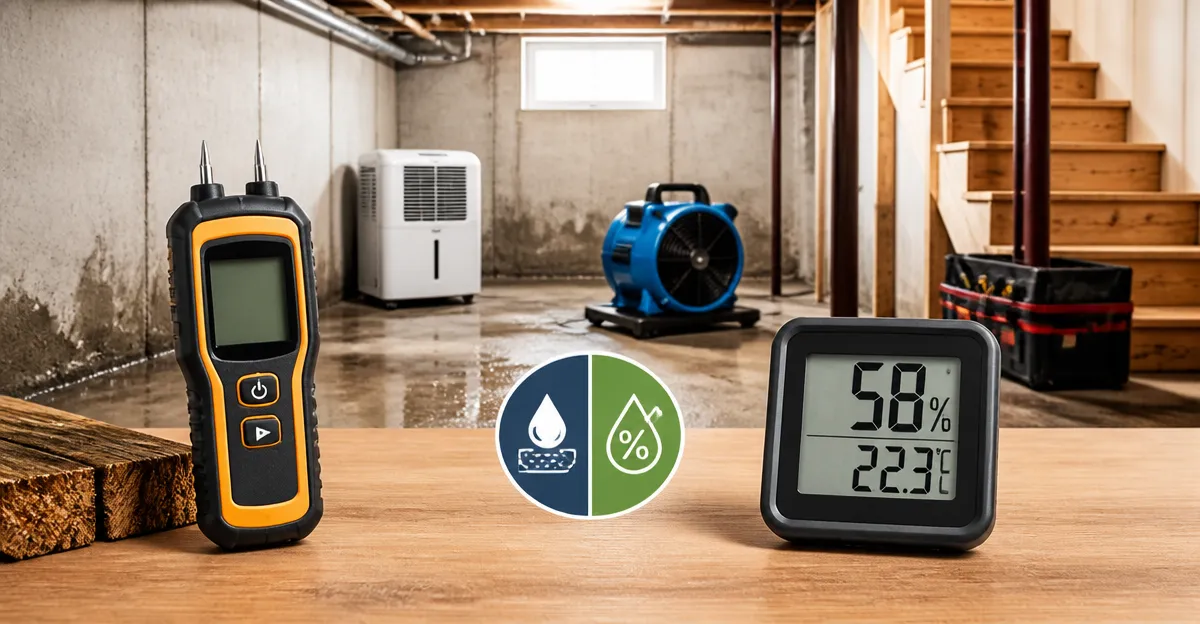
Moisture Meter vs Hygrometer: The Ultimate Guide to Choosing the Right Tool for Basement Restoration and Mold Prevention
Introduction
Basement restoration often hinges on accurate moisture assessment. Homeowners and professionals alike must decide whether a moisture meter or a hygrometer best serves their diagnostic needs. This guide explains the scientific differences, outlines practical applications, and recommends specific tools that excel in real‑world scenarios. By the end of the article, readers will understand how to select, use, and maintain the appropriate instrument to prevent mold growth and protect structural integrity.
The discussion balances theory with actionable product recommendations, ensuring that even readers who choose not to purchase a device gain valuable insight into moisture management.
Background and Context
Moisture is the silent catalyst behind most basement failures. When water infiltrates foundation walls, floor slabs, or interior finishes, it creates an environment where mold spores thrive. Two primary instruments measure moisture: moisture meters, which assess the water content of solid materials, and hygrometers, which measure ambient relative humidity in the air.
Understanding the physics behind each device is essential. Moisture meters typically employ either pin‑type electrical resistance or pinless electromagnetic (EMF) technology. Hygrometers rely on capacitive or resistive sensors that change electrical properties as humidity varies. Both devices provide quantitative data, yet they answer different questions about a building envelope.
Effective basement restoration therefore requires a strategic combination of both tools: a moisture meter to locate wet wood, drywall, or concrete, and a hygrometer to monitor the drying environment after remediation.
Understanding Moisture Meters
A moisture meter quantifies the amount of water contained within a material, expressed as a percentage of the material’s dry weight. Pin‑type meters, such as the General Tools Moisture Meter, insert stainless‑steel probes into the surface, creating an electrical circuit whose resistance changes with moisture level. Pinless models, like the Klein Tools Pinless Moisture Meter, emit an electromagnetic field that penetrates up to 19 mm, allowing non‑destructive testing of drywall, wood, and masonry.
Key specifications to evaluate include measurement range, depth of detection, material‑specific calibration, and data‑holding functions. For example, the General Tools device measures 5‑50 % in wood and 1.5‑33 % in building materials, while the Klein Tools meter offers a reverse‑contrast display and nine LED bars for quick visual assessment.
When selecting a moisture meter for basement work, consider the following criteria:
- Material compatibility – does the meter provide presets for wood, drywall, concrete, or masonry?
- Depth of detection – pinless meters typically reach 19 mm, sufficient for most interior finishes.
- Ease of use – backlit LCD, hold button, and audible alerts reduce user fatigue during extensive surveys.
- Durability – waterproof housing and robust probes extend service life in damp environments.
Understanding Hygrometers
A hygrometer measures relative humidity (RH) in the surrounding air, expressed as a percentage of the maximum amount of water vapor the air can hold at a given temperature. Modern digital hygrometers incorporate temperature sensors, allowing calculation of dew point – a critical metric for determining whether condensation will occur on basement walls.
While hygrometers do not pinpoint moisture within a specific substrate, they are indispensable for monitoring the effectiveness of drying equipment such as dehumidifiers and fans. An RH reading consistently above 60 % indicates a high risk of mold growth, whereas maintaining RH below 50 % accelerates the drying process.
When integrating hygrometers into a restoration workflow, place them at mid‑height in the basement, away from direct airflow, to obtain representative readings. Calibration checks using a saturated salt solution can verify accuracy over time.
Choosing Between a Moisture Meter and a Hygrometer
The decision is not binary; rather, it depends on the stage of the restoration project. Early investigation benefits from a moisture meter to locate hidden wet spots. Subsequent drying phases rely on a hygrometer to verify that ambient conditions remain unfavorable for mold.
Below is a concise decision matrix:
| Scenario | Primary Instrument | Reasoning |
|---|---|---|
| Identifying water‑logged studs | Moisture Meter (pin‑type) | Direct measurement of wood moisture content. |
| Detecting hidden leaks behind drywall | Pinless Moisture Meter | Non‑destructive scanning up to 19 mm. |
| Monitoring drying progress after pump‑out | Hygrometer | Tracks ambient RH and temperature. |
| Verifying dehumidifier performance | Hygrometer | Provides real‑time RH feedback. |
| Assessing moisture in firewood | Moisture Meter (pin‑type or pinless) | Ensures wood is below 20 % before storage. |
Product Recommendations for Basement Restoration
Each of the following devices excels in specific aspects of moisture management. The first mention of each product includes a direct affiliate link using a friendly name.
General Tools Moisture Meter
This pin‑type meter offers a wide range (5‑50 % for wood, 1.5‑33 % for drywall) and includes a backlit LCD, auto‑power‑off, and a protective cap that doubles as a calibration checker. With a 4.5‑star rating from over 15,000 reviewers and a price of $37.70, it provides excellent value for contractors who need precise wood moisture readings before installing flooring or repairing water‑damaged framing.
Klein Tools Pinless Moisture Meter
The Klein ET140 uses electromagnetic field technology to scan up to 3/4‑inch deep without penetrating surfaces. Its reverse‑contrast display and nine LED bars simplify interpretation, while the included 2 m drop‑protection cable and 9 V battery ensure field readiness. Priced at $49.97 with a 4.5‑star rating from 6,187 reviewers, it is ideal for homeowners who wish to locate hidden leaks in drywall or masonry without creating new holes.
General Tools Pinless Moisture Meter
For users seeking a balance between cost and functionality, this model delivers pinless scanning to 19 mm, a three‑color LED bar graph, and audible out‑of‑range alarms. At $49.99 and a 4.3‑star rating from 4,106 reviewers, it is a solid choice for DIY enthusiasts monitoring sub‑floor moisture after flood events.
RDINSCOS Pinless Moisture Meter
At a budget‑friendly $20.15, this meter provides quick non‑invasive readings on wood, walls, tile, and masonry. The backlit LCD and HOLD button enhance usability, though users should be aware of interference from metal studs or wiring. Its 4.5‑star rating from 2,497 reviewers makes it an attractive entry‑level option for occasional inspections.
AEGTEST Rechargeable Moisture Meter
The AWT‑380 stands out for its USB‑C rechargeable battery, color display with max‑hold, and adjustable visual/audible alarms. It scans to 20 mm depth and records data for later analysis, supporting professional‑grade documentation. With a price of $29.99, a 4.4‑star rating from 211 reviewers, and a three‑year after‑sale service, it bridges the gap between affordability and advanced functionality.
Comparison/Selection Guide
To aid readers in making an informed purchase, the following side‑by‑side comparison highlights the most relevant attributes for basement restoration.
| Feature | General Tools (Pin‑type) | Klein Tools (Pinless) | General Tools (Pinless) | RDINSCOS | AEGTEST |
|---|---|---|---|---|---|
| Detection Method | Pin‑type electrical resistance | Electromagnetic (EMF) | Electromagnetic (EMF) | Electromagnetic (EMF) | Electromagnetic (EMF) |
| Depth | Surface only (pins inserted) | Up to 19 mm | Up to 19 mm | Up to 19 mm | Up to 20 mm |
| Material Presets | Wood, drywall, concrete | Drywall, masonry, hardwood, softwood | Wood, drywall, masonry | Wood, wall, tile, masonry | Wood, drywall, masonry (user‑defined) |
| Display | Backlit LCD, large digits | Reverse‑contrast LCD, LED bar | 2" backlit LCD, 3‑color LED | Backlit LCD, green LEDs | Color LCD with max‑hold |
| Power Source | 9 V battery | 9 V battery | 9 V battery | 9 V battery | USB‑C rechargeable |
| Price (USD) | 37.70 | 49.97 | 49.99 | 20.15 | 29.99 |
| Average Rating | 4.5/5 (15,177 reviews) | 4.5/5 (6,187 reviews) | 4.3/5 (4,106 reviews) | 4.5/5 (2,497 reviews) | 4.4/5 (211 reviews) |
When budget is the primary constraint, the RDINSCOS model delivers acceptable performance for basic inspections. For professionals demanding material‑specific calibration and data logging, the AEGTEST AWT‑380 provides the most comprehensive feature set. Homeowners seeking a non‑destructive option without breaking the bank will find the Klein Tools ET140 to be a reliable middle ground.
Best Practices & Tips for Effective Moisture Management
- Calibrate before each use. Most meters include a calibration check; use the supplied cap or a known dry material to verify accuracy.
- Take multiple readings. Moisture can vary across a single board; scan in a grid pattern and record the highest value.
- Combine tools. Use a moisture meter to locate wet spots, then place a hygrometer nearby to monitor ambient drying conditions.
- Maintain proper ventilation. After water removal, run dehumidifiers until the hygrometer consistently reads below 50 % RH.
- Document findings. Photographs, meter readings, and timestamps create a clear remediation record for insurance purposes.
- Watch for metal interference. Pinless meters can be affected by studs, wiring, or pipework; keep the sensor at least a few centimeters away from metal.
- Replace batteries promptly. Low battery voltage can cause erratic readings, especially with pin‑type devices.
Frequently Asked Questions
- Can a moisture meter replace a hygrometer? No. A moisture meter measures water content in solids, while a hygrometer measures airborne humidity. Both are required for a complete assessment.
- Do pinless meters damage surfaces? Pinless meters are non‑destructive; they use electromagnetic fields instead of needles, making them safe for finished walls and delicate finishes.
- What is an acceptable moisture level for basement wood? For structural lumber, moisture below 15 % is generally safe. For flooring, aim for 6‑12 % depending on species and finish.
- How often should I check humidity during drying? Monitor RH at least twice daily during the first week, then daily until readings stabilize below 50 %.
- Are these meters accurate enough for professional use? While consumer‑grade meters provide reliable trends, certified professionals may use calibrated laboratory‑grade devices for legal or warranty disputes.
- Can I use a moisture meter on concrete? Yes, but ensure the device offers a concrete or masonry preset; pinless models typically handle concrete up to 19 mm depth.
- What maintenance does a hygrometer require? Periodic calibration with a saturated salt solution and battery replacement every 12‑18 months maintain accuracy.
Conclusion
Effective basement restoration depends on precise moisture detection and sustained humidity control. Moisture meters identify the source and severity of water intrusion, while hygrometers verify that the environment remains hostile to mold. By understanding the strengths of each instrument and selecting a tool that aligns with budget, material type, and depth requirements, homeowners and professionals can mitigate damage, accelerate drying, and protect health.
Investing in a reliable meter—whether the budget‑friendly RDINSCOS Pinless Moisture Meter or the feature‑rich AEGTEST Rechargeable Moisture Meter—provides long‑term value by preventing costly repairs and ensuring compliance with building standards.
Products Featured in This Guide
General Tools Moisture Meter
Price: $37.70 | Rating: 4.5/5 (15,177 reviews)
Featured for its wide measurement range, ergonomic pin design, and excellent value for wood‑frame inspections.
Klein Tools Pinless Moisture Meter
Price: $49.97 | Rating: 4.5/5 (6,187 reviews)
Chosen for its non‑destructive scanning up to 19 mm, durable construction, and professional‑grade brand reputation.
General Tools Pinless Moisture Meter
Price: $49.99 | Rating: 4.3/5 (4,106 reviews)
Highlighted for its three‑color LED bar graph, audible alarm, and affordable price point for DIY projects.
RDINSCOS Pinless Moisture Meter
Price: $20.15 | Rating: 4.5/5 (2,497 reviews)
Featured for its budget‑friendly price, easy‑to‑read backlit display, and suitability for occasional home inspections.
AEGTEST Rechargeable Moisture Meter
Price: $29.99 | Rating: 4.4/5 (211 reviews)
Selected for its USB‑C rechargeable battery, data‑hold capability, and adjustable alarm thresholds for professional documentation.