
Introduction
Basements that are exposed to high humidity present a unique set of challenges for homeowners who wish to improve energy efficiency and indoor comfort. Moisture infiltration can lead to mold growth, structural deterioration, and increased heating and cooling costs, making the selection of appropriate insulation critical.
Choosing insulation that resists moisture while providing thermal performance empowers one to create a dry, healthy environment without relying on costly professional installations. The following list presents ten insulation solutions that address humidity, each supported by a product that exemplifies the technology.
1. Closed‑Cell Spray Foam for Comprehensive Air Sealing
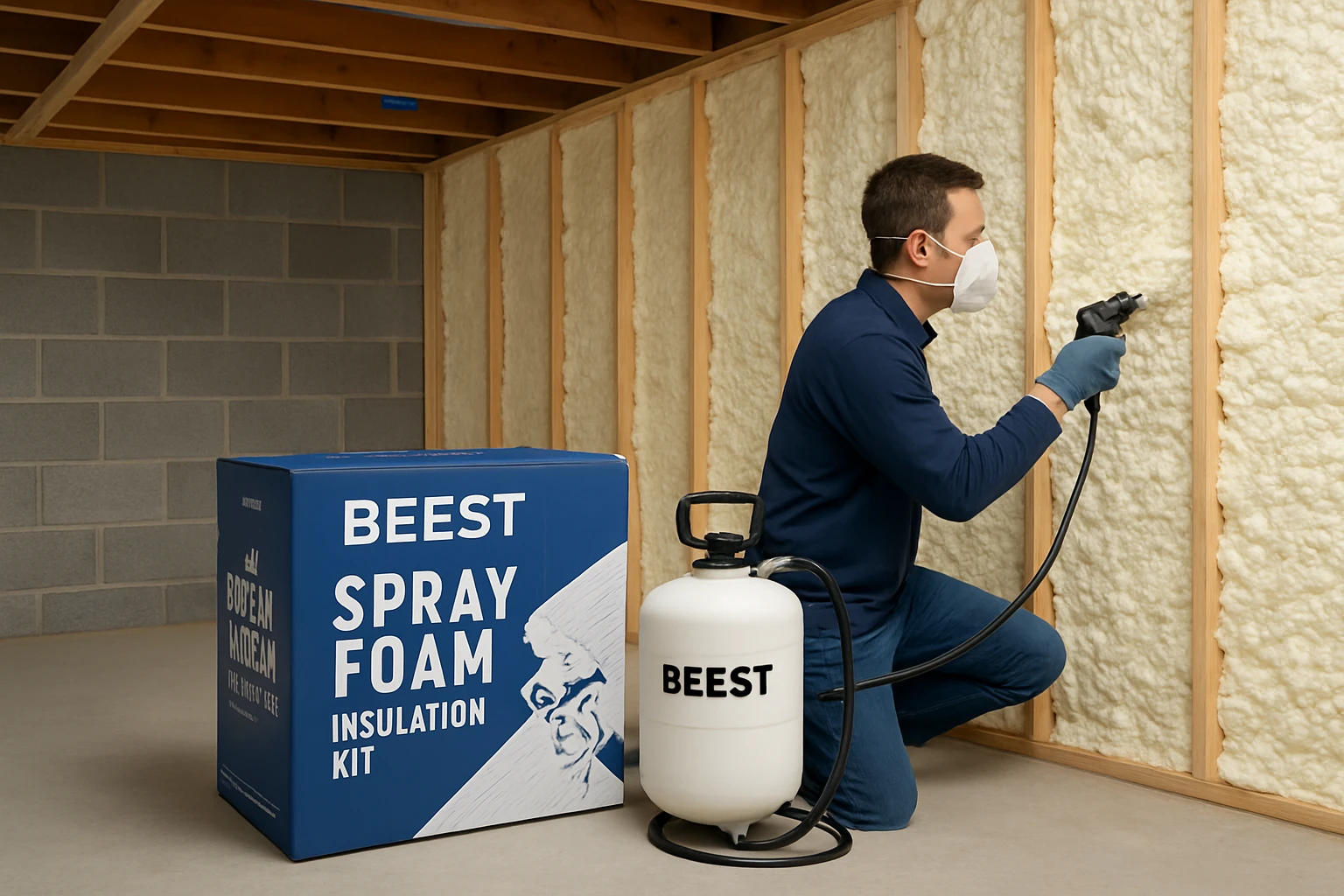
Closed‑cell spray foam creates an airtight barrier that prevents humid air from entering the basement envelope. Its dense cellular structure also acts as a vapor retarder, reducing the risk of condensation on interior surfaces. The BEEST Spray Foam Insulation Kit delivers a Class A fire‑rated solution with an R‑value of 8.24 at a 2‑inch thickness, making it suitable for walls, ceilings, and floor joists.
Customers praise the kit for its all‑in‑one convenience; one reviewer noted, “The gun and cleaner arrived ready to use, and the foam expanded evenly across the entire wall surface.” At $209.95 and a rating of 4.3 stars from 475 reviews, the kit offers both performance and value.
2. Open‑Cell Spray Foam for Flexible Coverage
Open‑cell spray foam expands more rapidly than its closed‑cell counterpart, filling irregular gaps and providing sound‑absorbing qualities. While it does not act as a vapor barrier, it still contributes to moisture control by reducing air infiltration. The BEEST Spray Foam Insulation Kit incorporates an advanced hybrid formulation that combines a closed‑cell outer skin with an open‑cell core, delivering the benefits of both technologies.
Homeowners who prioritize ease of application appreciate that the foam cures at typical indoor temperatures (68‑77 °F), ensuring consistent expansion. The inclusion of safety gear and a solvent‑based cleaner further simplifies the installation process for DIY enthusiasts.
3. Rigid Foam Board for Structural Insulation Panels
Rigid foam board, such as extruded polystyrene (XPS) or polyisocyanurate, provides high R‑values per inch and resists moisture absorption. These panels are often installed on exterior basement walls before the interior finish is applied, creating a continuous thermal envelope.
When paired with the BEEST Spray Foam Insulation Kit for sealing joints and penetrations, the combination yields a robust barrier against humidity. The foam board’s smooth surface also facilitates the attachment of interior drywall, reducing labor time.
4. Mineral Wool Batts for Fire‑Resistant Insulation
Mineral wool, made from basalt or slag, offers excellent fire resistance and does not promote mold growth due to its inorganic composition. Its dense fibers trap air, delivering thermal performance while allowing moisture to evaporate through the material.
Integrating mineral wool batts with targeted applications of the BEEST Spray Foam Insulation Kit around pipe penetrations enhances overall airtightness without compromising the fire‑rating of the assembly.
5. Fiberglass Batts with Vapor Retarder Facing
Fiberglass batts remain a cost‑effective option for basement insulation when equipped with a vapor retarder facing. The foil or kraft paper barrier helps to limit moisture migration from the interior to the colder wall cavity.
For seams and gaps that fiberglass cannot seal, the BEEST Spray Foam Insulation Kit provides a quick fix, ensuring that the overall system remains moisture‑tight.
6. Cellulose Blown‑In Insulation for Retrofit Projects
Cellulose, composed of recycled paper treated with fire retardants, can be blown into existing wall cavities, offering a sustainable solution that also resists mold when properly installed. Its dense composition slows air movement, contributing to a drier basement environment.
After the cellulose is installed, applying a thin layer of the BEEST Spray Foam Insulation Kit around rim joists and floor edges creates a continuous seal, preventing warm, humid indoor air from reaching the colder foundation.
7. Reflective Foil Insulation for Radiant Barrier Effects
Reflective foil insulation reflects radiant heat, reducing thermal gain in summer and heat loss in winter. When installed on the interior side of a concrete basement wall, it can lower surface temperature, discouraging condensation.
Because foil alone does not stop air movement, supplementing it with the BEEST Spray Foam Insulation Kit around seams and fasteners ensures a complete moisture‑resistant assembly.
8. Spray‑Applied Polyurethane Foam for Large Open Areas
For expansive ceiling areas, spray‑applied polyurethane foam can be dispensed directly from a bulk tank, providing uniform coverage and eliminating thermal bridges. This method is especially useful in high‑ceiling basements where traditional batts are difficult to install.
The BEEST Spray Foam Insulation Kit, while packaged for smaller projects, demonstrates the same chemical properties and can be used for spot‑treating critical junctions, ensuring that the larger foam system remains sealed.
9. Insulating Concrete Forms (ICFs) for New Construction
ICFs combine structural concrete with integrated insulation, creating a monolithic wall that resists moisture infiltration. The concrete core provides thermal mass, while the foam exterior offers high R‑values.
When renovating an existing basement with ICFs, the BEEST Spray Foam Insulation Kit can be employed to seal any gaps between the forms and existing framing, preserving the moisture‑resistant envelope.
10. Vapor‑Retarding Paint for Secondary Protection
Vapor‑retarding paint applied to interior walls can slow moisture transmission, acting as a secondary barrier behind primary insulation. This coating is particularly beneficial in older basements with historic brick walls.
Combining vapor‑retarding paint with the airtight seal achieved by the BEEST Spray Foam Insulation Kit offers a layered defense against humidity, ensuring long‑term durability.
Comparison of Key Insulation Solutions
| Solution | R‑Value (per inch) | Moisture Resistance | Fire Rating | Typical Cost |
|---|---|---|---|---|
| Closed‑Cell Spray Foam | 6‑7 | Excellent (vapor barrier) | Class A | $210 (kit) |
| Open‑Cell Spray Foam | 3.5‑4 | Good (air barrier) | Class A | Included in kit |
| Rigid Foam Board | 5‑6 | Very Good | Varies | $30‑$50 per sheet |
| Mineral Wool Batts | 4‑4.5 | Very Good | Class A | $0.80 per ft² |
| Fiberglass Batts | 3.2‑3.8 | Fair (requires vapor barrier) | Class A | $0.45 per ft² |
Conclusion
Effective insulation for humid basements requires a combination of thermal performance, moisture control, and fire safety. By selecting the appropriate material for each application and reinforcing seams with a reliable sealant such as the BEEST Spray Foam Insulation Kit, homeowners can achieve a dry, energy‑efficient space.
The ten options outlined above provide a spectrum of solutions ranging from DIY‑friendly kits to professional‑grade systems. One should evaluate the specific conditions of the basement, budget constraints, and long‑term maintenance requirements before finalizing a strategy.
Implementing these recommendations will reduce utility bills, prevent mold growth, and increase the overall value of the home.
Frequently Asked Questions
What insulation type best prevents moisture in humid basements?
Closed‑cell spray foam is ideal because its dense cells create an airtight barrier and act as a vapor retarder.
How does closed‑cell spray foam improve energy efficiency?
It delivers a high R‑value (about 8.24 per 2 in.) and eliminates air leaks, lowering heating and cooling costs.
Is spray foam safe for residential use and fire rated?
Yes, many kits such as the BEEST Spray Foam are Class A fire‑rated when installed according to code.
Can I install closed‑cell spray foam myself or do I need a professional?
It can be a DIY project with proper safety gear, though complex areas or large jobs may benefit from professional expertise.
What maintenance is required for spray foam insulation in basements?
Inspect the foam annually for gaps or damage and maintain adequate ventilation; the foam itself resists moisture degradation.