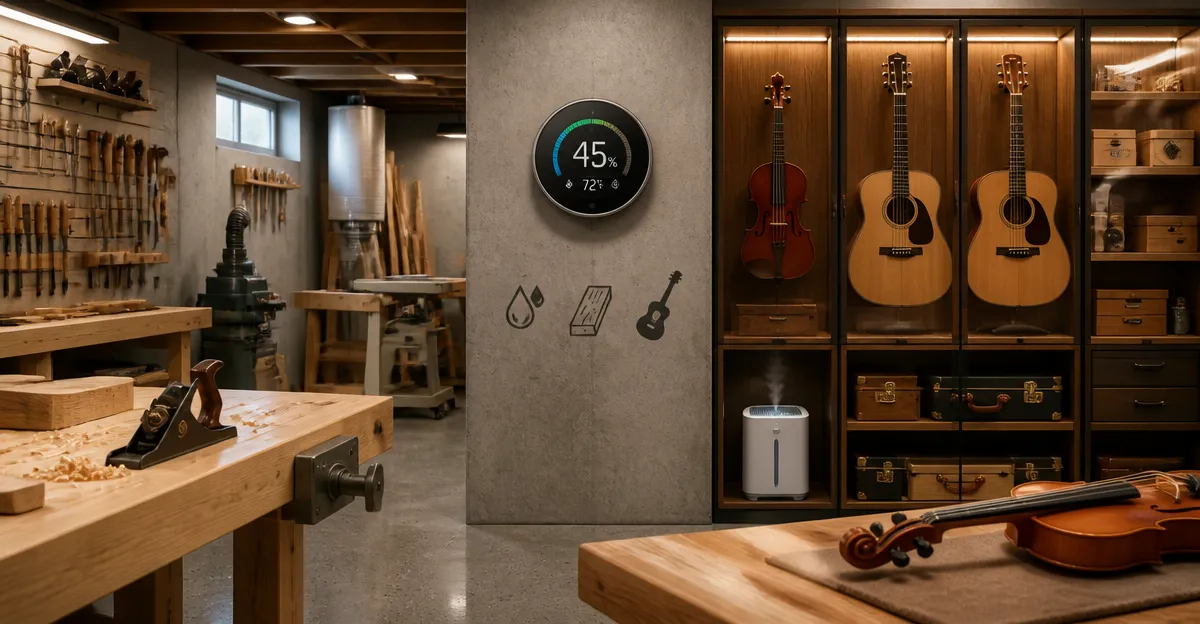
Basement Woodshop & Instrument Storage: The Complete Guide to Recommended Humidity Targets (40–50% RH)
Introduction
One will discover the essential principles for maintaining a stable relative humidity within a basement woodshop and instrument storage area. The guide explains why a target range of 40 % to 50 % relative humidity (RH) protects both wooden tools and delicate musical instruments. Readers will learn how to measure, control, and monitor humidity, as well as which products can simplify the process. By the end of the article, one will be equipped to create an environment that preserves craftsmanship and sound quality.
In addition to theoretical knowledge, the guide offers practical recommendations for affordable equipment. It also presents a comparison of popular humidifiers and dehumidifiers, helping the reader select the most suitable solution for a given space. The information is based on current best practices and peer‑reviewed research from the fields of woodworking and instrument conservation. The tone remains professional and authoritative throughout.
Background and Context
Relative humidity describes the amount of water vapor present in air relative to the maximum amount the air can hold at a specific temperature. When humidity falls below 40 %, wood begins to lose moisture, leading to cracks, warping, and dimensional instability. Conversely, humidity above 50 % encourages fungal growth and metal corrosion, both of which threaten tool longevity and instrument tone.
Wooden components such as guitar necks, violin bodies, and cabinet doors respond predictably to changes in moisture content. A 1 % change in RH can cause a one‑inch board to expand or contract by approximately 0.1 % of its thickness. Understanding this relationship is critical for anyone who stores valuable instruments or operates precision woodworking equipment in a basement environment.
Basements typically experience greater temperature fluctuations than climate‑controlled rooms, making humidity regulation more challenging. Concrete walls, limited ventilation, and ground moisture all contribute to a baseline RH that often exceeds the desired range. Therefore, a combination of passive and active control methods is required to achieve stability.
Understanding Relative Humidity Targets
The recommended humidity band of 40 % to 50 % RH balances the needs of most hardwoods used in musical instruments and furniture. Within this range, wood remains supple enough to avoid brittleness while limiting the growth of mold and mildew. Scientific studies indicate that acoustic instruments retain tonal consistency when stored at approximately 45 % RH.
One should consider seasonal variations when setting targets. In winter, heating systems dry indoor air, often pulling RH below 30 %. In summer, high outdoor humidity can push indoor levels above 60 %. A dynamic control system that adjusts output based on real‑time measurements is therefore advisable.
It is also important to recognize that different wood species have slightly different equilibrium moisture content (EMC) values. For example, spruce used in violin tops reaches equilibrium at a marginally lower RH than maple used for backs and necks. Nevertheless, the 40 %–50 % band serves as a practical compromise for mixed‑wood collections.
Measuring and Monitoring Humidity
Accurate measurement is the foundation of any humidity management plan. Digital hygrometers with a precision of ±2 % RH are recommended for baseline monitoring. One should place the sensor away from direct airflow, heat sources, and moisture‑producing activities to avoid skewed readings.
For continuous monitoring, wireless hygrometer systems can transmit data to a smartphone or computer. These devices often include alerts that trigger when RH deviates from the target range, enabling timely intervention. Calibration of the sensor every six months ensures ongoing accuracy.
In a woodshop, it is advisable to use multiple sensors: one near the workbench, one close to instrument storage, and one at the ceiling to detect stratification. By comparing readings, one can identify problem areas and adjust airflow or placement of humidification devices accordingly.
Humidification and Dehumidification Solutions
When humidity falls below the desired range, a humidifier adds moisture to the air. Evaporative cool‑mist humidifiers are energy‑efficient and suitable for basements because they also provide a modest cooling effect. For larger spaces, whole‑house humidifiers integrated into the HVAC system can maintain uniform conditions.
When humidity exceeds the target, a dehumidifier removes excess moisture. Desiccant dehumidifiers perform well in cooler basements, while refrigerant models are more effective in warm, damp conditions. Selecting a unit with a capacity of at least 30 pints per day for a 500‑square‑foot workshop is a reasonable starting point.
In many cases, a balanced approach that employs both a humidifier and a dehumidifier, controlled by a smart thermostat, yields the most stable environment. The thermostat can be programmed to maintain a setpoint of 45 % RH, automatically activating the appropriate device as conditions change.
Product Recommendations
One reference that provides a comprehensive overview of basement conditioning is The Basement. This hardcover guide, authored by Bari Wood, offers detailed strategies for moisture control, ventilation, and structural improvements. Although the book is modestly priced at $6.89, it delivers valuable insights that complement the technical recommendations presented in this article.
The Basement includes chapters on selecting appropriate humidifiers and dehumidifiers, interpreting hygrometer data, and implementing passive moisture barriers. Its rating of 3 out of 5 stars, based on a single review, suggests that readers find the content useful but may desire additional depth in certain areas. Nevertheless, the guide serves as an affordable entry point for anyone beginning a humidity‑management project.
In addition to literature, one may consider a digital hygrometer with Bluetooth connectivity, a 30‑pint dehumidifier, and an evaporative humidifier. While these specific models are not listed here, the principles for evaluating them are discussed in the comparison guide below.
Comparison and Selection Guide
When choosing a humidifier, one should evaluate capacity, energy consumption, and maintenance requirements. Evaporative models typically consume 30–50 W and require periodic cleaning of the wick filter. Refrigerant units, while quieter, may use 150–250 W and are better suited for warmer climates.
For dehumidifiers, key specifications include moisture removal rate, water tank capacity, and built‑in humidistat. A unit with a built‑in humidistat can automatically shut off when the target RH is reached, reducing energy waste. Desiccant models operate effectively at temperatures below 65 °F, which is common in many basements.
Price ranges vary widely. Entry‑level humidifiers can be purchased for $30–$50, while high‑capacity models may exceed $200. Dehumidifiers typically start at $100 for a 20‑pint unit and rise to $300 for larger, feature‑rich models. One should match the device capacity to the square footage and baseline humidity level of the basement.
Best Practices and Tips
One should seal cracks in foundation walls and apply a vapor barrier on concrete floors to reduce passive moisture ingress. Installing a sump pump with a backup power source can prevent water accumulation after heavy rains.
Air circulation improves humidity uniformity. Ceiling fans or low‑speed floor fans can distribute conditioned air without creating drafts that might dry wood unevenly. It is advisable to run fans for short periods during humidifier or dehumidifier cycles.
Regularly inspect wooden tools and instruments for signs of moisture stress, such as surface checking, swelling, or condensation. Early detection allows for prompt adjustment of humidity controls before irreversible damage occurs.
Maintain a log of temperature and RH readings to identify long‑term trends. This data can inform adjustments to setpoints, device capacities, or insulation improvements.
Frequently Asked Questions
- What is the ideal humidity range for most wooden musical instruments? The consensus among conservators is 40 %–50 % RH, which balances dimensional stability and resistance to mold.
- Can a single humidifier cover both a woodshop and instrument storage area? It can, provided the space is open and the humidifier’s capacity matches the combined square footage. Separate devices may be required for isolated rooms.
- How often should a hygrometer be calibrated? Calibration is recommended every six months, or sooner if the device shows inconsistent readings.
- Is a dehumidifier necessary in winter? Yes, because indoor heating often lowers temperature while simultaneously reducing RH, but outdoor moisture can still infiltrate basements, raising humidity levels.
- What maintenance does a dehumidifier require? The water collection tank must be emptied regularly, filters cleaned or replaced, and the coils inspected for dust buildup.
- Can I rely solely on passive methods such as silica gel? Passive methods can supplement active control but cannot maintain a stable 40 %–50 % RH range on their own.
- Does The Basement cover modern smart‑home humidity controls? The book provides a solid foundation on traditional methods; readers may need additional resources for the latest smart‑home integrations.
Conclusion
One has learned that maintaining a humidity range of 40 %–50 % RH in a basement woodshop and instrument storage area protects both functional tools and valuable instruments. By measuring accurately, selecting appropriate humidification and de‑humidification equipment, and implementing structural improvements, one can achieve long‑term stability. The recommended reference, The Basement, offers further guidance on these topics.
Consistent monitoring, routine maintenance, and adherence to best practices will ensure that wood remains resilient and instruments retain their tonal integrity. The reader is now equipped to design a humidity‑controlled environment that supports craftsmanship and preserves heritage.
Products Featured in This Guide
The Basement
Price: $6.89
Rating: 3/5.0 (1 review)
Why it is featured: It provides a comprehensive overview of basement moisture control, ventilation, and structural improvements, making it a valuable reference for readers seeking to implement the humidity strategies discussed in this guide.