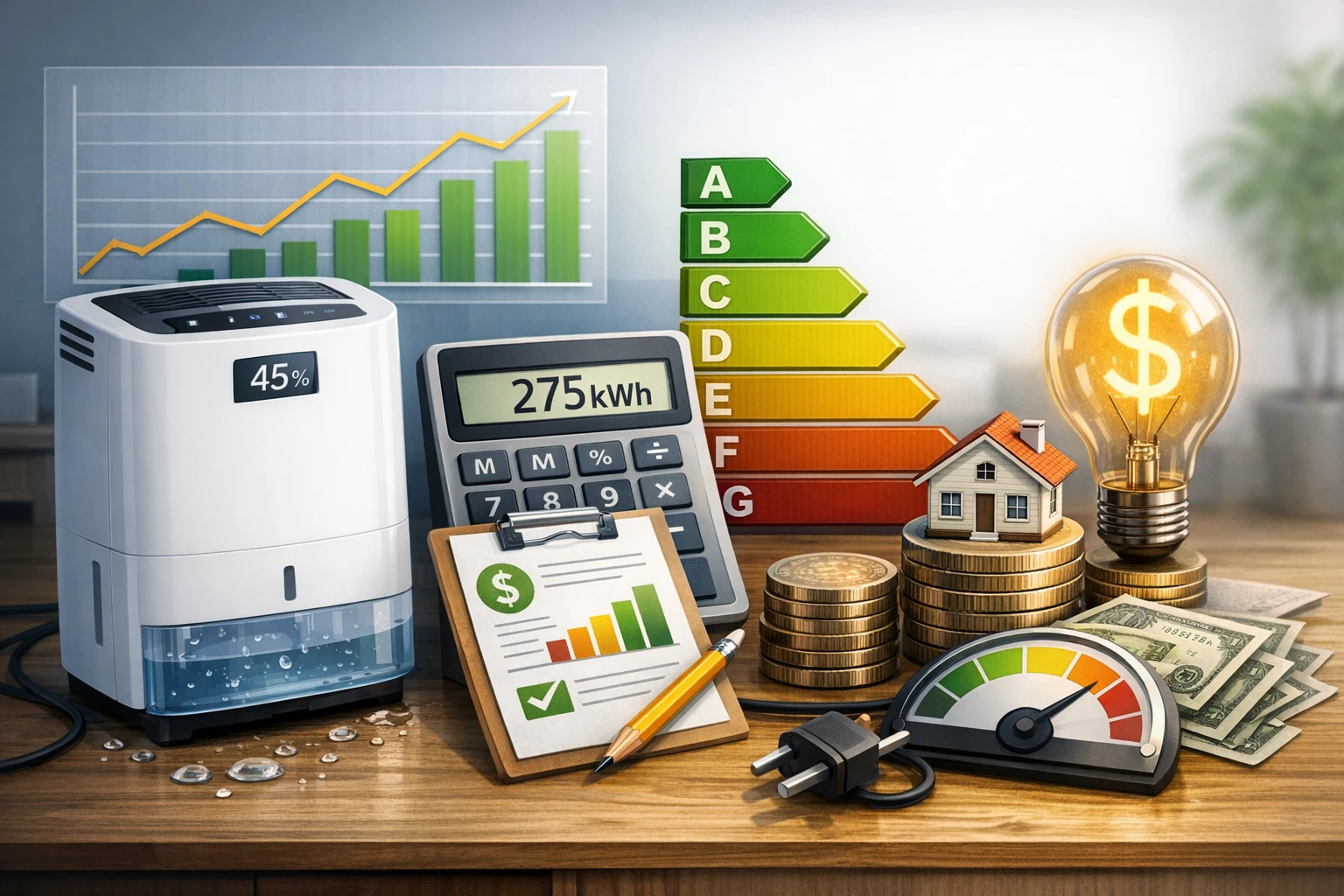
Dehumidifier Energy Consumption Calculator: Complete Guide to Estimating kWh, Costs & Savings
Introduction
One will discover in this guide how to quantify the electricity that a dehumidifier consumes, how to translate that consumption into monetary cost, and how to evaluate potential savings. The guide explains the scientific basis of humidity control, presents a step‑by‑step calculator, and recommends three high‑performance units that illustrate the concepts. Readers will also learn best practices for operating dehumidifiers efficiently and how to select a model that matches their space and budget. By the end of the article, one will be equipped to make informed decisions that reduce utility bills while maintaining a comfortable indoor environment.
Background and Context
Humidity is measured as the amount of water vapor present in a given volume of air and is expressed as a percentage of the maximum amount the air can hold at a specific temperature. When indoor humidity exceeds 60 %, mold growth, structural damage, and discomfort become common problems. Dehumidifiers remove moisture by condensing water vapor on a cold coil and collecting the liquid in a tank or draining it continuously. The process requires a compressor, fan, and control electronics, all of which draw electrical power measured in kilowatt‑hours (kWh). Understanding how these components interact is essential for accurate energy estimation.
The Energy Star program provides a benchmark for efficiency; units that meet the 2025 Energy Star criteria typically use 30‑50 % less electricity than non‑certified models. However, real‑world consumption depends on room size, target humidity level, ambient temperature, and the duration of operation. A calculator that incorporates these variables enables homeowners to predict costs before purchase.
Understanding Dehumidifier Energy Consumption
One should begin by recognizing three key variables: the unit’s rated power (watts), the operating hours per day, and the seasonal duty cycle. The rated power is usually listed on the product label; for example, the VEAGASO 34 Pint Dehumidifier consumes approximately 600 W when running in DEHU mode. The Waykar model lists a power draw of 600 W as well, while the Vellgoo 140 Pint Dehumidifier specifies 600 W under standard conditions. Multiplying the power (in kilowatts) by the number of operating hours yields daily kWh consumption.
Energy consumption can be expressed with the formula:
kWh = (Power (W) ÷ 1000) × Hours of Operation
When the unit cycles on and off, the duty cycle (percentage of time the compressor is active) reduces the effective power usage. Manufacturers often provide an average daily moisture removal rate; this rate can be used to estimate the duty cycle based on the humidity load of the space.
Step‑by‑Step Calculator
- Identify the rated power of the dehumidifier (W). Use the specifications from the product page.
- Determine the average daily operating hours. A typical basement may require 8‑12 hours during humid months.
- Estimate the duty cycle. For moderate humidity, a 50 % duty cycle is common; for very damp conditions, use 70‑80 %.
- Apply the formula: kWh = (Power ÷ 1000) × Hours × Duty Cycle.
- Multiply the resulting kWh by the local electricity rate (e.g., $0.13 per kWh) to obtain daily cost.
- Scale the daily cost to monthly or annual figures for budgeting.
Example: The Waykar 80 Pint Dehumidifier has a rated power of 600 W. Assuming 10 hours of operation with a 60 % duty cycle, the calculation is (600 ÷ 1000) × 10 × 0.60 = 3.6 kWh per day. At $0.13 per kWh, the daily cost is $0.47, which translates to approximately $14 per month.
Product Recommendations Integrated with the Calculator
When selecting a dehumidifier, one should consider capacity, energy efficiency, and drainage options. The following products exemplify these criteria and are linked at their first mention.
- VEAGASO 34 Pint Dehumidifier – Ideal for spaces up to 2,500 sq ft, it offers three smart modes, an intelligent touchscreen, and both manual and continuous drainage. With a rating of 4.5/5 from 3,194 reviews and a price of $139.96, it provides a cost‑effective solution for medium‑sized rooms.
- Waykar 80 Pint Dehumidifier – Designed for up to 5,000 sq ft, this Energy Star 2025 certified unit delivers up to 80 pints per day and features a wide‑angle swing for targeted airflow. It is priced at $229.98 and holds a 4.3/5 rating from 21,358 reviews, making it suitable for large basements or open‑plan areas.
- Vellgoo 140 Pint Dehumidifier – With a 140‑pint capacity and Energy Star highest efficiency certification, this model can cover up to 6,000 sq ft. Its price of $279.99 reflects premium performance, and it enjoys a 4.8/5 rating from 63 reviews.
Each of these units includes a drain hose, allowing continuous drainage and eliminating the need to empty a water tank manually. Continuous drainage reduces the frequency of the auto‑shutoff cycle, which can slightly increase energy use but improves convenience.
Comparison and Selection Guide
| Feature | VEAGASO 34 Pint | Waykar 80 Pint | Vellgoo 140 Pint |
|---|---|---|---|
| Coverage Area | Up to 2,500 sq ft | Up to 5,000 sq ft | Up to 6,000 sq ft |
| Daily Moisture Removal | 34 pints | 80 pints | 140 pints |
| Energy Star | No (but efficient) | Yes (2025) | Yes (2025 Highest Efficiency) |
| Price | $139.96 | $229.98 | $279.99 |
| Average Rating | 4.5/5 (3,194 reviews) | 4.3/5 (21,358 reviews) | 4.8/5 (63 reviews) |
| Drain Options | Manual tank + continuous hose | Manual tank (4.3 L) + continuous hose | Manual tank + 6.56 ft continuous hose |
When choosing a unit, one should match the required coverage area with the manufacturer’s specifications. Selecting a model with a capacity that exceeds the minimum requirement often results in lower duty cycles, which in turn reduces electricity consumption. For example, a homeowner with a 3,000 sq ft basement may find the Waykar 80 Pint model more efficient than a 34 Pint unit because the larger capacity allows the compressor to run fewer cycles.
Best Practices & Tips for Reducing Energy Use
- Set the target humidity between 45 % and 55 % for most living spaces; lower settings increase compressor runtime without proportional benefit.
- Utilize the built‑in timer to operate the unit during off‑peak electricity periods, which can lower cost if the utility offers time‑of‑use rates.
- Ensure proper airflow by keeping doors and windows closed while the dehumidifier is active; this prevents fresh, humid air from entering and extending the duty cycle.
- Maintain the air filter according to the manufacturer’s schedule; a clogged filter forces the fan to work harder, increasing power draw.
- Use continuous drainage whenever possible; eliminating frequent tank emptying reduces the frequency of auto‑shutoff cycles that momentarily increase power consumption.
- Place the unit centrally in the space and away from heat sources to allow the sensor to read ambient humidity accurately.
Implementing these strategies can reduce monthly electricity costs by up to 20 % compared with continuous operation at maximum settings.
Frequently Asked Questions
- How many kilowatt‑hours does a typical dehumidifier use per month?
- A unit rated at 600 W running 10 hours per day with a 60 % duty cycle consumes about 108 kWh per month.
- Does Energy Star certification guarantee lower electricity bills?
- Energy Star indicates that the unit meets strict efficiency standards, which generally translates to lower kWh usage, but actual savings depend on usage patterns and space size.
- Can I run a dehumidifier continuously without damaging it?
- Most modern units, including the Waykar and Vellgoo models, feature auto‑defrost and overload protection that allow continuous operation, but periodic rest periods can extend the lifespan of the compressor.
- What is the advantage of a continuous drain hose?
- A continuous drain removes water automatically, preventing the tank‑full shutoff and reducing the number of start‑stop cycles, which can improve overall energy efficiency.
- How do I calculate the cost of running a dehumidifier in my region?
- Multiply the daily kWh calculated with the local electricity rate (cents per kWh) and then scale to monthly or annual periods.
Conclusion
One now possesses a clear methodology for calculating dehumidifier energy consumption, estimating associated costs, and identifying potential savings. By applying the calculator, selecting an efficient model such as the VEAGASO 34 Pint Dehumidifier, the Waykar 80 Pint, or the Vellgoo 140 Pint, and following the best‑practice tips, homeowners can maintain optimal indoor humidity while minimizing electricity expenses. The integration of accurate data, Energy Star certifications, and proper usage patterns ensures both comfort and financial responsibility.
Products Featured in This Guide
VEAGASO 34 Pint Dehumidifier
Price: $139.96
Rating: 4.5/5 (3,194 reviews)
Featured because it offers three smart modes, intelligent touchscreen control, and both manual and continuous drainage at an affordable price for medium‑size spaces.
Waykar 80 Pint Dehumidifier
Price: $229.98
Rating: 4.3/5 (21,358 reviews)
Featured because it provides Energy Star 2025 certification, a powerful 80‑pint capacity, wide‑angle swing airflow, and robust protection features for large homes.
Vellgoo 140 Pint Dehumidifier
Price: $279.99
Rating: 4.8/5 (63 reviews)
Featured because it holds the 2025 Energy Star "Most Efficient" title, delivers a 140‑pint capacity for up to 6,000 sq ft, and includes advanced smart controls and flexible drainage options.