
Introduction
When selecting a check valve for residential plumbing or pool systems, two popular options appear on Amazon: the Homewerks 1.5" PVC Check Valve and the FibroPool 1.5" Spring Check Valve. Both products claim to prevent reverse flow, yet they differ in material, design, and price. Understanding these differences matters because a poorly chosen valve can lead to pump damage, reduced circulation, or costly repairs. This article evaluates each valve against objective criteria to help installers, pool owners, and DIY enthusiasts make an informed decision.
Individual Product Overviews
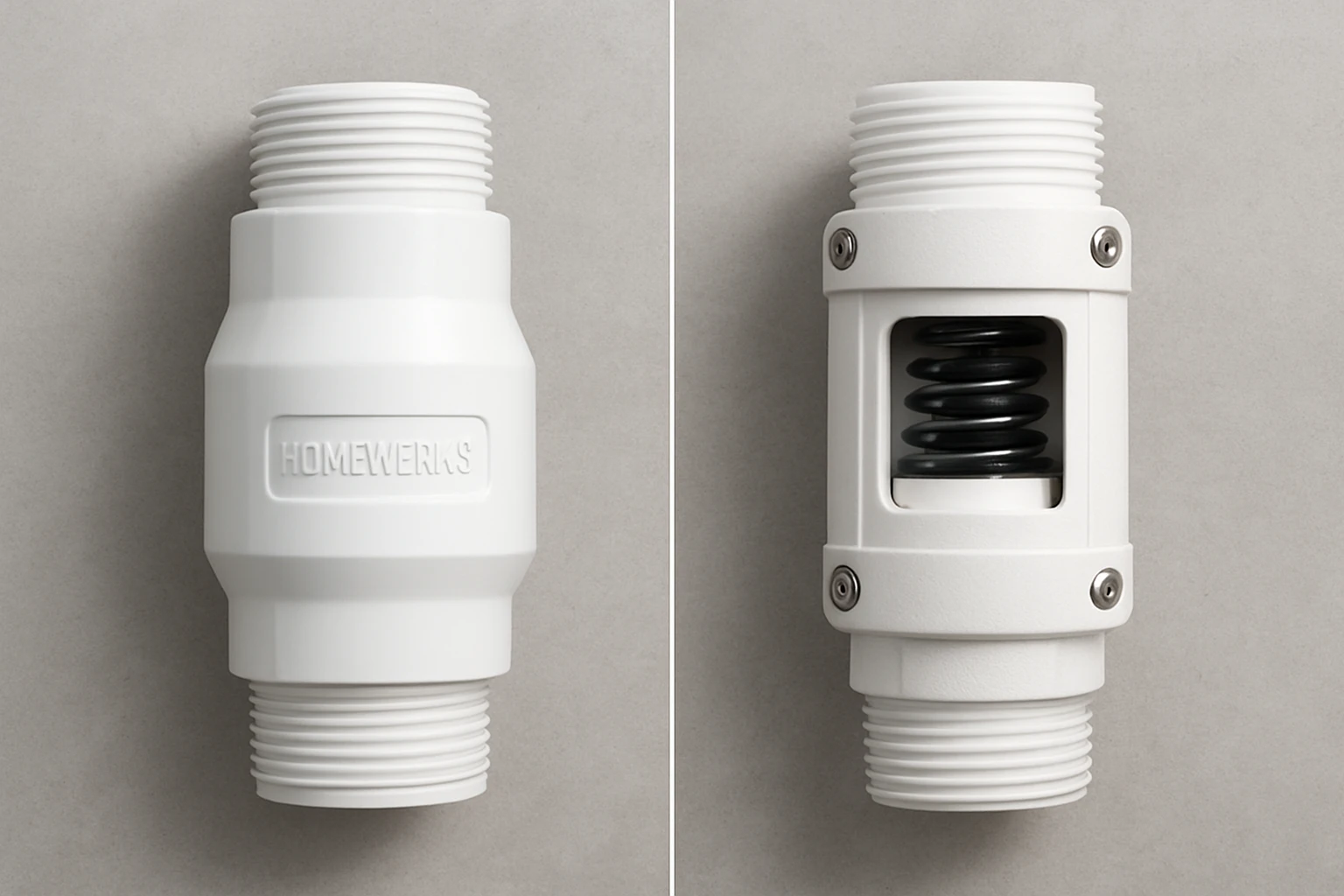
Homewerks 1.5" PVC Check Valve
The Homewerks valve is an in‑line, solvent‑weld PVC Schedule 40 component designed for 1‑1/2 in. connections. It carries a 4.4‑star rating from 477 Amazon reviewers, indicating generally high satisfaction. The product description emphasizes a single application size: "Installation for 1‑1/2 in. SOLVENT x 1‑1/2 in. SOLVENT applications." The simplicity of a pure PVC construction makes it compatible with standard PVC pipe systems and suitable for water lines where chemical resistance is not a primary concern.
FibroPool 1.5" Spring Check Valve
The FibroPool valve combines a spring‑loaded mechanism with a CPVC body and PTFE (polytetrafluoroethylene) seats. Priced at $32.99, it holds a 4.3‑star rating from 230 reviews and is listed as in‑stock. Its key features include a 5 psi spring opening pressure, non‑lubricated PTFE seats, and compatibility with Schedule 40 PVC slip connections. The CPVC construction is marketed for resistance to heat, pool chemicals, and pressure, making it a strong candidate for pool, spa, heater, and salt‑system installations.
Head‑to‑Head Comparison
Price and Value
- Homewerks: Price not disclosed on the product page; however, the absence of a listed price suggests a lower‑cost offering typical of basic PVC valves.
- FibroPool: Clearly priced at $32.99, positioning it in the mid‑range for specialty pool check valves.
When price is the primary driver, the Homewerks valve likely offers a lower upfront cost, while the FibroPool valve justifies its price through additional features such as a spring mechanism and chemical‑resistant materials.
Features and Specifications
| Feature | Homewerks PVC Check Valve | FibroPool Spring Check Valve |
|---|---|---|
| Material | PVC Schedule 40 | CPVC body, PTFE seats |
| Opening Pressure | Passive (no spring) | 5 psi spring‑loaded |
| Connection Type | Solvent‑weld (1‑1/2 in.) | Standard slip (dual 1‑1/2 in.) |
| Temperature Resistance | Typical PVC limits (≈140 °F) | CPVC handles higher temperatures (≈200 °F) |
| Chemical Resistance | Standard for water lines | Designed for pool chemicals and salt systems |
Customer Ratings and Feedback
The Homewerks valve enjoys a 4.4‑star rating based on 477 reviews, reflecting a strong consensus of reliability. Reviewers frequently mention the ease of solvent welding and the valve’s durability in standard water‑line applications. The FibroPool valve holds a 4.3‑star rating from 230 reviews. Customers often praise the spring‑loaded design for preventing backflow in high‑pressure pool circuits and appreciate the PTFE seats for low maintenance. Both products demonstrate consistent satisfaction, though the Homewerks valve has a larger review base, which can provide a broader perspective on long‑term performance.
Performance and Reliability
In purely hydraulic terms, a spring‑loaded valve such as the FibroPool model offers a defined opening pressure (5 psi), ensuring that flow resumes promptly after a pressure drop. This feature is advantageous in pool recirculation loops where pressure fluctuations are common. Conversely, the Homewerks valve relies on passive flow direction, which may be sufficient for residential water supply lines but can be slower to open under low‑pressure conditions. The CPCPV construction of the FibroPool valve also resists degradation from chlorine and salt, extending service life in aggressive pool environments.
Best Use Cases
- Homewerks PVC Check Valve: Ideal for standard residential water lines, irrigation systems, and any application where chemical exposure is minimal and cost sensitivity is high.
- FibroPool Spring Check Valve: Suited for pool and spa plumbing, heater return lines, salt‑water systems, and any scenario demanding reliable backflow protection under varying pressure and chemical conditions.
Pros & Cons
Homewerks 1.5" PVC Check Valve
- Pros: Simple installation with solvent welding, lower cost, high rating from a large review pool, compatible with standard PVC pipe.
- Cons: No spring mechanism, limited temperature and chemical resistance, price not disclosed.
FibroPool 1.5" Spring Check Valve
- Pros: Spring‑loaded 5 psi opening, CPVC body resists heat and chemicals, PTFE seats reduce maintenance, clear price point.
- Cons: Slightly higher price, larger number of duplicate feature listings in description, may be over‑engineered for simple water‑line use.
Recommendations
For homeowners installing a new water‑supply line or upgrading an irrigation system, the Homewerks PVC Check Valve provides adequate protection at a likely lower cost. Those managing a residential pool, spa, or heater system should consider the FibroPool Spring Check Valve because its spring‑loaded design and chemical‑resistant materials align with the demanding environment of pool plumbing.
FAQ
- Can the Homewerks valve be used in a pool system? It can be installed, but the lack of a spring and limited chemical resistance make it less ideal than a CPVC‑based valve.
- What does a 5 psi spring opening mean? The valve will remain closed until water pressure exceeds 5 psi, then it opens fully, preventing backflow during low‑pressure conditions.
- Is PTFE truly lubrication‑free? PTFE (Teflon) provides a low‑friction surface without the need for additional lubricants, reducing wear over time.
- Do both valves require glue for installation? The Homewerks valve uses solvent welding, while the FibroPool valve employs slip‑fit connections that can also be glued for a secure seal.
- Which valve offers better temperature tolerance? The FibroPool CPVC construction tolerates higher temperatures (up to ≈200 °F) compared to standard PVC.
- Are these valves compatible with existing PVC pipe? Yes; both can connect to Schedule 40 PVC, though the FibroPool valve uses slip connections rather than solvent welding.
- How long do the valves typically last? Customer feedback indicates the Homewerks valve performs reliably for several years in water lines, while the FibroPool valve’s chemical‑resistant materials suggest a longer lifespan in pool environments.
Conclusion
Both the Homewerks and FibroPool 1.5" check valves meet the fundamental requirement of preventing backflow, yet they serve distinct market segments. The Homewerks PVC valve excels in simplicity and cost‑effectiveness for standard water‑line use, whereas the FibroPool spring‑loaded CPVC valve delivers enhanced performance for pool and spa systems where pressure fluctuations and chemical exposure are common. Based on the data, the final recommendation is to select the Homewerks valve for ordinary residential plumbing and the FibroPool valve for any pool‑related application.
Products Mentioned in This Review
Frequently Asked Questions
What are the main material differences between the Homewerks 1.5" PVC check valve and the FibroPool 1.5" spring check valve?
The Homewerks valve is made of Schedule 40 PVC, while the FibroPool valve uses a spring‑loaded stainless‑steel body.
Which check valve is better suited for preventing reverse flow in a residential sump pump system?
Both work, but the PVC Homewerks valve is ideal for static pipe installations, whereas the spring‑type FibroPool valve handles pressure fluctuations better.
How does the installation process differ for the Homewerks PVC check valve compared to the FibroPool spring check valve?
The Homewerks valve requires solvent‑weld connections on 1‑1/2" PVC, while the FibroPool valve typically uses threaded or push‑fit fittings and may need spring orientation.
Is the price difference between the Homewerks and FibroPool check valves justified by performance?
FibroPool’s spring design is usually pricier but offers higher reliability under variable flow, whereas Homewerks provides a cost‑effective solution for steady flow applications.
Can either check valve cause damage to a pool pump if installed incorrectly?
Improper installation of either valve can lead to backflow and pump strain, so follow the manufacturer’s guidelines and verify correct orientation.
