Introduction
This guide explains how airflow from heating, ventilation, and air‑conditioning (HVAC) systems directly affects basement humidity levels. Readers will learn the science behind moisture transport, practical methods to improve airflow, and product recommendations that complement a balanced indoor environment. By the end of the article, one will understand how to reduce dampness, prevent mold growth, and select equipment that matches specific basement conditions. The information is presented in a professional tone suitable for homeowners, contractors, and facility managers.
Background / Context
Basements are naturally prone to higher relative humidity because they are partially or fully below ground level, where soil moisture and groundwater can infiltrate the structure. When warm indoor air contacts cooler basement surfaces, condensation forms, raising the moisture content of the air. HVAC systems move air throughout a home, but improper distribution can trap humid air in the lowest levels, creating a feedback loop that encourages mold and structural decay. Understanding the interaction between temperature, airflow, and moisture is essential before implementing corrective measures.
Two key variables determine how effectively a system controls humidity: the volume of air exchanged per hour (measured in cubic feet per minute, CFM) and the temperature differential between supply and return air. A higher CFM promotes mixing, while a modest temperature lift encourages moisture‑laden air to rise and be exhausted. When these variables are balanced, the basement experiences a drier, more stable environment.
Understanding Airflow and Humidity
Airflow can be categorized into three functional zones: supply, return, and exhaust. Supply air delivers conditioned air from the furnace or heat pump, return air collects stale air for re‑conditioning, and exhaust air removes excess moisture to the outdoors. In many homes, the return grille is located on an upper floor, causing humid basement air to rise slowly and remain trapped.
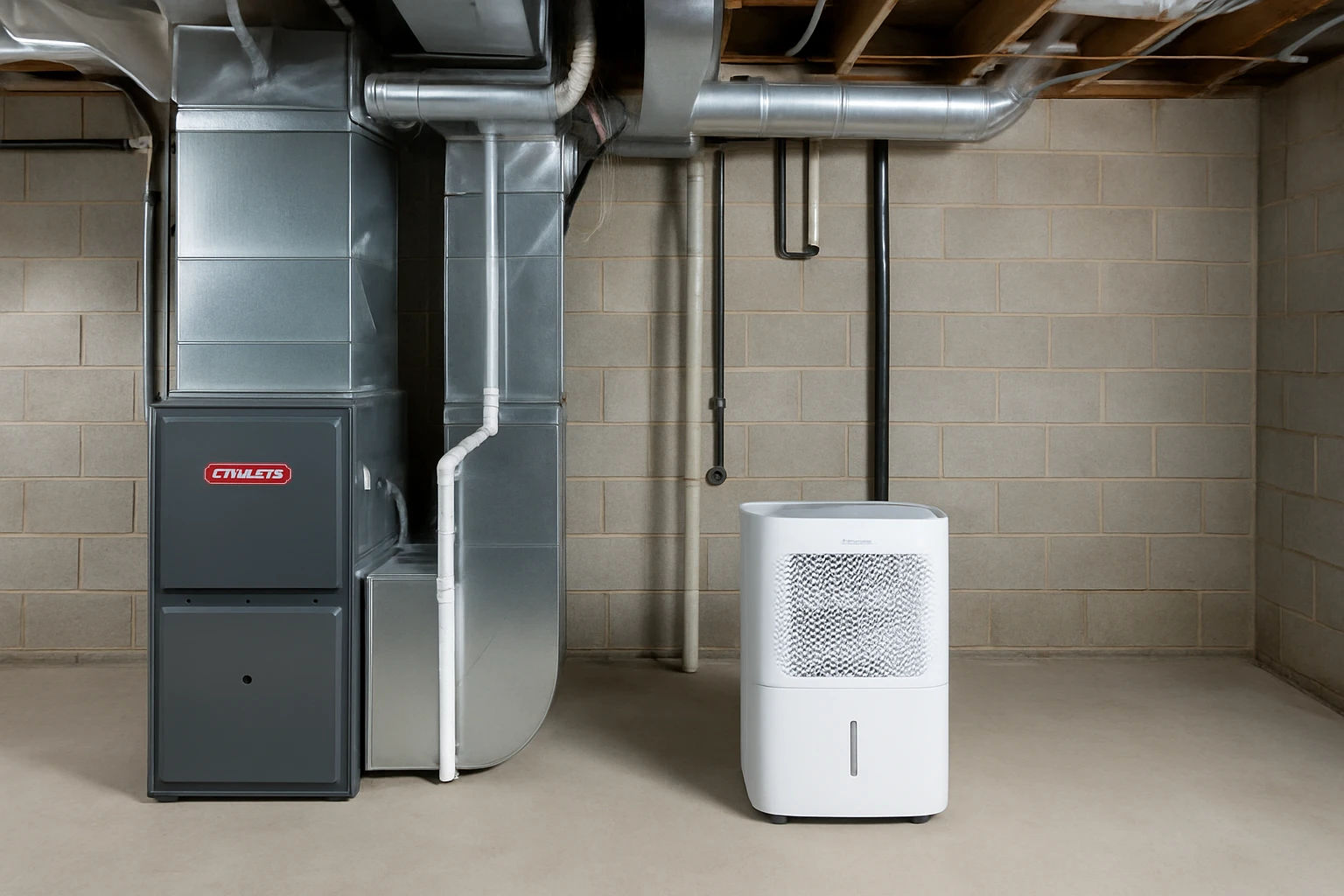
Strategic placement of supply registers and return grilles can create a pressure gradient that pulls moist air upward. For example, installing a low‑velocity supply register near the basement floor and a return grille on the ceiling of the same room encourages a vertical airflow pattern that carries humidity toward the conditioned space. This principle is reinforced by the use of a dedicated dehumidifier, which removes moisture from the air before it re‑enters the HVAC loop.
Optimizing HVAC Airflow for Basement Moisture Control
One of the most effective ways to manage basement humidity is to ensure that the heat pump or furnace delivers sufficient airflow to the lower level. The Goodman 4 Ton SEER2 Heat Pump System provides a robust solution for homes with larger basements or high‑ceiling spaces. With a Seasonal Energy Efficiency Ratio (SEER) of 15.2 and a multi‑position air handler, the system can be configured for upflow, downflow, or horizontal installation, allowing precise airflow direction toward the basement.
The Goodman system includes a direct‑drive 9‑speed ECM blower motor that adjusts speed based on demand, delivering up to 2,400 CFM at maximum setting. This variable speed capability ensures that the basement receives adequate air exchange without creating excessive drafts. Additionally, the system’s R‑32 refrigerant offers higher efficiency and lower global warming potential compared with older refrigerants, contributing to a greener operation.
When installing a heat pump, it is essential to balance duct sizing to avoid static pressure that reduces airflow. Oversized ducts can cause air to move too quickly, limiting moisture removal, while undersized ducts increase resistance and strain the blower. Consulting a qualified HVAC technician to perform a Manual D calculation ensures that ductwork matches the blower’s performance curve.
Dehumidification Solutions Complementing Airflow
Even with optimized airflow, basements often require supplemental dehumidification because the soil’s moisture content can exceed the HVAC system’s latent heat removal capacity. The Waykar 120 Pint Dehumidifier is engineered for large spaces up to 6,000 square feet, making it suitable for most residential basements. It extracts up to 120 pints of water per day at 95°F and 90% relative humidity, a rate that surpasses many standard units tested under less demanding conditions.
Key features of the Waykar unit include an Energy Star rating, which delivers up to 50 % greater efficiency than non‑certified models, and a 30°–90° automatic swing that directs airflow to damp corners. The device operates as quietly as 42 dB, allowing continuous use in living spaces without disturbance. Its built‑in auto‑defrost and memory‑restart functions protect the unit during colder months and power outages, ensuring consistent performance.
For basements with limited drainage options, the Waykar dehumidifier offers a removable 1.14‑gallon tank and a 3.3‑ft drain hose for continuous drainage. The washable air filter captures dust and spores, contributing to a healthier indoor environment. When paired with a properly balanced HVAC airflow, the dehumidifier can maintain relative humidity below 60 %, a threshold that inhibits mold growth.
Comparison / Selection Guide
Choosing the right equipment depends on three primary factors: square‑footage coverage, climate severity, and budget. The table below summarizes the core specifications of the two featured products.
| Feature | Goodman 4 Ton SEER2 Heat Pump System | Waykar 120 Pint Dehumidifier |
|---|---|---|
| Primary Function | Heating and cooling with air distribution | Moisture removal |
| Coverage Area | Up to 2,500 sq ft (depends on duct design) | Up to 6,000 sq ft |
| Energy Efficiency | SEER 15.2, R‑32 refrigerant | Energy Star certified, 50 % higher efficiency |
| Airflow Capacity | Up to 2,400 CFM (9‑speed ECM motor) | Variable fan speeds, 30°–90° swing |
| Noise Level | Typical indoor unit ~55 dB | As low as 42 dB |
| Warranty | 10‑year parts warranty | 2‑year registered warranty |
| Price (USD) | $5,268.00 | $309.99 |
| Rating | 4.5/5 (0 reviews) | 4.3/5 (21,418 reviews) |
For homeowners seeking a comprehensive climate‑control solution, the Goodman heat pump addresses temperature regulation while the Waykar dehumidifier targets moisture removal. In colder regions where heating demand is high, a heat kit compatible with the Goodman system may be required to maintain efficiency.
Best Practices & Tips
- Seal all foundation cracks and install a vapor barrier on walls to reduce ground‑water intrusion.
- Maintain a consistent indoor temperature of 68–72 °F; temperature fluctuations encourage condensation.
- Inspect and clean HVAC filters monthly to ensure unrestricted airflow.
- Use a hygrometer to monitor basement relative humidity; aim for 45–55 % for optimal mold resistance.
- Periodically check the dehumidifier’s water tank or drainage line to avoid overflow.
- Schedule professional duct inspections annually to verify that airflow remains balanced after renovations.
Frequently Asked Questions
- Can a heat pump alone control basement humidity? A heat pump can lower humidity by cooling air below its dew point, but in high‑moisture basements it often requires supplemental dehumidification to achieve target levels.
- How often should the dehumidifier be emptied? When operating with the internal tank, the Waykar unit typically fills within 8‑10 hours at maximum capacity; emptying daily prevents auto‑shutoff and maintains efficiency.
- Is R‑32 refrigerant safe for residential use? R‑32 has a lower global warming potential and operates at higher efficiency; it is approved for residential systems and poses no additional safety risk when installed correctly.
- What CFM rating is ideal for a 1,200 sq ft basement? A general rule is 1 CFM per square foot; therefore, a system delivering at least 1,200 CFM on the lowest level is recommended, adjustable via variable‑speed blower.
- Will continuous drainage affect my home’s plumbing? Continuous drainage should be routed to a floor drain, sump pump, or utility sink; using a condensate pump ensures proper flow when gravity drainage is unavailable.
- How does Energy Star certification impact operating costs? Energy Star units consume up to 50 % less electricity than non‑certified models, resulting in lower utility bills and reduced environmental impact.
- Do I need a professional to install the Waykar dehumidifier? Installation is straightforward; the unit can be placed on the floor with a hose attached to a nearby drain. However, professional assistance is advisable for permanent drainage solutions.
Conclusion
Effective control of basement humidity relies on a balanced approach that combines proper HVAC airflow with targeted dehumidification. By selecting a high‑efficiency heat pump such as the Goodman 4 Ton SEER2 system and pairing it with a capable dehumidifier like the Waykar 120 Pint model, homeowners can achieve a dry, comfortable environment while preventing mold and structural damage. Implementing the best‑practice tips outlined in this guide will further enhance system performance and extend equipment lifespan.
Products Featured in This Guide
Goodman 4 Ton SEER2 Heat Pump System
Price: $5,268.00 | Rating: 4.5/5 (0 reviews)
Featured for its high SEER rating, variable‑speed ECM blower, and flexible multi‑position air handler that enables precise airflow to basements.
Waykar 120 Pint Dehumidifier
Price: $309.99 | Rating: 4.3/5 (21,418 reviews)
Featured for its large coverage area, Energy Star efficiency, and intelligent swing function that enhances moisture removal in spacious basements.