Introduction
Maintaining balanced humidity throughout an entire home improves comfort, protects structures, and reduces mold risk. This guide explains how to design, install, and fine‑tune a multi‑zone dehumidification system that serves every major area. Readers will learn to assess space requirements, select appropriate tools, and configure controls for reliable performance. By following the steps, one can achieve a healthier indoor environment while minimizing energy consumption.
What You'll Need
- Central dehumidifier unit (e.g., a high‑capacity model for the main system)
- Zone‑specific dehumidifiers for smaller areas or crawlspaces
- Flexible drain hoses, pump kits, and condensate pumps
- HVAC ducting or insulated flexible tubing for air distribution
- Smart humidistats or programmable controllers for each zone
- Electrical wiring, circuit breakers, and safety equipment
- Tools: drill, screwdriver set, level, pipe cutter, and sealant
All recommended products are linked in the steps below, and each includes price, rating, and key features drawn from verified Amazon listings.
Step 1: Evaluate Home Zones and Moisture Loads
Begin by mapping each area of the house that requires humidity control, such as basements, bathrooms, living rooms, and crawlspaces. Measure square footage and note typical temperature and relative humidity conditions; this data determines the required pint‑per‑day capacity for each zone. For large open spaces up to 7,000 sq ft, the Waykar 150 Pint Industrial Dehumidifier provides the necessary throughput, removing up to 150 pints per day under high‑humidity conditions. It is Energy Star certified, includes a built‑in pump for flexible drainage, and offers quiet operation, making it ideal for whole‑house central units.
For medium‑sized zones of up to 5,000 sq ft, the Waykar 80 Pint Home Dehumidifier delivers 80 pints per day and features auto‑defrost, a 24‑hour timer, and easy mobility. Its price of $199.98 and 4.4‑star rating make it a cost‑effective solution for living rooms, large bedrooms, or finished basements. By matching capacity to zone size, one avoids undersizing, which leads to excessive run‑time, and oversizing, which wastes electricity.
Step 2: Select a Smart Central Unit for Primary Distribution
The backbone of a multi‑zone system is a central dehumidifier capable of handling the aggregate moisture load. The AEOCKY 4500 Sq.Ft Smart Dehumidifier removes up to 80 pints per day in extreme conditions and is certified as ENERGY STAR Most Efficient 2025. Priced at $239.97 with a 4.5‑star rating, it includes Wi‑Fi connectivity, an intelligent humidistat, and a programmable schedule, allowing remote monitoring via smartphone. Its high‑efficiency rotor compressor and copper‑core heat exchange ensure low power draw, which translates into annual savings of up to $1,000.
Install the central unit in a mechanically ventilated utility closet, ensuring at least 12 inches of clearance on all sides for airflow. Connect the unit to the main power circuit using a dedicated 15‑amp breaker, and attach a condensate pump if a gravity drain is unavailable. The smart controller can be linked to zone thermostats, enabling automated adjustments based on real‑time humidity readings.
Step 3: Install Zone‑Specific Dehumidifiers
For areas that are difficult to reach with ductwork, such as crawlspaces or tight basements, a dedicated unit offers the simplest solution. The Moiswell 155 Pint Commercial Dehumidifier excels in low‑clearance environments, measuring only 22.5 × 14 × 14.7 inches and fitting between floor joists. It removes up to 155 pints per day, making it suitable for large crawlspaces up to 6,000 sq ft, and includes auto‑defrost, auto‑restart, and a 24‑hour timer. At $499.00 and a 4.5‑star rating, it provides industrial‑grade performance for specialized zones.
Place the Moiswell unit on a stable platform, connect the 3.3‑ft drain hose to a floor drain, and set the desired humidity level using the built‑in digital display. For smaller zones like bathrooms, the Waykar 80 Pint model can be positioned on a floor‑level shelf; its four casters allow easy relocation during seasonal adjustments.
Step 4: Route Ductwork and Connect Air Distribution
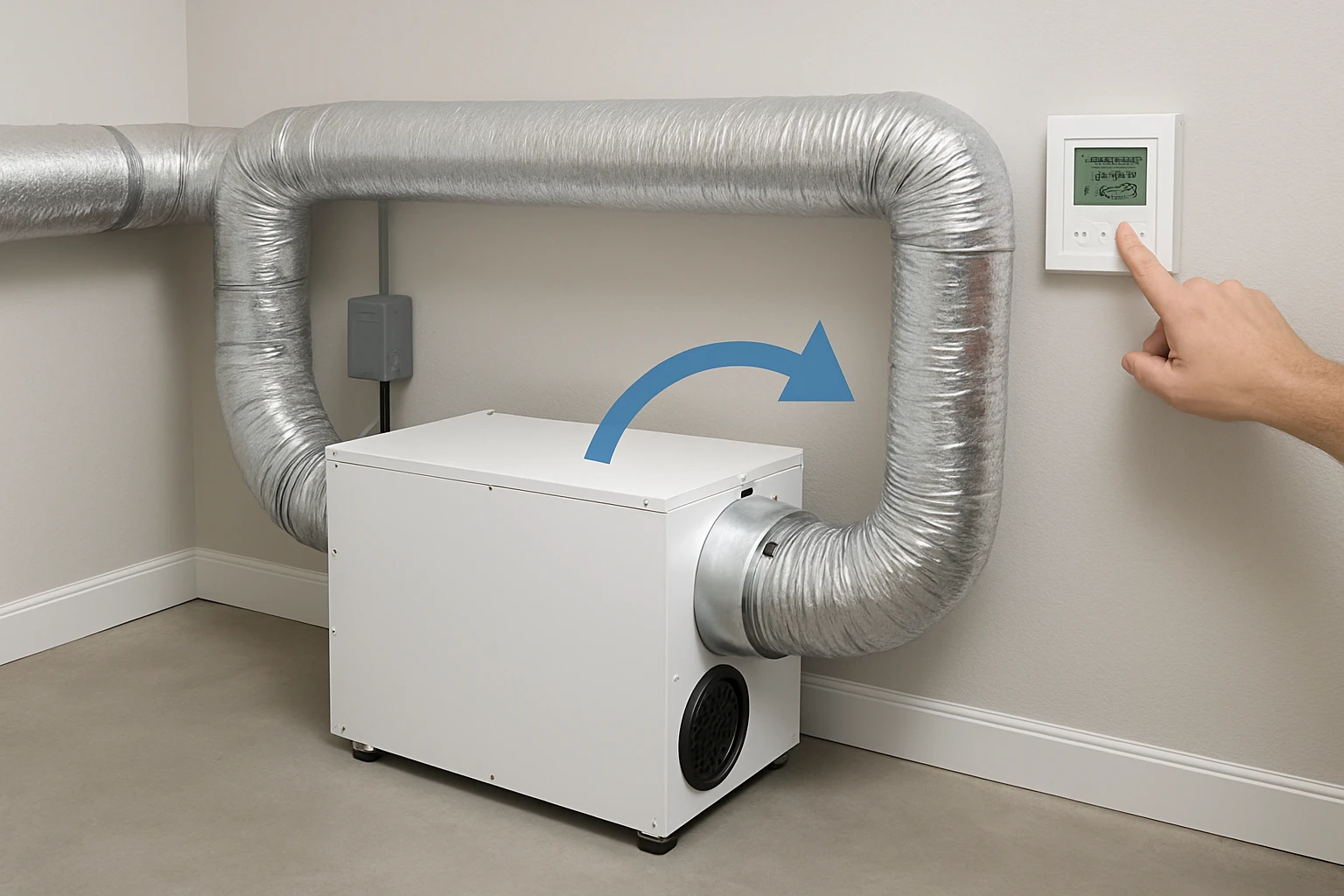
Flexible insulated ducting transports conditioned air from the central dehumidifier to each zone. Use 6‑inch diameter duct for optimal airflow, sealing all joints with foil‑tape to prevent leaks. Install a motorized damper in each branch line; these dampers open or close based on signals from the zone humidistats, ensuring precise control. The central AEOCKY unit’s smart interface can command the dampers via a low‑voltage relay, creating a true multi‑zone system.
When routing ducts through walls or ceilings, maintain a minimum bend radius to reduce static pressure. Secure ducts with metal straps every 4 feet, and insulate them in unconditioned spaces to avoid condensation on the exterior of the pipes. Properly balanced ductwork reduces fan load, extending the life of the central compressor.
Step 5: Set Up Drainage and Condensate Management
Each dehumidifier generates condensate that must be safely removed. The Waykar 150 Pint unit includes a built‑in pump capable of lifting water up to 9.84 ft, allowing drainage to a remote floor drain or sump basin. Connect the pump’s outlet to a 3.3‑ft hose, securing it with a hose clamp. For the Waykar 80 Pint and Moiswell units, use the provided 3.5 L tank or attach a continuous drain hose if a permanent line is available.
Install a condensate alarm near each drain line to alert occupants of blockages or overflow. Regularly inspect the hoses for kinks, and clean the filters on each unit monthly to maintain optimal water extraction efficiency.
Step 6: Electrical Wiring and Safety Checks
All dehumidifiers require a dedicated circuit to prevent overload. Use 14‑gauge wire for 15‑amp circuits and 12‑gauge for 20‑amp circuits, following local electrical codes. Install GFCI outlets in damp locations such as basements and bathrooms, and verify that each unit’s power cord is in good condition before connection.
After wiring, perform a continuity test on each circuit and confirm that the ground fault protection trips correctly. Use a multimeter to verify that the voltage at each unit matches the manufacturer’s specifications (typically 120 V AC). Document all connections in a wiring diagram for future maintenance.
Step 7: Calibration, Programming, and Initial Run
Power on the central AEOCKY dehumidifier and allow it to run for one hour to stabilize its internal sensors. Use the built‑in smart humidistat to set a target humidity of 45 % for the entire house, adjusting each zone’s setpoint based on specific needs (e.g., 50 % for a finished basement, 40 % for a wine cellar). Program the 24‑hour timer on each Waykar unit to operate during peak humidity periods, such as early mornings or evenings.
Run the system in “auto” mode for 24 hours while monitoring temperature and humidity on the LCD displays. Verify that each zone reaches its target within two hours, and that the dampers open and close as expected. Record the run‑time of each unit to assess energy usage and make further adjustments if necessary.
Tips & Pro Tips
- Place dehumidifiers on a level surface and avoid direct contact with walls to allow proper airflow.
- Use a hygrometer calibrated to ±2 % RH to validate sensor accuracy across zones.
- Schedule regular filter cleaning (every 4‑6 weeks) to prevent airflow restriction and microbial growth.
- Consider installing a whole‑house humidistat that integrates with your HVAC thermostat for unified climate control.
- When using the Waykar 150 Pint pump, set the pump’s auto‑restart feature to prevent water backup after power interruptions.
Troubleshooting
Unit does not start: Verify that the circuit breaker is on, the GFCI outlet is not tripped, and the power cord is fully seated. Check the unit’s internal safety switch for a clogged filter.
Excessive noise: Ensure the unit is on a stable, vibration‑isolating pad. For the AEOCKY model, confirm that the compressor is not operating in “high‑speed” mode continuously; adjust the humidistat setpoint to reduce duty cycle.
Water leakage: Inspect the drain hose connections for tightness, and confirm that the pump’s discharge height does not exceed its rated lift. Replace any cracked condensate tank.
Conclusion
By following this guide, one can install a robust multi‑zone whole‑house dehumidification system that balances comfort, energy efficiency, and durability. The combination of a smart central unit, zone‑specific dehumidifiers, and proper ducting ensures each area receives tailored humidity control. Regular maintenance and periodic calibration will keep the system operating at peak performance for years to come. Implementing these steps protects the home’s structure, improves indoor air quality, and reduces long‑term energy costs.
Products Mentioned in This Guide
Frequently Asked Questions
How do I determine the capacity needed for a multi‑zone dehumidifier system?
Calculate total square footage and moisture load, then select a central unit that can handle about 0.5 pints per 100 sq ft per day and add zone units for high‑humidity areas.
What is the best way to route ductwork for even humidity distribution?
Use insulated flexible tubing or HVAC ducts sized for airflow, keep runs short, and balance each zone with dampers or smart humidistats.
Can I use existing HVAC vents for the dehumidifier’s air supply?
Yes, if the vents are properly sized and sealed; integrate the dehumidifier’s supply and return ducts into the HVAC plenum to share airflow.
How often should I clean or replace the filters in a multi‑zone system?
Clean reusable filters every 1–3 months and replace disposable ones annually, or follow the manufacturer’s schedule.
What safety precautions are required when installing the electrical components?
Connect the unit to a dedicated circuit with the correct breaker, use GFCI protection in damp areas, and comply with local code or hire a licensed electrician.