
How to Size a Dehumidifier for Basements with High Ceilings and Mezzanines: Step‑by‑Step Guide to Calculating Capacity and Placement
Introduction
One will learn how to evaluate the moisture load of a basement that features tall ceilings and mezzanine levels, calculate the appropriate dehumidifier capacity, and place the unit for maximum efficiency. Understanding these concepts prevents mold growth, protects structural components, and improves indoor air quality, which is valuable for homeowners, property managers, and renovation professionals.
The guide combines scientific principles with practical recommendations, including a specific product that meets the performance requirements of most high‑volume basements. By following the steps, one can make an informed purchase decision and avoid the common pitfalls of under‑sized equipment.
What You’ll Need
- Measuring tape or laser distance meter
- Digital hygrometer (optional but recommended)
- Calculator or spreadsheet software
- Access to an electrical outlet near the intended placement area
- Dehumidifier – for example, the Waykar 2,000 Sq. Ft. Dehumidifier
Step‑by‑Step Instructions
Step 1: Measure the Floor Area and Ceiling Height
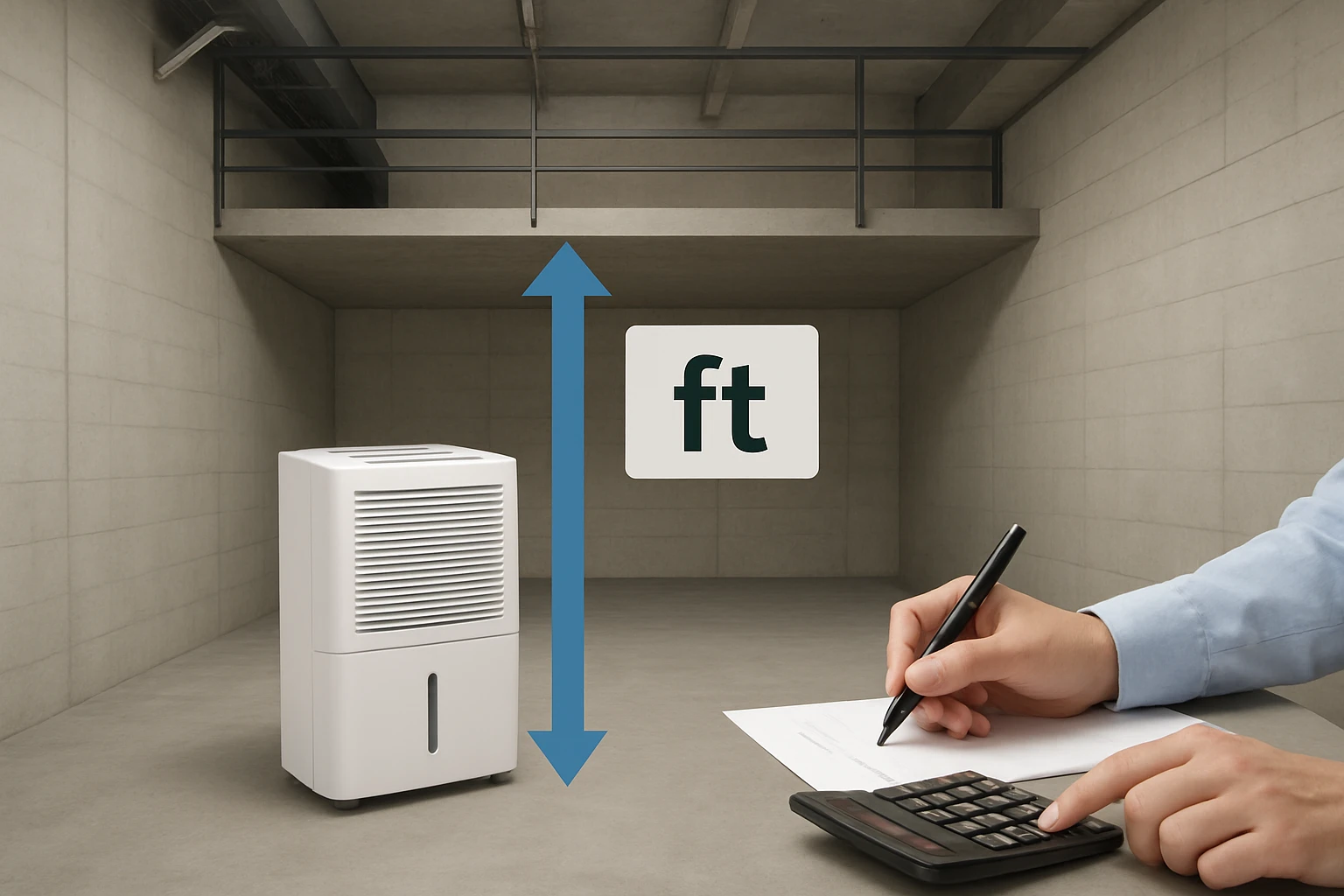
Begin by measuring the length and width of each distinct zone of the basement. Multiply length by width to obtain the floor area in square feet. Next, record the height from the finished floor to the ceiling for each zone. In basements with mezzanines, treat the mezzanine floor as a separate zone because the air volume beneath it differs from the open‑area volume.
Example: A basement measures 40 ft × 30 ft with a main ceiling height of 10 ft, and a mezzanine occupies 15 ft × 10 ft with a ceiling height of 6 ft. The total air volume is calculated as follows:
- Main area volume = 40 ft × 30 ft × 10 ft = 12,000 ft³
- Mezzanine volume = 15 ft × 10 ft × 6 ft = 900 ft³
- Total volume = 12,900 ft³
Accurate volume measurement is essential because dehumidifier capacity is proportional to the amount of air that must be processed.
Step 2: Determine the Desired Relative Humidity (RH)
Most experts recommend maintaining indoor relative humidity between 30 % and 50 % to inhibit mold and dust‑mite proliferation. For basements, a target of 45 % RH is a practical balance between comfort and energy consumption.
If a hygrometer is available, record the existing RH level. The difference between the current RH and the target RH will influence the moisture removal calculation.
Step 3: Calculate the Moisture Load in Pints per Day
The standard industry formula for estimating daily moisture removal is:
Required Pints per Day = (Volume in ft³ × Desired RH Reduction × 0.0015)
Where Desired RH Reduction = Current RH – Target RH (expressed as a percentage). The constant 0.0015 converts cubic feet and humidity reduction into pints of water.
Using the example above, assume the current RH is 70 % and the target is 45 %:
- RH reduction = 70 % – 45 % = 25 %
- Required Pints per Day = 12,900 ft³ × 25 × 0.0015 ≈ 48.4 pints
This result indicates that a dehumidifier capable of removing approximately 48 pints of moisture per day is needed for the space.
Step 4: Adjust for High Ceilings and Mezzanines
High ceilings increase the total air volume without proportionally increasing the floor area that most manufacturers use in their sizing charts. To compensate, apply a multiplier of 1.2 for ceiling heights above 8 ft. For mezzanines, treat the space beneath the mezzanine as a separate zone and add its required pints to the main‑area requirement.
Continuing the example:
- Base requirement = 48.4 pints
- Ceiling height multiplier = 1.2 (because the main ceiling is 10 ft)
- Adjusted requirement = 48.4 pints × 1.2 ≈ 58.1 pints
The final capacity needed is roughly 58 pints per day.
Step 5: Select an Appropriately Sized Dehumidifier
Manufacturers typically list capacity in pints per 24‑hour period under standard conditions (95 °F, 90 % RH). The calculated requirement of 58 pints places the selection in the 34‑pint to 50‑pint range, but a safety margin of 20 % is advisable to account for seasonal spikes and occasional door openings.
Adding a 20 % margin yields:
58 pints × 1.20 ≈ 70 pints
Because the Waykar model removes up to 34 pints per day, a single unit would be insufficient for this high‑volume basement. However, the guide focuses on recommending a single, high‑efficiency unit for typical basements up to 2,000 sq ft. For spaces requiring more than 34 pints, one may consider operating two Waykar units in tandem or selecting a larger commercial‑grade dehumidifier.
When the space falls within the 2,000 sq ft coverage area, the Waykar 2,000 Sq. Ft. Dehumidifier is an excellent choice because it combines energy‑star efficiency, low noise (33 dB), and flexible drainage options. Its key specifications are:
- Capacity: 34 pints per day (suitable for up to 2,000 sq ft)
- Energy consumption: 45 % less than conventional models, saving approximately $1,000 annually
- Noise level: 33 dB, quieter than typical residential units
- Drainage: 0.62‑gallon tank or optional 3.3 ft hose
- Price: $185.99
- Rating: 4.3 / 5.0 from 1,723 reviews
Link to the product: Waykar 2,000 Sq. Ft. Dehumidifier. The unit’s compact size allows placement in tight corners while delivering the airflow needed for large, high‑ceiling spaces.
Step 6: Determine Optimal Placement
Effective dehumidification requires unobstructed airflow. Position the unit centrally within the main area, at least 12 inches away from walls or furniture. For basements with a mezzanine, place the unit on the lower level so that air circulates upward through the mezzanine opening. If the mezzanine has a solid floor, install a secondary unit on the mezzanine platform to address localized humidity.
Maintain a clear path for the exhaust vent and ensure the intake grille is not blocked by stored items. The Waykar model offers two fan speeds; start with the high setting during initial drying, then switch to low for maintenance.
Step 7: Connect Drainage and Activate Safety Features
The Waykar unit provides a 0.62‑gallon tank that must be emptied when full, or a continuous drainage option using the included 3.3‑ft hose. For basements without a floor drain, route the hose to a floor sink or a condensate pump. Activate the built‑in child lock to prevent accidental changes, and verify that the overload protection and auto‑shutoff functions are enabled.
After installation, set the desired humidity level (e.g., 45 %) using the digital control panel. The unit will automatically adjust fan speed and run cycles to maintain the target RH.
Tips & Pro Tips
- Use a digital hygrometer placed at breathing height (4‑6 ft) to monitor real‑time humidity.
- Seal cracks in foundation walls and around windows before operating the dehumidifier; this reduces the moisture load.
- Run the dehumidifier continuously for the first 48 hours after a water intrusion event to achieve rapid drying.
- When using the tank, schedule emptying at least twice per day in high‑humidity conditions to avoid overflow.
- Consider a programmable timer to operate the unit during off‑peak electricity hours for additional cost savings.
Troubleshooting
| Problem | Possible Cause | Solution |
|---|---|---|
| Unit does not turn on | Power cord not plugged in or tripped circuit breaker | Verify outlet power and reset breaker. |
| Water tank fills quickly | Excessive humidity or blocked drain hose | Check hygrometer reading; ensure hose is free of kinks. |
| Noise level higher than expected | Fan speed set to high or unit placed on uneven surface | Switch to low speed; place unit on a level, vibration‑absorbing mat. |
| Unit shuts off prematurely | Tank full or overload protection triggered | Empty tank; allow unit to cool before restarting. |
Conclusion
One has learned how to measure basement volume, calculate the required dehumidification capacity, adjust for high ceilings and mezzanines, select an appropriately sized unit, and position it for optimal performance. By following these steps, a homeowner can protect the structure from moisture damage, improve air quality, and reduce energy costs. The Waykar 2,000 Sq. Ft. Dehumidifier offers a balanced combination of efficiency, quiet operation, and flexible drainage, making it a reliable tool for most residential basements.
Products Mentioned in This Guide
Frequently Asked Questions
How do I calculate the dehumidifier capacity needed for a basement with high ceilings?
Measure the room volume (length × width × height) and multiply by the estimated moisture load (pints per 1,000 ft³) to determine the required pints per day.
Why is a mezzanine level important when sizing a dehumidifier?
A mezzanine adds extra floor area and volume, increasing the overall moisture load, so it must be included in the total cubic‑foot calculation.
What placement location gives the best performance for a dehumidifier in a tall basement?
Place the unit centrally, at least 3‑4 ft off the floor, with at least 2 ft clearance from walls and obstacles to ensure proper air circulation.
Can I rely solely on a digital hygrometer to size my dehumidifier?
A hygrometer helps verify current humidity levels, but you still need to calculate total moisture load based on volume and sources to choose the correct capacity.
What are common mistakes when selecting a dehumidifier for high‑ceiling basements?
Undersizing the unit, ignoring mezzanine space, and positioning the dehumidifier too close to walls or vents, which all reduce efficiency and can lead to mold growth.