Introduction
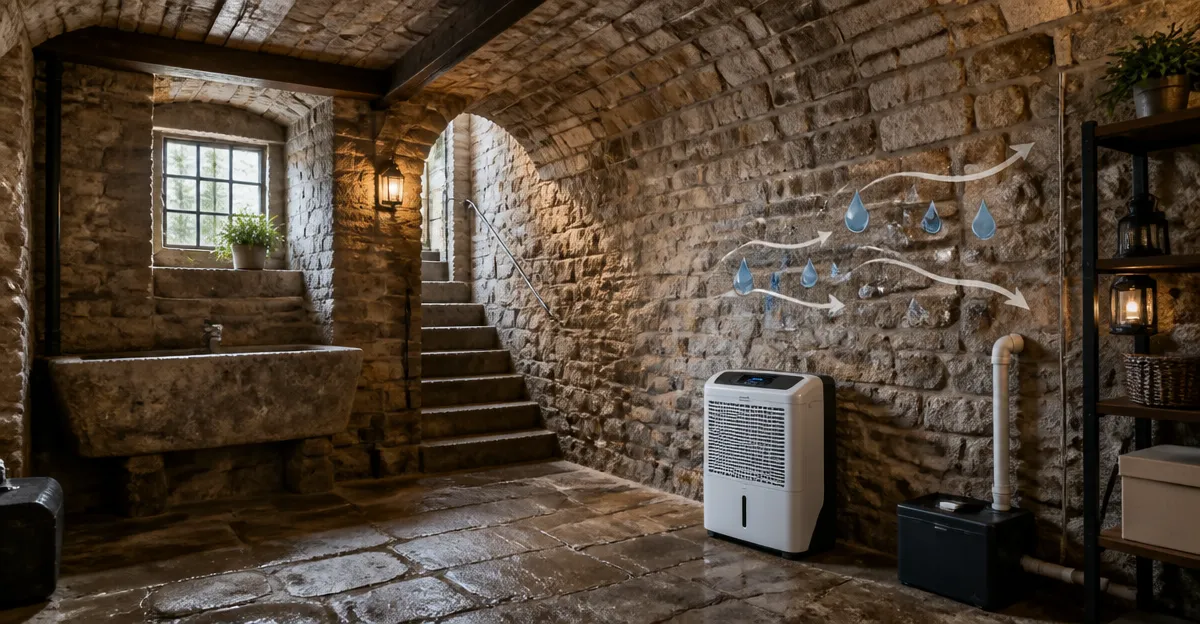
Historic masonry basements present unique challenges for moisture management. Their thick stone or brick walls, often built before modern waterproofing standards, can absorb and retain water, creating conditions that foster mold, rot, and structural deterioration. This guide explains the science of humidity control, outlines practical mitigation strategies, and recommends three highly rated dehumidifiers that complement traditional methods. Readers will learn how to assess moisture sources, select appropriate equipment, and implement best‑practice maintenance routines to preserve the integrity of historic foundations.
Background and Context
Moisture intrusion in masonry is driven by three primary mechanisms: capillary rise, vapor diffusion, and external water pressure. Capillary rise occurs when groundwater travels upward through porous bricks, while vapor diffusion allows humid indoor air to condense on cooler surfaces. External pressure, such as hydrostatic forces from surrounding soil, can force water through cracks and joints. Understanding these mechanisms is essential for selecting the most effective control measures.
Relative humidity (RH) above 60 % typically creates an environment conducive to mold growth. Historic basements often lack mechanical ventilation, making RH levels fluctuate dramatically with seasonal changes. Maintaining RH between 30 % and 50 % is generally recommended for preservation of both the structure and stored belongings.
Modern dehumidification technology, when combined with proper drainage, sealing, and ventilation, can dramatically reduce indoor moisture without compromising the historic fabric of the building.
Assessing Moisture Sources
Before installing any equipment, conduct a thorough moisture audit. Key steps include:
- Inspect exterior walls for cracks, deteriorated mortar, and missing flashing.
- Measure interior surface moisture with a hygrometer or moisture meter; values above 15 % indicate significant dampness.
- Check for condensation on cold surfaces, which signals vapor diffusion problems.
- Evaluate drainage around the foundation; ensure gutters and downspouts direct water at least six feet away.
Document findings in a log, noting temperature, RH, and any visible water stains. This data will guide the selection of dehumidification capacity and supplemental measures.
Strategic Moisture Mitigation
Effective humidity control combines passive and active approaches. The following strategies are organized by their primary function.
Passive Measures
- Exterior Waterproofing: Apply a breathable, vapor‑permeable sealant to exterior brick to repel liquid water while allowing trapped moisture to escape.
- Interior Sealants: Use lime‑based mortars for repointing historic brick; they maintain breathability compared to cement‑based products.
- Improved Drainage: Install French drains or interior perimeter drainage systems to lower groundwater tables.
- Ventilation: Incorporate low‑flow exhaust fans or passive vents to exchange stale, humid air with drier outdoor air.
Active Measures
- Dehumidification: Deploy a dehumidifier sized for the square footage and expected moisture load. Capacity is measured in pints per day; larger basements require higher capacity units.
- Temperature Control: Use space heaters or heat pumps to raise indoor temperature modestly, reducing condensation risk.
- Continuous Drainage: Connect dehumidifiers to a floor drain or sump pump to avoid manual emptying.
When historic preservation is a priority, select equipment that operates quietly, consumes minimal energy, and can be placed without altering original finishes.
Product Recommendations
Three dehumidifiers meet the criteria of efficiency, smart control, and adaptability for historic basements. The first mention of each product includes a direct affiliate link.
1. TCL 50-Pint Smart Dehumidifier
This Energy Star® certified unit removes up to 50 pints per day and covers up to 4,500 sq ft, making it suitable for large historic basements. It integrates with Alexa and Google Assistant, allowing voice‑activated adjustments. Key features include a 24‑hour timer, built‑in drain pump, and a removable water bucket. At a price of $291.47 and a rating of 4.5 / 5 from 26 reviews, it offers high capacity while maintaining energy efficiency.
- Capacity: 50 pints/day
- Coverage: 4,500 sq ft
- Smart Control: Alexa, Google Assistant, TCL Home app
- Drain Options: Built‑in pump or manual bucket
- Energy Star 2024 Most Efficient list
2. VEAGASO 34-Pint Dehumidifier
Designed for spaces up to 2,500 sq ft, this unit offers three smart modes—DEHU, DRY, and CONT—tailored for everyday humidity control, rapid clothes drying, and continuous operation in damp areas. It features a 0.53‑gallon tank, optional continuous drainage hose, and an intuitive LED touch panel. Priced at $139.94 with a 4.5 / 5 rating from 2,943 reviews, it provides a cost‑effective solution for medium‑sized historic basements.
- Capacity: 34 pints/day
- Coverage: 2,500 sq ft
- Modes: DEHU, DRY, CONT
- Noise Level: ≤40 dB
- Drainage: Manual tank or hose
3. KeepGlad 98oz Dehumidifier
Ideal for smaller basements or auxiliary rooms, this compact unit extracts up to 40 oz (approximately 0.5 pint) per day at 86 °F and 80 % RH. It includes a dual‑core hurricane dehumidification system, washable filter, and an automatic shut‑off with red‑light warning. The device operates below 30 dB in sleep mode and offers seven ambient light colors for visual feedback. At $69.99 and a 4.6 / 5 rating from 73 reviews, it delivers quiet performance for limited‑area humidity control.
- Capacity: 40 oz/day (≈0.5 pint)
- Coverage: 1,000 sq ft
- Features: Dual‑core system, washable filter, automatic shut‑off
- Noise: <30 dB in sleep mode
- Ambient lighting: 7 colors
Comparison and Selection Guide
| Feature | TCL 50‑Pint Smart | VEAGASO 34‑Pint | KeepGlad 98oz |
|---|---|---|---|
| Coverage (sq ft) | 4,500 | 2,500 | 1,000 |
| Daily Removal (pints) | 50 | 34 | 0.5 |
| Smart Integration | Alexa, Google, App | LED touch only | None |
| Noise Level | Typical dehumidifier range | ≤40 dB | <30 dB |
| Price | $291.47 | $139.94 | $69.99 |
| Average Rating | 4.5/5 (26 reviews) | 4.5/5 (2,943 reviews) | 4.6/5 (73 reviews) |
Choose the TCL model for expansive basements where high capacity and remote control are essential. Opt for the VEAGASO unit when moderate coverage and multiple operation modes are desired, especially in basements that also serve as laundry or workshop spaces. The KeepGlad device is best suited for small auxiliary rooms, closets, or as a supplemental unit alongside a larger system.
Best Practices & Tips
- Calibrate Sensors: Place hygrometers away from doors and vents to obtain accurate RH readings.
- Set Appropriate Humidity Targets: Aim for 40 % RH in winter and 45 % RH in summer; avoid setting the dehumidifier too low, which can over‑dry historic masonry.
- Use Continuous Drainage: Connect the built‑in pump of the TCL unit or the hose of the VEAGASO model to a floor drain to prevent bucket overflow.
- Schedule Maintenance: Clean filters monthly, inspect drainage hoses for clogs, and verify that the unit’s condensate pump functions correctly.
- Combine with Ventilation: Run a low‑flow exhaust fan for 10‑15 minutes each hour during high‑humidity periods to promote air exchange.
- Monitor Energy Consumption: Use a smart plug or energy monitor to track usage; Energy Star models typically consume 30‑40 % less power.
- Preserve Historic Finishes: Position dehumidifiers on rubber‑footed pads to avoid direct contact with original flooring.
Frequently Asked Questions
- Can a dehumidifier replace exterior waterproofing? No. Dehumidifiers manage indoor moisture, but water that continuously penetrates walls will eventually overwhelm any unit. Exterior waterproofing remains a primary defense.
- How often should I empty the water tank? With continuous drainage enabled, manual emptying is unnecessary. If using a bucket, empty it when the indicator signals full—typically every 24‑48 hours in damp basements.
- Is it safe to run a dehumidifier in a room with antique books or artwork? Yes, provided the humidity is kept within the recommended 30‑50 % range. Excessively low RH can cause paper to become brittle, so avoid settings below 30 %.
- Do smart dehumidifiers require a constant Wi‑Fi connection? They function normally without Wi‑Fi; however, remote monitoring and voice commands require an active internet connection.
- What size dehumidifier is needed for a 3,000 sq ft basement? A unit capable of 40‑45 pints per day is advisable. The TCL 50‑Pint model comfortably covers this area, while the VEAGASO 34‑Pint could be supplemented with a second unit.
- Can I place a dehumidifier directly on concrete floors? Yes, but use a moisture‑resistant mat to prevent potential corrosion of the unit’s base and to protect historic flooring finishes.
- How does temperature affect dehumidifier efficiency? Dehumidifiers extract more moisture at higher temperatures. In colder basements, consider a model with an auto‑defrost feature, such as the KeepGlad unit.
Conclusion
Effective humidity control in historic masonry basements requires a balanced approach that respects the building’s original materials while leveraging modern technology. By conducting a thorough moisture audit, implementing passive waterproofing and ventilation, and selecting an appropriately sized dehumidifier, owners can prevent mold, protect structural integrity, and extend the lifespan of treasured historic features. The products highlighted in this guide—each with distinct capacities, smart capabilities, and quiet operation—provide flexible options for a range of basement sizes and preservation goals.
Products Featured in This Guide
TCL 50-Pint Smart Dehumidifier
Price: $291.47 | Rating: 4.5/5 (26 reviews)
Featured for its high 50‑pint capacity, Energy Star efficiency, and voice‑activated smart control, making it ideal for large historic basements.
VEAGASO 34-Pint Dehumidifier
Price: $139.94 | Rating: 4.5/5 (2,943 reviews)
Featured for its versatile three‑mode operation, quiet performance, and affordable price, suitable for medium‑sized basements.
KeepGlad 98oz Dehumidifier
Price: $69.99 | Rating: 4.6/5 (73 reviews)
Featured for its ultra‑quiet operation, built‑in automatic shut‑off, and ambient lighting, perfect for small rooms or supplemental use.