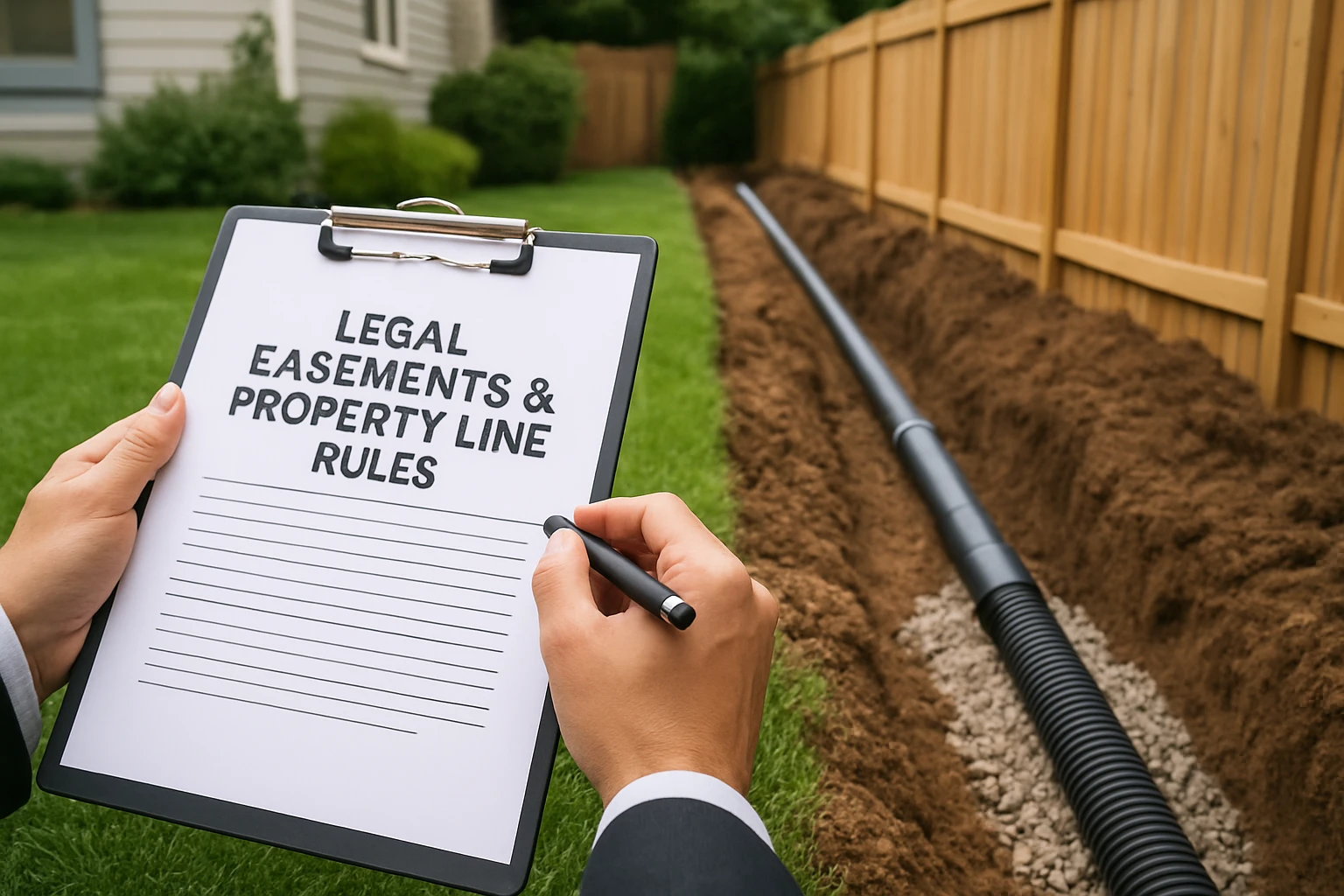

Legal Easements & Property Line Rules for Routing Exterior Drains: A Homeowner’s Step-by-Step Guide to Compliance, Permits & Best Practices
Introduction
This guide explains the legal framework that governs the placement of exterior drainage systems on residential properties. Readers will learn how easements, property line restrictions, and local permitting processes interact with practical installation considerations. The article also recommends reliable tools, such as Keyfit Tools Property Markers, that assist in accurate boundary identification. By the end of the guide, homeowners will possess a clear roadmap for compliant and efficient drain routing.
Background and Context
Exterior drains are essential for managing surface water, preventing foundation damage, and protecting landscaping investments. However, the placement of these systems often intersects with legal concepts such as easements, right‑of‑way, and lot line setbacks. An easement is a non‑possessory right that permits a third party to use a portion of land for a specific purpose, such as utility access or drainage. Understanding whether a proposed drain path crosses an easement is the first step toward avoiding costly disputes.
Local jurisdictions typically adopt building codes that prescribe minimum distances between drainage structures and property boundaries. These codes are enforced through the permitting process, which may require site plans, engineering calculations, and proof of boundary surveys. Failure to obtain the proper approvals can result in fines, forced removal of the system, or legal action from neighboring owners.
Survey markers are the most reliable method for confirming the exact location of property lines and easement boundaries. Modern markers, such as stainless‑steel property stakes, provide durability and visibility even in harsh soil conditions. Selecting a high‑quality marker reduces the risk of misplacement and supports compliance documentation.
Understanding Legal Easements
An easement can be created by deed, contract, prescription, or necessity. Deed‑based easements are recorded in the county land records and are typically permanent unless expressly terminated. Contractual easements arise from agreements between property owners, often for shared driveways or drainage rights. Prescription easements develop over time when a party openly and continuously uses a portion of land without permission for a statutory period, usually ten to twenty years depending on state law.
Homeowners should obtain a copy of the recorded easement map during the title search phase. The map will indicate the width, orientation, and purpose of each easement. In many cases, a utility easement will allow the installation of drainage pipes, provided the work does not interfere with the utility’s operation.
If an easement is identified, the homeowner must seek written consent from the easement holder before proceeding. Consent may be granted through a simple amendment to the easement agreement or through a formal variance from the local planning commission.
Assessing Property Lines for Drain Routing
Accurate determination of property boundaries is essential before any excavation begins. Professional land surveys provide the highest level of certainty, but homeowners can perform a preliminary assessment using reliable markers. The Keyfit Tools Property Markers are engineered for this purpose. Each marker features a 3‑inch diameter, 304 stainless‑steel plaque that resists corrosion and can be driven into soil, gravel, or even frozen ground.
These markers are designed with a low‑profile, mow‑over shape that prevents interference with lawn maintenance equipment. The bronze‑plated, self‑drilling screw anchor ensures a secure fit without the need for additional fasteners. A removable protective film protects the finish during installation and storage.
To use the markers, one should first locate the existing corner stakes or survey pins and verify their accuracy against the recorded plat. The markers are then positioned at the intended drain route intersection points, providing a visible reference for contractors and permitting officials.
Obtaining Permits and Approvals
The permitting process varies by jurisdiction but generally follows a consistent sequence. First, the homeowner prepares a site plan that illustrates the proposed drain layout, including pipe diameters, slopes, and connection points. Second, the plan must reference the property line locations confirmed by the survey markers.
Next, the plan is submitted to the local building department along with any required engineering reports. Some municipalities require a certified civil engineer to sign off on the design, especially when the drain discharges to a public storm sewer. The review period typically lasts two to four weeks, during which the department may request clarifications or modifications.
Once the permit is issued, the homeowner must display the permit number at the job site and adhere to any inspection schedules. Final inspection confirms that the installation matches the approved plan and that no easement violations occurred.
Choosing the Right Survey Markers
When selecting markers for boundary identification, durability, visibility, and ease of installation are paramount. The Keyfit Tools Property Markers excel in each of these categories. Their 304 stainless‑steel construction offers superior corrosion resistance compared with galvanized or painted alternatives. The 10‑inch long anchor provides sufficient embedment depth for stability in loose or compacted soils.
Customers rate the product 4.6 out of 5 stars based on 168 reviews, highlighting its robustness and low‑profile design. The markers are sold in a four‑pack, which is sufficient for most residential projects that require corner and mid‑line staking.
Alternative products on the market may include plastic or aluminum stakes, but these often suffer from reduced longevity and may bend under heavy equipment. For projects that demand long‑term accuracy, stainless‑steel markers represent the most reliable investment.
Installation Best Practices for Exterior Drains
After securing permits and confirming boundary locations, the homeowner can begin excavation. It is advisable to dig a shallow trench first to expose any existing utilities, which can be identified using a utility locator service. The trench depth should accommodate the pipe diameter plus a minimum of six inches of cover to protect against surface loads.
Pipe slope is critical for proper drainage; a standard recommendation is a one‑percent grade, or one foot of drop per 100 feet of run. The slope can be measured using a laser level or a transit, both of which provide precise elevation data.
When the pipe is laid, it should be surrounded by a bedding material such as sand or fine gravel to promote uniform support. A filter fabric can be placed over the bedding to prevent soil intrusion. Finally, the trench is backfilled in layers, compacting each layer to avoid future settlement.
Comparison and Selection Guide
| Feature | Keyfit Tools Property Markers | Typical Plastic Stakes | Aluminum Stakes |
|---|---|---|---|
| Material | 304 Stainless Steel (corrosion‑resistant) | Polyethylene (prone to UV degradation) | Aluminum (moderate corrosion resistance) |
| Anchor Length | 10 inches (self‑drilling) | 6‑8 inches (requires pre‑drilling) | 8‑10 inches (requires hammering) |
| Profile | Low‑profile, mow‑over design | High‑profile, may obstruct mowing | Medium profile, may interfere with equipment |
| Rating | 4.6/5 (168 reviews) | Varies, generally lower | Varies, generally lower |
| Pack Size | 4‑Pack | Typically 10‑Pack | Typically 5‑Pack |
Homeowners who prioritize durability and minimal maintenance should select the stainless‑steel option. Those on a tight budget may consider plastic stakes, but they should be aware of the reduced lifespan and potential for breakage during installation.
Best Practices & Tips
- Document every step of the boundary verification process, including photographs of the placed markers.
- Maintain a copy of the recorded easement map and any written consents in a readily accessible location.
- Use a reputable contractor who is familiar with local drainage codes and easement considerations.
- Consider installing a clean‑out access point at strategic locations to facilitate future maintenance.
- Schedule a post‑installation inspection with the building department to verify compliance before finalizing the project.
Frequently Asked Questions
- Do I need a professional survey to install an exterior drain? While a professional survey provides the highest level of certainty, many homeowners can verify boundaries using high‑quality markers such as the Keyfit Tools Property Markers in conjunction with the recorded plat.
- Can I install a drain within a utility easement? Installation within a utility easement is permissible only with written consent from the easement holder and often requires additional engineering review.
- What slope is required for a typical residential drain? A one‑percent slope (one foot of vertical drop per 100 feet of horizontal run) is the standard recommendation for gravity‑driven systems.
- How long do stainless‑steel property markers last? The 304 stainless‑steel composition resists rust and corrosion, providing a service life of many decades even in harsh environments.
- Do I need a permit for a small curbside drain? Most jurisdictions require a permit for any permanent drainage alteration that connects to a public storm sewer, regardless of size.
- What should I do if my neighbor objects to the drain route? Engage in a dialogue to understand the concern, review easement documents, and, if necessary, seek mediation or a formal variance.
- Is it safe to install a drain in frozen ground? The stainless‑steel markers are designed to be driven into frozen ground, but pipe installation should be scheduled for a season when the soil is thawed to ensure proper bedding and compaction.
Conclusion
Routing exterior drains requires a careful balance of legal compliance, engineering precision, and practical execution. By understanding easements, confirming property lines with reliable markers, and adhering to permitting procedures, homeowners can avoid disputes and ensure the longevity of their drainage solutions. The recommended Keyfit Tools Property Markers provide an effective tool for boundary verification, supporting both regulatory compliance and project efficiency.
Products Featured in This Guide
Keyfit Tools Property Markers
Rating: 4.6/5 (168 reviews)
Why featured: Provides durable, low‑profile stainless‑steel markers that ensure accurate property line identification for drainage projects.