Seasonal Basement Humidity Setpoints by Region: The Complete Homeowner’s Guide
Introduction
Basement humidity control is a critical, yet often overlooked, component of home maintenance. Maintaining the correct relative humidity (RH) prevents mold growth, protects structural components, and improves indoor air quality. This guide explains how seasonal setpoints differ across U.S. climate regions and provides actionable strategies for homeowners. Readers will also discover two highly rated humidity controllers that simplify automation and enhance energy efficiency.
Background and Context
Relative humidity measures the amount of water vapor present in the air compared to the maximum amount the air can hold at a given temperature. In basements, RH values above 60 % frequently lead to condensation on cold surfaces, creating an environment where mold spores thrive. Conversely, RH below 30 % can cause wood to shrink, leading to cracks in flooring and framing. The United States spans several climate zones—cold, temperate, and warm—each requiring distinct seasonal setpoints to balance moisture control with energy consumption.
Understanding Regional Humidity Patterns
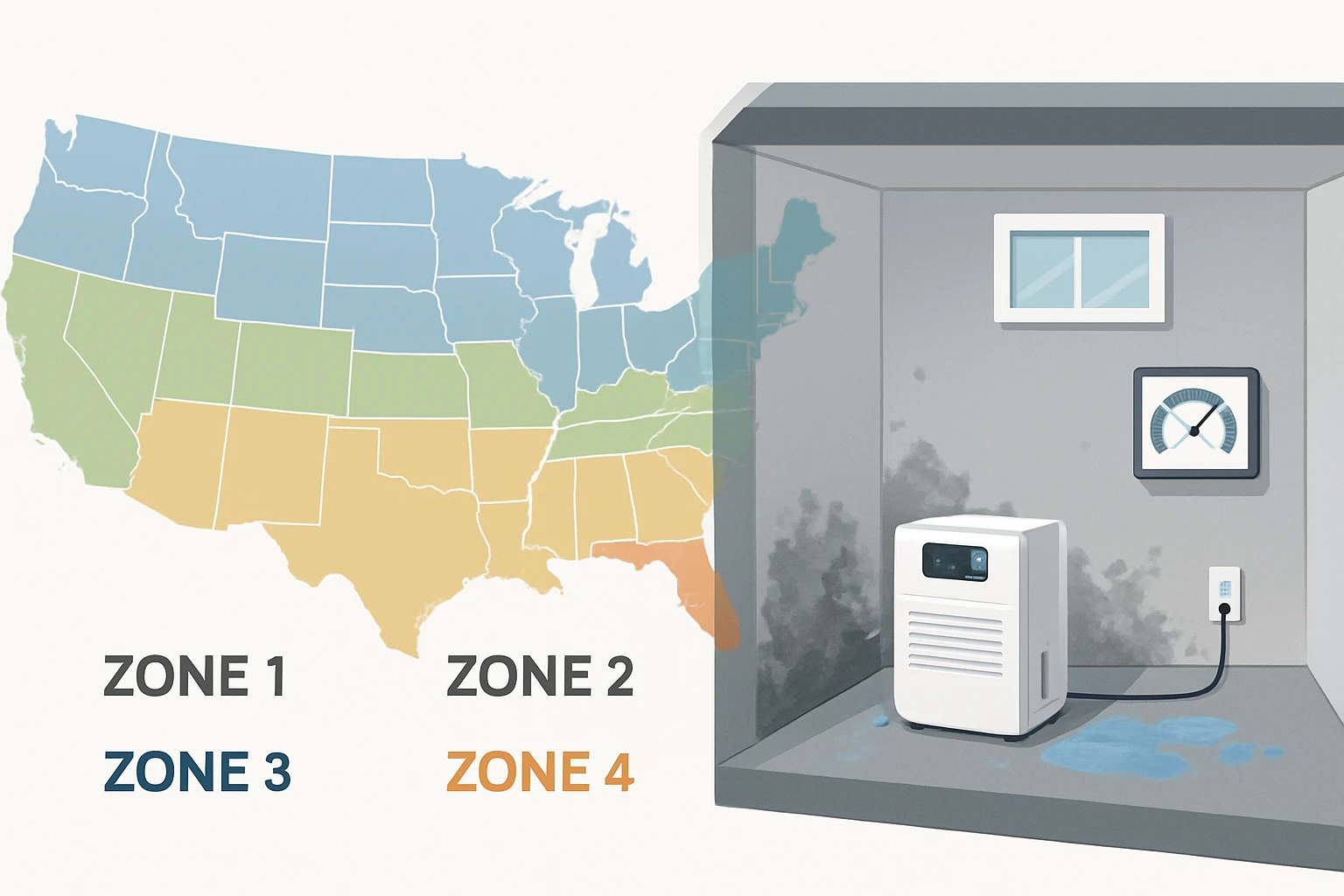
Climate data from the National Oceanic and Atmospheric Administration (NOAA) shows that average indoor humidity in cold‑climate states such as Minnesota often falls below 35 % during winter, while southern states like Florida routinely experience indoor RH above 70 % in summer. These variations dictate the seasonal targets that homeowners should aim for. The table below summarizes recommended baseline setpoints for three primary zones.
| Region | Winter Setpoint (RH) | Summer Setpoint (RH) |
|---|---|---|
| Cold (e.g., Upper Midwest, New England) | 30‑35 % | 45‑55 % |
| Temperate (e.g., Pacific Northwest, Mid‑Atlantic) | 35‑40 % | 50‑60 % |
| Warm (e.g., Southeast, Gulf Coast) | 40‑45 % | 55‑65 % |
Setting Seasonal Setpoints
Homeowners should adjust their humidistats at the start of each season, allowing the controller to maintain the target range automatically. For most basements, a differential of 3‑5 % works well; the controller will activate the humidifier or dehumidifier when the measured RH deviates beyond this band. In addition to the differential, calibrating the sensor annually ensures the displayed values remain accurate within the manufacturer’s ±3 % tolerance.
Cold‑Climate Basements
In regions where outdoor temperatures frequently drop below freezing, basements tend to stay cool and dry. However, heating systems can lower RH to uncomfortable levels, causing wood shrinkage. A modest humidifier set to 32‑35 % RH during winter mitigates this risk without over‑humidifying. For dehumidification in summer, aim for 45‑55 % RH to prevent condensation on cold foundation walls.
For this scenario, the Inkbird Humidity Controller IHC200 offers dual‑stage control, allowing a single unit to manage both a humidifier and a dehumidifier. Its digital display provides precise readings, and the built‑in alarm notifies the homeowner of sensor errors or out‑of‑range conditions.
Temperate‑Climate Basements
Temperate zones experience moderate temperature swings, but humidity can fluctuate dramatically due to seasonal rainfall. Maintaining a winter setpoint of 35‑40 % RH protects against mold while preserving wood integrity. Summer setpoints of 50‑60 % RH balance comfort with energy efficiency, especially when the basement is used as a utility or storage space.
The VIVOSUN Dual-Stage Humidity Controller excels in this environment because of its 1200 W output capacity, which can drive larger commercial‑grade humidifiers or dehumidifiers commonly employed in grow tents and greenhouse projects.
Warm‑Climate Basements
In warm, humid regions, basements are prone to chronic high RH, especially during summer thunderstorms. A target range of 40‑45 % RH in winter and 55‑65 % RH in summer prevents mold while allowing the structure to breathe. Because the ambient temperature remains relatively high, dehumidifiers must run more frequently, making energy‑efficient controllers essential.
Both featured controllers can be employed, but the VIVOSUN model’s higher power rating and built‑in compressor delay protection make it particularly suitable for continuous dehumidification cycles common in the Southeast.
Comparison and Selection Guide
Choosing the right humidity controller depends on load requirements, installation preferences, and user‑interface expectations. The table below contrasts the two products based on key specifications extracted from the manufacturer listings.
| Feature | Inkbird IHC200 | VIVOSUN Dual‑Stage |
|---|---|---|
| Control Range | 5‑99.99 % RH | 5‑99 % RH |
| Accuracy | ±3 % RH | ±3 % RH |
| Relay Capacity | Dual outlet, suitable for standard 120 V appliances | Dual 20 A relay, 1200 W load |
| Display | Single digital LCD | Dual LED screens (measured vs. set) |
| Alarms | High/low humidity, sensor error | Audible/visual high‑low, sensor fault, compressor delay |
| Price (USD) | $41.99 | $31.34 |
| Average Rating | 4.5/5 (4,941 reviews) | 4.4/5 (98 reviews) |
Homeowners with modest power needs and a preference for a compact design may favor the Inkbird IHC200. Those requiring higher load capacity, visual dual‑screen feedback, or additional safety features should consider the VIVOSUN Dual‑Stage model.
Best Practices & Tips
- Install the humidity sensor away from direct airflow of HVAC vents to avoid skewed readings.
- Calibrate the sensor annually using a known‑reference hygrometer; most controllers provide a simple calibration button.
- Set a differential of 3‑5 % RH to reduce frequent cycling of humidifiers or dehumidifiers, which extends equipment lifespan.
- Combine humidity control with proper basement insulation and vapor barriers to minimize external moisture intrusion.
- Schedule routine inspections for water leaks, especially after heavy rain or snow melt, as leaks can overwhelm even the best controllers.
Frequently Asked Questions
- 1. How often should I adjust my basement humidity setpoints?
- Adjust the setpoint at the start of each season—typically in late September for fall, late December for winter, late March for spring, and late June for summer.
- 2. Can I use a single controller for both a humidifier and a dehumidifier?
- Yes. Both the Inkbird IHC200 and VIVOSUN Dual‑Stage controllers feature dual relay outputs that allow simultaneous connection to a humidifier and a dehumidifier.
- 3. What is the ideal differential setting?
- A differential of 3‑5 % RH provides a balance between comfort and equipment wear, preventing rapid on/off cycling.
- 4. Are these controllers compatible with smart home systems?
- While the listed models do not include native Wi‑Fi, they can be integrated with smart plugs or home automation hubs that support outlet control based on temperature or humidity sensors.
- 5. How do I know if my basement is too dry?
- If wood flooring begins to creak, paint peels, or static electricity becomes noticeable, the RH is likely below 30 % and a humidifier should be added.
- 6. What maintenance does the sensor require?
- Keep the sensor clean and free of dust; replace it after three to five years of continuous use to maintain accuracy.
Conclusion
Effective basement humidity management hinges on understanding regional climate patterns, setting appropriate seasonal targets, and selecting a reliable controller. By following the recommended setpoints—30‑35 % RH in cold‑climate winters, 35‑40 % RH in temperate winters, and 40‑45 % RH in warm‑climate winters—homeowners can protect structural components and prevent mold. Pairing these setpoints with a dual‑stage controller such as the Inkbird Humidity Controller IHC200 or the VIVOSUN Dual‑Stage Humidity Controller provides automation, safety, and energy savings.
Products Featured in This Guide
Inkbird Humidity Controller IHC200
Price: $41.99 | Rating: 4.5/5 (4,941 reviews)
Featured because it offers dual‑outlet control, a clear digital display, and reliable alarm functions at an affordable price, making it ideal for both humidification and dehumidification in cold‑ and temperate‑climate basements.
VIVOSUN Dual-Stage Humidity Controller
Price: $31.34 | Rating: 4.4/5 (98 reviews)
Featured because its 1200 W relay capacity, dual LED displays, and comprehensive safety features make it well‑suited for warm‑climate basements and larger ventilation or dehumidification setups.